The Forest River Cherokee problems owners report most are water leaks at roof seams and seals, slide-outs that stick or won’t seal, and power awning or leveling jack failures. Several model years also have hitch coupler, draw bar or entry step recalls. Most of these issues can be caught early with simple checks, and recall repairs are free.
What are the most common Forest River Cherokee problems?
Across the Cherokee line, including Grey Wolf and Wolf Pup models, owner reports fall into a few systems. Leaks come first. Next are slide-outs, then powered parts like awnings and jacks, then hitch and step hardware covered by recalls, then small fit-and-finish defects found at delivery.
| Problem | Likely cause | DIY or dealer | Recall or warranty angle |
|---|---|---|---|
| Roof or wall leaks | Cracked lap sealant at vents, AC and antennas; cap, window or door seals | DIY for resealing; dealer if there’s water damage | Sealant upkeep is the owner’s job |
| Slide-out won’t move or seal | Low battery, blown fuse, debris, motor or controller fault | DIY checks; dealer for binding or broken parts | Warranty in year one |
| Power awning fails | Low 12V supply, fuse, wind sensor or controller fault, torn fabric | DIY checks; dealer for controller or motor | Warranty in year one |
| Leveling jacks fail (if equipped) | Low battery, fluid or motor fault, panel error codes | DIY checks; dealer for hydraulic or motor work | Warranty in year one |
| Coupler or draw bar defect | Under-rated coupler or breaking draw bar | Dealer only | Recalls 19V844, 24V003, 24V531 |
| Entry step detaches | Loose clip-on bracket bolts | Dealer repair; DIY bolt check | Recall 25V245 |
| Delivery-day defects | Loose trim, appliance faults, plumbing leaks | Dealer before you sign | Get fixes promised in writing |
Is the Forest River Cherokee a good travel trailer?
Forum threads can make any trailer look bad. Owners who post are mostly the ones who had problems, so those threads don’t show a real failure rate. Many Cherokee owners report no major issues. A better test is how a specific unit was built and cared for. Check its recall status, its seals and its slides before you judge it.
Which Forest River Cherokee recalls should you check first?
Yes, the Forest River Cherokee has several NHTSA safety recalls. Most involve the hitch coupler, the draw bar or the entry step. These are the ones that can let a trailer detach or a step fall off, so check them first.
| Recall | Model years | Problem | Free fix |
|---|---|---|---|
| 19V844 (Forest River 64-1114) | 2018-2020 Cascade and Cherokee | GVWR is higher than the coupler rating, so the coupler may fail and the trailer may detach. 328 units potentially affected. | Coupler replaced |
| 24V003 (Forest River 95-1705) | 2020 Cherokee | Draw bar locking mechanism may break, which can let the trailer’s front end contact the road. 302 units potentially affected. | Ice Hose swing arm draw bars replaced |
| 24V531 | 2025 Cherokee (plus some 2024 Salem, Puma and Wildwood) | Some Pacific Rim couplers carry an incorrect 14,000-lb load rating and may be overloaded and fail. | Date code checked; coupler replaced as needed |
| 25V245 (Forest River 51-1915) | 2025 Cherokee (among 2024-2025 units) | Bolts on the clip-on bracket may loosen and let the removable step detach. 4,179 units potentially affected. | Step inspected, repaired or replaced |
Forest River also filed recall 26V039 for certain 2026 Cherokee, Campsite Reserve and Cascade Icehouse travel trailers. If you own a 2026 unit, check your VIN to see whether it applies and what the fix is.
How do I check my Forest River Cherokee for open recalls by VIN?
- Find your 17-character VIN. It’s on the federal certification label, usually on the front left side of the trailer, and on your title or registration.
- Go to nhtsa.gov/recalls and enter the VIN.
- Write down any open recall numbers that show up.
- Call a Forest River dealer or Forest River to book the repair. Give them the recall number.
- If you can’t get answers, call the NHTSA Vehicle Safety Hotline at 1-888-327-4236.
Recall repairs are free, even if you bought the trailer used and the warranty has ended.
Why is my Cherokee leaking, and how do I fix it?
Most Cherokee leaks start where something passes through the roof or where two panels meet. Sealant dries, cracks and pulls away over time, and water follows. Check these spots from most to least likely:
- Roof lap sealant around vents, the AC unit, antennas and other roof penetrations
- Front and rear cap seams
- Window and door frames
- Slide-out seals
Roof seams and penetrations
A Forest River service bulletin tells technicians to inspect roof sealant for cracking, pulling or loose seals. You can do the same check yourself.
- Inspect every seam and roof fixture for cracks, gaps or sealant pulling away from the edge.
- Clean the area with a cleaner that is safe for your roof membrane.
- Remove loose or failed sealant with a plastic scraper. Don’t cut the membrane.
- Apply a sealant made for your roof type. Rubber (EPDM or TPO) and fiberglass roofs need different products, so check the label.
- Let it cure for the time on the label.
- Water-test with a gentle hose spray while a helper watches inside.
How often? Camping World says most manufacturers recommend inspecting exterior seams and seals about every 90 days. Confirm the exact schedule in your Cherokee owner’s manual.
Front cap and window seals
The front cap takes rain and road spray head-on while you tow. Look along the cap seam for gaps, and press gently on the cap’s edges. Around windows and doors, check for cracked caulk and gaps at the corners. Reseal using the same clean, remove, apply and test steps above. Use a sealant rated for vertical surfaces on walls.
Signs of hidden water damage
Resealing stops new water. It doesn’t fix damage that’s already there. Watch for these signs:
- Soft spots in the floor, especially near doors, slides and the front
- Walls that feel spongy or bow outward
- Bubbles or waves in the outside wall (delamination)
- Stains on ceilings, a musty smell or swollen wall panels
Warning: If you find any of these, water has already done damage. Stop DIY work and get a dealer or RV technician to inspect it.
Why won’t my Cherokee slide-out move or seal properly?
A slide that won’t retract is usually a power problem, not a broken motor. Check the simple things first, in this order.
Step-by-step slide-out checks
- Battery voltage. Slide motors draw a lot of current. A battery that seems fine at rest can drop too low under load. Plug into shore power or charge the battery, then try again.
- Fuses and breakers. Check the 12V fuse panel and any inline fuse for the slide. Replace a blown fuse with one of the same rating.
- Debris. Look along the slide rails, the floor edge and the seals for leaves, ice, gravel or a folded wiper seal. Clear anything in the path.
- Motor or controller. Listen while pressing the switch. A click with no movement, or no sound at all, often points to the motor or controller. This is usually a dealer repair.
If the slide seals poorly, inspect the rubber wiper and bulb seals for tears, flat spots or sections that have rolled under. Clean them and treat them with a product the seal maker approves.
How do I retract a stuck slide manually?
Many slide systems have a manual override, but the method depends on the brand and type of system in your unit. Find the slide system manual in your owner’s packet, or look up the label on the slide motor. Follow that manual’s steps exactly. Forcing a slide the wrong way can bend parts.
Stop and call a tech if: the slide binds, moves unevenly or at an angle, makes grinding noises, or you see a broken cable or gear.
What causes power awning and leveling jack failures?
Both systems run on 12V power, so low voltage is the first suspect for each. Check power before assuming a part has failed.
Power awning checks
- Confirm the battery is charged or the trailer is on shore power.
- Check the awning fuse and replace it if blown.
- If the awning retracts on its own or won’t extend, check whether a wind sensor is triggering. See the awning manual for how to reset it.
- Inspect the fabric for tears and the arms for bends.
Leveling jack checks (if equipped)
- Charge the battery or connect to shore power.
- Read any error code on the control panel and look it up in the jack system manual.
- On hydraulic systems, check the fluid level as the manual describes.
- Listen for the motor. No sound with good voltage points to a motor or wiring fault.
Once power, fuses and simple resets don’t fix it, the job moves to a dealer. Controller, motor and hydraulic repairs are best handled under warranty if your unit is still covered.
How do you check the hitch, coupler and entry steps for safety?
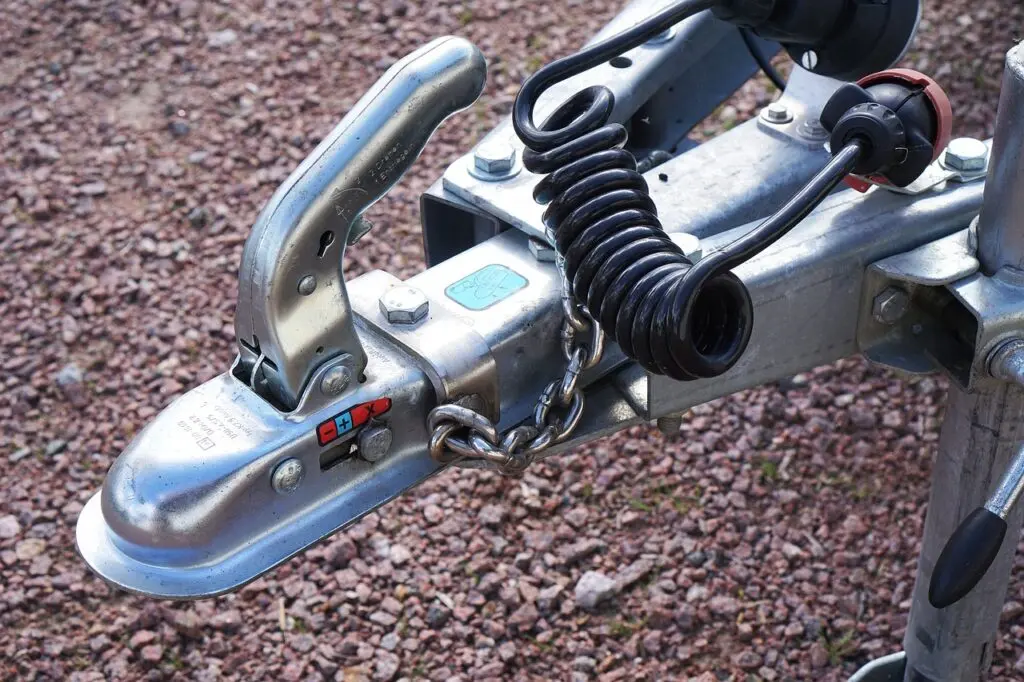
This matters more than any other check. Two Cherokee recalls involved couplers rated below what the trailer can weigh. One involved a draw bar that could break, and one involved step bracket bolts that could loosen.
Pre-trip safety check
- Find the trailer’s GVWR on the certification label.
- Find the load rating stamped on the coupler.
- Compare them. The coupler rating must be equal to or higher than the GVWR.
- If recall 24V531 applies to your 2025 unit, have the dealer check the coupler date code.
- Check that the step bracket bolts are tight and the step doesn’t wobble.
- Inspect the safety chains for wear and cross them under the coupler.
- Check the breakaway cable for fraying and clip it to the tow vehicle, not to the hitch ball or chains.
Rule: If the coupler rating is lower than the GVWR, don’t tow. Contact a dealer.
What delivery-day defects should you check on a new Cherokee?
Your best leverage is before you sign. Do a full pre-delivery inspection (PDI) and test every system yourself.
- Trim and moldings: look for loose, missing or poorly fitted pieces inside and out.
- Appliances: light the stove and test the fridge, water heater, furnace, AC and roof fans.
- Plumbing: run water at every faucet and the shower, then check under sinks and around the toilet for drips.
- Fresh tank: compare how much the tank actually holds with the spec sheet.
- Slides: run every slide in and out fully. Check the seals in both positions.
- Awning and jacks: extend and retract each one.
Write down every defect before you sign. Get the dealer to commit in writing to fixing each one, with a date.
What should I check before buying a used Forest River Cherokee?
- Run the VIN on NHTSA and ask for proof that recall repairs were done.
- Walk the floor and press on walls to find soft spots.
- Look for delamination bubbles on the outside walls.
- Inspect roof sealant and ask when it was last resealed.
- Compare the coupler rating with the GVWR.
- Test every slide, the awning, the jacks and all appliances.
- If you aren’t sure, pay an independent RV inspector before you buy.
What does Forest River’s warranty cover on a Cherokee?
The Forest River Cherokee warranty lasts one year. Forest River says its RV brands offer a one-year limited warranty and no other type of warranty. Its towable warranty document covers the body structure against substantial defects in materials and workmanship for one year from the date of purchase. That document applies to units bought on or before June 30, 2021.
Terms vary by purchase date. Check the Forest River warranty page for the document that matches your product type and purchase date.
Routine maintenance, such as keeping roof and seam sealant in good shape, is the owner’s job. Skipping it can hurt a warranty claim if the damage traces back to neglected seals.
How to file a warranty claim
- Take photos of the problem and note the date you found it.
- Contact a Forest River dealer to start the claim.
- Keep copies of work orders, emails and your maintenance records.
- Report problems before the one-year period ends.
When should you take your Cherokee to a dealer or RV technician?
DIY is fine for sealant touch-ups, fuses and basic checks. Go to a dealer or certified RV technician for any of these:
- Any open recall on your VIN
- Structural or frame damage
- Soft floors, spongy walls or delamination
- Propane leaks or smells, or electrical faults beyond a blown fuse
- Slide mechanism failures such as binding or broken cables or gears
- Anything still under warranty, so you don’t risk voiding coverage
If you own an Alpha Wolf, see our [INTERNAL LINK: Alpha Wolf problems article] for issues specific to that model.
Forest River Cherokee FAQs
Are Forest River Cherokee recall repairs free if I bought the trailer used?
Yes. Recall repairs are free, even if you bought the trailer used and the warranty has ended. Enter your VIN at nhtsa.gov/recalls, write down any open recall numbers, and give them to a Forest River dealer when you book the repair. If you’re buying used, ask the seller for proof that recall work was done.
How often should I inspect the roof seals on a Forest River Cherokee?
Inspect exterior seams and seals about every 90 days. Camping World says most manufacturers recommend that interval. Check lap sealant around vents, the AC unit and antennas, and check cap seams, windows and doors. Confirm the exact schedule in your Cherokee owner’s manual, because keeping sealant in good shape is the owner’s job.
Can neglected sealant hurt a Forest River Cherokee warranty claim?
Yes, it can. Routine maintenance is the owner’s job, and that includes keeping roof and seam sealant in good shape. A claim can be hurt if leak damage traces back to neglected seals. Keep your maintenance records and take dated photos of any problem. Report it to a Forest River dealer before the one-year warranty period ends.
Do Grey Wolf and Wolf Pup trailers have the same problems as the Cherokee?
Largely, yes. Owner reports across the Cherokee line fall into the same systems, and the line includes Grey Wolf and Wolf Pup models. The main problem areas are leaks, slide-outs, awnings and jacks, hitch and step hardware, and delivery-day defects. Recalls apply only to certain model years, so check your own VIN at nhtsa.gov/recalls.
Is it safe to tow a Cherokee if the coupler rating is lower than the GVWR?
No. The load rating stamped on the coupler must be equal to or higher than the trailer’s GVWR. You’ll find the GVWR on the certification label. If the coupler rating is lower, don’t tow, and contact a dealer. Two Cherokee recalls involved couplers rated below what the trailer can weigh, and that can let the trailer detach.