If your RV fridge is not cooling on electric but still works on propane, the cooling unit is almost always fine. The problem is in the 120V side. Either power isn’t reaching the fridge, a fuse has blown, the heating element has failed, or the control board isn’t sending power to it. Work through the checks below in order, from the easiest to the most involved.
Why is my RV fridge not cooling on electric when it works on propane?
When propane mode works, you know the cooling unit can still do its job. That points the fault at the parts only electric mode uses: incoming power, the breaker or GFCI, the fuse on the control board, the board itself, and the 120V heating element.
An absorption fridge cools by heating. In propane mode, a flame heats the cooling unit. In electric mode, a 120VAC heater does the same job. Some 3-way units also have a 12VDC heater. If that heater gets no power or has burned out, the fridge can’t cool on electric.
If your fridge won’t cool on propane or electric, this guide isn’t the right fit. That usually means a cooling unit or ventilation problem. See our guides on propane-mode problems and hot-weather cooling instead.
What should I check first?
Start with the simple causes. They take a few minutes and solve a lot of “dead on electric” calls.
Is the fridge set to the right mode?
Set the mode selector to AC or ELEC, or to AUTO with shore power connected. Turn the thermostat to its coldest setting while you test. A Norcold troubleshooting guide lists the mode selector as the first thing to confirm.
Is shore power actually reaching the RV?
- Confirm you’re plugged into shore power or a running generator.
- If you rely on an inverter, check whether it feeds the fridge outlet. Many inverter setups power only some outlets.
- Check the RV’s breaker panel for a tripped fridge breaker. Reset it once.
- Look for a tripped GFCI outlet. The fridge circuit may run through a GFCI in the kitchen, bathroom or an outside outlet. Press reset on each one.
Has it had enough time to cool?
An absorption fridge cools slowly. A Dometic manual says the first cooling cycle can need up to four hours before the cooling unit is fully working. If you just turned it on, give it that time before you start testing parts.
Is the fridge getting the right voltage?
Yes, low campground voltage can stop your RV fridge from cooling well on electric. Shore power below about 110VAC may signal a supply problem. One manufacturer specifies ±10%, or 108 to 132VAC.
Low voltage matters more than you might think. A heater’s output drops with the square of the voltage. A heater that makes about 300 watts at 120V makes only about 243 watts at 108V. That’s roughly 20% less heat, so the fridge cools more slowly or not at all.
How to check:
- Open the fridge’s outside access door.
- Find the 120V receptacle the fridge plugs into.
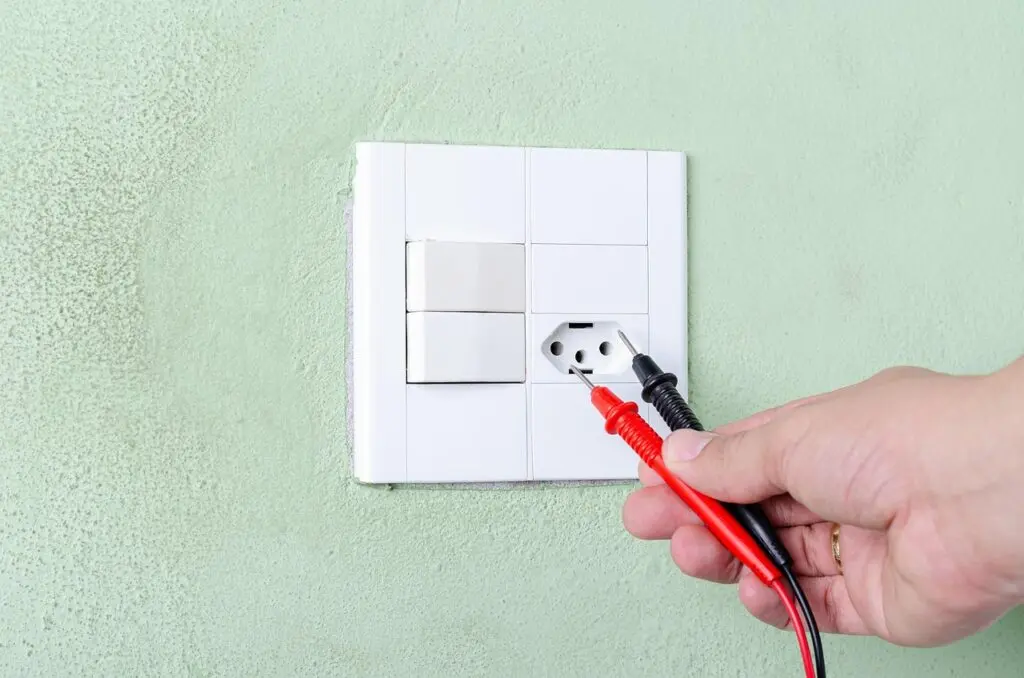
- Set your meter to AC volts.
- Measure the receptacle voltage.
- Measure at the campground pedestal too, and compare the two readings.
Low at the pedestal means a weak campground supply. Good at the pedestal but low at the fridge points to a long or undersized extension cord, or a wiring problem inside the RV. No voltage at all sends you back to the breakers and GFCIs.
Warning: 120V can kill. Use a meter rated for AC voltage, hold the probes by their insulated grips, and keep your fingers off the terminals.
How do I check the fridge’s AC fuse and control board output?
The fuse for the electric side of an RV fridge sits on the control board, also called the power board. You’ll find it behind the controller cover at the outside access panel.
- Turn off the fridge breaker and unplug the fridge.
- Remove the control board cover.
- Pull the heater fuse.
- Test it for continuity with your meter.
- If it’s blown, replace it only with the exact rating the manufacturer lists.
Fuse ratings vary by model. For example, Norcold NX-series boards protect the heater with an 8A fast-acting fuse labeled F2. Check your own manual or the label on the board.
What does a blown fuse tell me?
A fuse that blew once may have been a one-time surge. A new fuse that blows right away is a warning. The most likely cause is a shorted heating element. Stop replacing fuses and test the element.
The same goes for a fridge that keeps tripping a breaker or GFCI on electric. If breakers, GFIs or fuses keep tripping, unplug the fridge and measure the heater’s resistance with its wires disconnected from the controller. A heater shorted to the metal frame is a common reason a GFCI trips.
How do I test the board’s heater output?
This test is done with power on, so take extra care.
- With a good fuse installed, restore power.
- Set the fridge to AC mode and the coldest setting.
- Measure AC voltage at the board’s 120V input.
- Measure AC voltage across the board’s heater output terminals.
You should see about 120V at both points. Good input with no output points to the control board or its relay. Good output means the board is doing its job, so test the element next.
How do I test the RV fridge heating element?
The heating element sits behind the exterior access door. Two wires run from the control board to the element at the flue stack. You’ll test it at the board end.
- Turn off the fridge breaker.
- Disconnect shore power.
- Disconnect the house batteries.
- Remove the outside access door and the control board cover.
- Unplug the element’s two leads from the board.
- Set your meter to continuity and check across the two leads.
- Set your meter to ohms and measure resistance across the two leads.
- Measure from each lead to the metal frame or a ground point.
Here’s how to know if your RV fridge heating element is bad:
- Open circuit (OL) between the leads: the element or its wire is broken. Replace the element.
- Resistance outside the manual’s range: replace the element.
- Any reading from a lead to ground other than open (OL) or megohms: the element is shorted. A shorted element can blow fuses and trip a GFCI.
What resistance should an RV fridge heating element read?
It depends on the model. Most 120V elements read in the 40 to 70 ohm range, but you need your model’s exact spec. Thetford notes that values differ by element and model.
| Model | Heater rating | Resistance between leads | Each lead to ground |
|---|---|---|---|
| Norcold NX series | 300W (2.5A at 120VAC) | 46 to 51 ohms | Open (OL) or megohms |
| Norcold 1200 series | See manual | 57.6 to 70.4 ohms | Open (OL) or megohms |
If you don’t have the manual, use a quick math check. Watts equal volts squared divided by ohms. At 120V, a 48-ohm element works out to 14,400 ÷ 48 = 300 watts. If your element’s wattage is printed on it or on the fridge’s data label, you can estimate the expected resistance the same way.
Bad heating element or bad control board: how do I tell?
Use your fuse, board and element results together. This table gives you the answer.
| What you found | Likely problem |
|---|---|
| Fuse blown, and element is shorted or open | Heating element |
| Fuse good, 120V at board output, element out of spec | Heating element |
| Fuse good, 120V at board input, no 120V at output | Control board or its relay |
| Element in spec, board outputs 120V, still no cooling | Cooling unit or ventilation |
If the element tests good but the fridge still won’t cool on electric, check the control board and the RV’s power center for tripped breakers or blown fuses. If everything electrical checks out, see our guides on cooling unit and ventilation problems.
Don’t wire the element straight to 120V to “test” it. That bypasses the thermostat and safety controls. The element can overheat the cooling unit and create a fire risk.
How do I replace an RV fridge heating element?
Before you buy a part, match the part number, voltage and wattage to your manual or the fridge’s data label. Camping World advises checking the manual for the correct wattage before installing a new element.
- Turn off the fridge breaker, disconnect shore power and disconnect the batteries.
- Unplug the element’s leads from the control board.
- Find the element housing on the flue stack.
- Open the tabs or clamp on the element cover.
- Spray a non-flammable penetrating oil around the element if it’s stuck.
- Wiggle the old element up and out of its sleeve.
- Slide the new element in until it’s fully seated.
- Close the cover tabs.
- Route the leads away from hot surfaces and reconnect them to the board.
- Restore power, set the fridge to AC and confirm 120V reaches the element.
Polarity doesn’t matter for most heating elements, so either lead can go on either terminal. Give the fridge several hours to cool before you judge the repair.
When should I call an RV technician?
Some problems aren’t worth a DIY fix. Call a pro if any of these apply:
- Ammonia smell, yellow residue or gurgling sounds. Shut the fridge off and call a technician. That’s a cooling unit leak, not an electric-mode problem.
- You aren’t comfortable testing live 120V circuits. The board output test requires it.
- The control board tests bad, or fuses keep blowing after you replace the element.
- The fridge is under warranty or has an open recall. DIY repairs can void coverage, so check with the manufacturer or dealer first.
Whether you have a Dometic not cooling on electric or a Norcold not cooling on AC, the order stays the same: mode, power, breaker and GFCI, fuse, board output, then element. Following that order means you replace only the part that actually failed.
RV Fridge Not Cooling on Electric: FAQ
Why does my RV fridge keep tripping the GFCI on electric?
A heating element shorted to the metal frame is a common reason an RV fridge trips a GFCI on electric. Unplug the fridge, disconnect the heater wires from the control board, and measure from each lead to ground. Any reading other than open (OL) or megohms means the element is shorted.
How long does an RV fridge take to get cold on electric?
An absorption RV fridge cools slowly on electric. A Dometic manual says the first cooling cycle can need up to four hours before the cooling unit is fully working. Give the fridge that time on its coldest setting before you start testing fuses, the control board or the heating element.
Can low campground voltage stop my RV fridge from cooling?
Yes. Shore power below about 110VAC can keep an RV fridge from cooling well on electric. Heater output drops with the square of the voltage, so a 300-watt element makes only about 243 watts at 108V. That is roughly 20% less heat, which slows cooling or stops it.
Where is the fuse for the electric side of an RV fridge?
The fuse for the electric side sits on the fridge’s control board, also called the power board. You reach it through the outside access door by removing the controller cover. Ratings vary by model. Norcold NX boards, for example, use an 8A fast-acting fuse labeled F2.
Can I test an RV fridge heating element by wiring it straight to 120V?
No. Wiring the element directly to 120V bypasses the thermostat and the safety controls. The element can overheat the cooling unit and create a fire risk. Test it safely instead. Unplug its leads from the control board, then check continuity and resistance with a multimeter.