An RV fridge that stops cooling in hot weather usually can’t get rid of heat fast enough. The most common causes are a blocked or poorly vented exterior vent, a fridge that isn’t level, worn door seals, or a weak power source. Start with those checks before you suspect the cooling unit.
Most fixes are simple: clear the vent, level the RV, add vent fans, and check the seals and power mode.
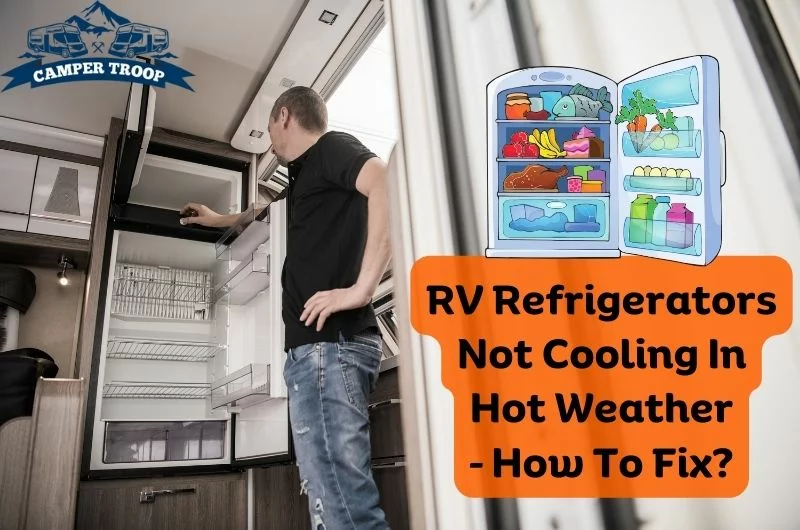
Why is the RV refrigerator not cooling in hot weather?
Many RV fridges are absorption units that run on propane or electricity. They cool by moving heat out through coils behind the fridge. When it’s hot outside, that heat has nowhere to go if airflow is poor. On the sun-facing side of the RV, the vent area gets even hotter, which makes the problem worse.
Here are the common causes, roughly in order of how often they happen:
- Ventilation issue (blocked or hot exterior vent)
- Unleveled position of the refrigerator
- Insulation or door seal issue
- Malfunction of the cooling fan
- Faulty thermistor or thermostat
- Bad cooling unit
Not every RV fridge is an absorption unit. Many current RVs come with residential or 12V compressor fridges. Those work like a home fridge, so in hot weather, focus on airflow around the fridge, door seals, and steady power from your batteries, inverter, or shore power. The leveling and burner checks below don’t apply to them.
Read Also: Dometic RV Fridge Not Working On Electric? Causes & Fixes
How do you fix an RV refrigerator not cooling in hot weather?
Work through these checks in order. Each one rules out a common cause before you move on to costly repairs.
Check ventilation
An absorption fridge needs a steady flow of air across the coils at the back. If that airflow is weak, heat builds up and cooling drops.
- Turn off the fridge and the LP gas supply.
- Remove the exterior fridge vent cover on the side of the RV.
- Look for leaves, dirt, spider webs, or bird and wasp nests.
- Clear the debris gently so you don’t bend coils, fins, or wires.
- Check that the roof vent is open and clear, too.
- Put the cover back on and restart the fridge.
Inside the fridge, don’t overload the shelves. Packed food blocks cold air from moving. When you can, park so the fridge side of the RV faces away from the afternoon sun, or park in the shade.
Level the refrigerator
Since you might need to park your RV in several different spots, it might not always be level with the ground.
Leveling matters most when the RV is parked for several hours with the fridge running. A fridge that is badly out of level can cool poorly and can even damage the cooling unit. It isn’t critical while you’re driving, because the motion keeps the fluid moving.
Manufacturers give specific guidance. One Dometic manual says to park so there is no noticeable slope in the floor or walls. Norcold manuals reportedly allow up to 3° off level side to side and 6° front to back, measured from the fridge’s point of view. Check your model’s manual, and use a bubble level on the freezer floor if you’re unsure.
Fix insulation issue
RV refrigerators are smaller and less powerful than most home fridges. So any heat leak hits them harder in hot weather.
Over the years, the foam insulation can get damaged, and the magnetic door seal can wear out or lose its shape.
You can check the seal by closing the door on a piece of paper. If it’s hard to pull the paper out, the seal is okay. If it slides out easily, the seal is leaking at that spot. Test several spots around the door.
Clean or replace a worn seal to keep cold air in on summer days.
Add vent fans and an inside fridge fan
Yes, fans usually help in hot weather. There are two kinds, and they do different jobs.
- Vent fans: Small 12V fans, like 3-inch computer case fans, mounted in the exterior vent area. They push hot air off the coils and out the roof vent. Some fridges already have one. If yours does, make sure it spins.
- Inside fridge fan: A small battery-operated fan placed on a shelf. It moves cold air from the fins through the whole compartment.
Check the thermistor
Many absorption fridges use a thermistor to sense the temperature and control cooling. It is often clipped to the cooling fins inside the fresh food compartment.
If the thermistor slips off or moves along the fins, it can send wrong readings. The fridge may then shut off cooling too early. Make sure it is firmly clipped in place. Your fridge’s manual shows the correct position.
If the thermistor itself has failed, replace it with the part listed for your model. Follow the manual for testing, or have a technician check it.
Check gas and electric modes
An absorption fridge runs on LP gas (propane) or electricity. That means 120V AC shore power, or 12V DC on some models. On models like the Dometic NDR1292, an automatic energy selector switches between 120V AC and LP gas. The controls still need 12V DC and work down to 9.6V, so a weak battery can stop the fridge in either mode.
Test each mode for several hours. If the fridge cools on one mode but not the other, the problem is in that mode’s parts:
- Gas mode: A dirty burner, flue, or orifice can weaken the flame. A technician should clean these.
- Electric mode: Check the fuse and the heating element. Low campground voltage can also weaken cooling.
Safety note: Dometic says to shut off LP gas appliances vented to the outside while refueling, because the burner flame can ignite gasoline fumes.
Replace cooling unit
If none of the steps above fix the problem, the cooling unit itself may be failing.
A yellow powder near the coils or an ammonia smell are signs that the sealed cooling unit is leaking. Turn off the fridge, stop using it, and call a professional.
The cooling unit is a sealed system. It contains ammonia (the refrigerant), water, hydrogen gas, and a small amount of corrosion inhibitor. You can’t recharge or top it off like a car AC. A technician will usually replace the whole cooling unit or recommend a new fridge.
The cost depends on your model and the damage. Get a quote for both a new cooling unit and a new fridge before work starts.
Read Also: Why Is Norcold RV Refrigerator Not Cooling? (Causes & Fixes)
When should you call an RV technician?
Call a technician if any of these apply:
- You see yellow residue or smell ammonia.
- The fridge won’t cool on gas or electric after you’ve cleared the vent and leveled the RV.
- The burner, flue, or gas orifice needs cleaning.
- You suspect a bad heating element, control board, or thermistor and aren’t comfortable testing it.
Also check for recalls. Absorption cooling units have been recalled for fire risk. In 2001, CPSC and Norcold recalled about 360 gas/electric fridges because cooling-unit tubing could crack and leak flammable gas. Enter your fridge’s model and serial number in the NHTSA and CPSC recall databases.
Tips to Help Your RV Refrigerator Work Better in Hot Weather
An RV fridge that works fine in mild weather can struggle in extreme heat. These habits help it keep up.
- Turn the fridge on about 24 hours before you load stuff in it, so it starts cold.
- Avoid putting hot foods or pots inside the fridge.
- Don’t overload your fridge; otherwise, it’ll affect the inner air circulation.
- Park as level as you can whenever the fridge runs for hours.
- Keep a small battery-operated fan inside the fridge to move cold air around.
- Keep a thermometer in the fridge and the freezer, so you notice early when cooling drops.
Read Also: 7 Common Residential RV Refrigerator Problems [Solved]
FAQs
Here are quick answers to common RV fridge questions.
How can I cool my RV refrigerator faster?
Use a small battery-operated fan inside to move the cold air evenly. Load food that is already cold, and don’t pack the shelves tight. Clearing the exterior vent and adding a vent fan also helps the fridge shed heat faster.
How long does an RV fridge take to get cool?
An absorption fridge cools slowly. It often takes several hours, and longer in hot weather. That’s why it’s best to start the fridge the day before your trip and load it once it’s cold.
What type of refrigeration is used in RV fridges?
Many RV fridges use absorption refrigeration. Ammonia is the refrigerant, water absorbs the ammonia, and hydrogen gas helps the ammonia evaporate. This design lets the fridge run on either propane or electricity, which makes it flexible. Other RVs use residential or 12V compressor fridges instead.
Final words
Most hot-weather cooling problems come down to heat that can’t escape. Start with the vent, leveling, and door seals, then check each power mode. If you see a leak or nothing helps, call a technician.
Read Also: Dometic RV Refrigerator Reset: 4 Steps to Get It Done!