

To test an RV water heater element, turn off 120V power, take one wire off the element, and measure across its two terminals with a multimeter set to ohms. A good 1400-1440W RV element reads about 10 ohms. Here is how to run the test, read the result, and tell whether the element or the thermostat is the real problem.
How do you test an RV water heater element?
Shut off 120V power to the water heater. Disconnect one wire from the element. Set your multimeter to ohms and put one probe on each element terminal.
A good 120V element rated at 1400-1440 watts reads about 10 ohms. An open reading (OL or infinite) means the element is burned out. Any continuity from a terminal to the metal flange or tank means the element is shorted to ground. Both results come from RV Water Heater Parts’ Atwood/Dometic testing guide.
Can you test an RV water heater element without removing it?
Yes. You can test the element in place. You only need to reach the terminals and take one wire off. You don’t have to drain the tank or pull the element just to test it. Draining is only needed if the test shows the element is bad and you replace it.
What tools and safety steps do you need first?
This is a simple test with basic tools. The safety steps matter more than the tools.
Tools
- A digital multimeter that reads ohms (resistance) and AC volts
- A screwdriver to remove the element terminal cover
- Optional: a non-contact voltage tester for a quick power check
Safety steps
- Unplug shore power or switch off the water heater breaker. If you run a generator, shut it off too.
- Turn off the electric switch on the water heater.
- Check for zero volts at the terminals before you touch them.
Warning: Never measure resistance on a live circuit. Always disconnect power to a component before checking its resistance. A live circuit can damage your meter, give a false reading, or shock you.
What happens if you turn on an RV water heater element with no water in the tank?
An element needs water around it to carry the heat away. If you switch on the electric side with an empty tank, the element can overheat and burn out quickly. Always make sure the tank is full before you turn on electric heat, especially after winterizing or draining.
Step-by-step: testing the element for resistance (ohms)
- Turn off shore power or the water heater breaker.
- Turn off the water heater’s electric switch.
- Open the outside water heater access door. Some models put the electrical parts behind an inside panel instead.
- Remove the element terminal cover.
- Confirm zero volts at the terminals.
- Disconnect one wire from the element. Note where it goes.
- Set the meter to ohms. On a manual-range meter, pick the 200-ohm range.
- Touch the probes together. The meter should read near zero.
- Put one probe on each element terminal.
- Read the number and write it down.
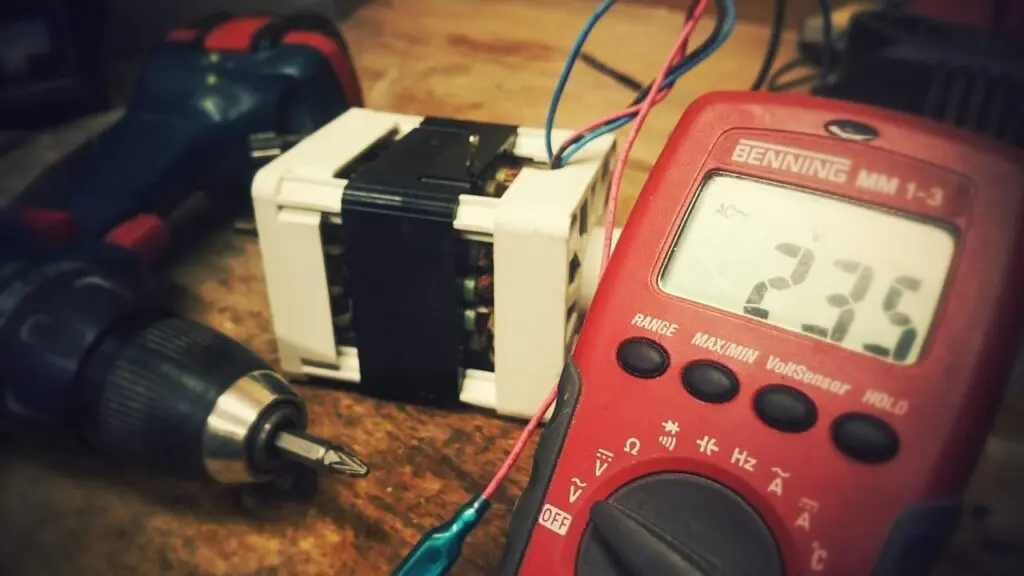
Why take one wire off? With both wires connected, the meter can read through the thermostat and wiring behind the element. That can hide a bad element. Removing one wire makes the meter read the element alone.
What should an RV water heater element read in ohms?
Most current RV elements should read about 10 ohms. Suburban’s service material rates its 120V elements at 1440 watts and says they should measure about 10 ohms. Atwood/Dometic elements are rated at 1400 watts at 110-120V, down from 1500 watts before 1996. Atwood doesn’t publish an ohm value, but the math puts it near 10 ohms.
| Element wattage | Common brand | Expected ohms at 120V |
|---|---|---|
| 1000W | Lower-wattage elements | About 14.4 ohms |
| 1400W | Atwood/Dometic (1996 and later) | About 10.3 ohms |
| 1440W | Suburban | About 10 ohms |
| 1500W | Atwood (before 1996) | About 9.6 ohms |
How to figure the right reading for any element
Use the formula R = V² ÷ W. Square the voltage, then divide by the wattage on the element’s label. For a 1440W element at 120V: 120 × 120 = 14,400, and 14,400 ÷ 1440 = 10 ohms. Small differences of an ohm or so are normal.
Why does my Suburban manual say 14.5-17 ohms when my element reads 10 ohms?
An older Suburban troubleshooting guide lists 14.5-17 ohms as normal. That range lines up with older, lower-wattage elements, not the current 1440W element. If your element is labeled 1440W, about 10 ohms is correct. The label on your element decides which number applies.
What your reading means
| Reading | What it means | Action |
|---|---|---|
| About 10-14 ohms (matches the wattage math) | Element is good | Run the short-to-ground check next |
| OL, 1, or infinite | Open circuit: element is burned out | Replace the element |
| Near 0 ohms | Element is shorted | Replace the element |
What does OL or infinite resistance mean on a water heater element?
OL (over limit) or infinite resistance means no current can flow through the element. The heating wire inside has broken. The element can’t make heat and needs to be replaced.
How do you check the element for a short to ground?
An element can read a normal 10 ohms and still be bad. If the heating wire touches the outer sheath, current leaks to the tank. This check finds it.
- Keep power off and one wire disconnected.
- Leave the meter on ohms or continuity.
- Put one probe on an element terminal.
- Put the other probe on the element flange or bare tank metal.
- Repeat with the other terminal.
A good element shows OL (no continuity) on both tests. Any continuity means the element is shorted to ground and must be replaced. A grounded element can trip the breaker or GFCI even when its ohm reading looks normal.
How do I know if my RV water heater element is bad?
Common signs include no hot water on electric while propane still works, a breaker or GFCI that trips when the electric side turns on, and water that heats much more slowly than it used to. Only the meter confirms it: an open reading, a near-zero reading, or any continuity to ground means the element is bad.
How do you check for voltage at the element?
Run this check when the element tests good but the water stays cold. It tells you whether power is reaching the element.
Warning: This test is done on a live 120V circuit. Keep your hands off bare metal and hold the probes only by their insulated grips. If you aren’t comfortable working near live 120V, skip this step and call a technician.
- Reconnect the element wire you removed.
- Make sure the tank is full and the water is below the thermostat setpoint.
- Set the meter to AC volts.
- Restore shore power and turn on the breaker.
- Turn on the water heater’s electric switch.
- Carefully place one probe on each element terminal.
- Read the voltage, then shut power off again.
About 120V AC, similar to what an RV outlet reads, means power is reaching the element. If the element also passed the ohm and ground checks, the problem is probably not the element. No voltage points upstream to the thermostat/ECO, the electric switch, the breaker or the wiring.
Element good but still no hot water? Check the thermostat and ECO
The electric thermostat turns the element on and off. The ECO (energy cut-off) is a high-limit safety switch. If either one stays open, the element gets no power. For full model-specific steps, see our [LINK: Atwood water heater troubleshooting guide], [LINK: Dometic water heater troubleshooting guide] and [LINK: RV water heater works on propane but not electric].
Atwood/Dometic thermostat and ECO quick test
On the Atwood/Dometic electric thermostat/ECO (part 91873), the thermostat opens at 140°F and the ECO opens above 170°F. With power off:
- Press the ECO’s manual reset button.
- Check continuity across the ECO terminals.
- If it still reads open after a reset, replace the thermostat/ECO.
- With cool water in the tank, check the electric thermostat. It should test closed.
- If the thermostat reads open, replace it and make sure it sits flat against the tank.
What do your results mean? A quick decision guide
Is it the element or the thermostat when an RV water heater won’t heat on electric?
Use your test results together. The element tests tell you if it can heat. The voltage test tells you if it is getting power.
| Test results | Likely problem | Next step |
|---|---|---|
| Open reading (OL) | Burned-out element | Replace the element |
| Near 0 ohms or continuity to ground | Shorted or grounded element | Replace the element, then reset the breaker or GFCI |
| Good ohms, no ground fault, no voltage | Thermostat/ECO, switch, breaker or wiring | Test the thermostat/ECO first, then the switch and wiring |
| Good ohms, about 120V, still cold | Element may fail under load, or another fault | Re-check the element or call a technician |
If you need to replace the element, drain the water heater tank first. Removing an element from a full tank will dump water through the opening. See our [LINK: RV water heater element replacement guide] for the full steps.
When should you call an RV technician?
Stop and get professional help if you see any of these:
- Burnt, melted or discolored wiring at the element terminals
- A breaker or GFCI that trips again after you replace the element
- Aluminum wiring or a damaged junction box
- Water leaking from around the element or tank
- You aren’t comfortable taking voltage readings on a live 120V circuit
Heat damage at the terminals often means a loose connection or a deeper wiring fault. A new element won’t fix that, and the wiring should be checked before you turn the electric side back on.
Frequently Asked Questions
Why do you disconnect one wire before testing an RV water heater element?
Disconnecting one wire makes the meter read the element alone. With both wires connected, the meter can read through the thermostat and wiring behind the element, and that can hide a bad element. Note where the wire goes so you can reconnect it correctly after the test.
What multimeter setting do you use to test a water heater element?
Set the multimeter to ohms (resistance). On a manual-range meter, pick the 200-ohm range. Touch the probes together first. The meter should read near zero. Then place one probe on each element terminal, with power off and one wire disconnected.
Can an RV water heater element read 10 ohms and still be bad?
Yes. An element can show a normal 10-ohm reading and still be shorted to ground if the heating wire touches the outer sheath. Check from each terminal to the flange or bare tank metal. Any continuity means the element is bad, and it can trip the breaker or GFCI.
Do you need to drain the tank to replace an RV water heater element?
Yes. Drain the tank before you remove the element, or water will dump out through the opening. You don’t need to drain it just to test the element. The test is done in place, at the terminals, with one wire disconnected.
At what temperature does the Atwood/Dometic electric thermostat shut off?
On the Atwood/Dometic electric thermostat/ECO (part 91873), the thermostat opens at 140°F to stop heating. The ECO is a high-limit safety switch that opens above 170°F. If the ECO still reads open after you press its manual reset button, replace the thermostat/ECO.
