If your Dometic RV water heater works on gas but not on electric, the 120V side has lost power or has a failed part. Check in this order: the electric switch, the breaker or GFCI, and shore power. Next, check for a tripped ECO high-limit switch or a bad thermostat. Last, check for a burned-out heating element.
Dometic RV water heaters, including former Atwood models, can heat water with propane, 120V electric, or both. When only the electric side fails, the gas side tells you the tank and burner are fine. That narrows the problem down to a short list of electrical parts.
Why Does a Dometic RV Water Heater Work on Gas but Not Electric?
The usual causes are listed below, from most to least likely:
- No 120V power. The electric switch is off, a breaker or fuse has tripped, a GFCI outlet has tripped, or the RV isn’t on shore power or a generator.
- Tripped or failed ECO or thermostat. The ECO (energy cut-off) is the high-limit safety switch, also called the thermal cutoff. If it trips or fails, power never reaches the element.
- Burned-out heating element. This often happens when the element was turned on with an empty tank.
- Loose or burned wiring at the switch, ECO, thermostat, or element terminals.
- Failed relay or control board. On some newer Dometic models, these parts control the electric mode.
Electronic (DSI) ignition problems only affect gas mode. They show up as a DSI-FLT code or a lockout when the burner fails to light. They do not stop the electric element from working.
Can an RV Water Heater Run on Electric Without Shore Power?
Not on battery power alone. The heating element runs on 120V AC, so it needs shore power, a generator, or an inverter big enough to carry the load. Your 12V battery only powers the controls and the gas igniter. If you’re dry camping, use gas mode.
How Do You Fix a Dometic Water Heater That Won’t Heat on Electric?
Work through these steps in order. Most fixes happen in the first three.
Safety first: Never turn on the electric element when the tank is empty. Dry firing burns out a standard element within moments. Before you touch any wiring, turn off 120V power at the switch and the breaker.
Step 1: Check the power supply
The most common reason for a faulty electrical Dometic water heater is a power problem.
- Make sure the electric switch is ON. This is usually on the monitor panel inside the RV. Some models also have a switch at the heater itself.
- Confirm the RV is plugged into shore power or the generator is running.
- Check the water heater breaker in the power center and reset it if it’s tripped.
- Press the reset button on any GFCI outlets in the RV. Some RVs put the water heater on a GFCI-protected circuit.
A tripped breaker usually just needs a reset. If it trips again right away, there is a short somewhere. Stop and find it before you go further.
Read Also: Dometic RV Fridge Not Working On Electric? Causes & Fixes
Step 2: Make sure the tank is full and not bypassed
If you recently de-winterized, check that the water heater bypass valves are back in their normal (not bypassed) position. Then open a hot faucet until water flows steadily with no sputtering. That confirms the tank is full. If the heater was switched on while bypassed or empty, the element may already be burned out.
Step 3: Reset the water heater
If the power supply is fine, the ECO high-limit switch may have tripped. How you reset it depends on your model:
- Models with a reset button: Turn off the power. Remove the outside access panel and find the manual reset button on the ECO switch, near the thermostat. Press it firmly.
- Models without a button: Follow Atwood’s manual. Let the water cool, turn the switch OFF for at least 30 seconds, then turn it back ON.
If the heater keeps locking out, don’t keep resetting it. Contact a service center.
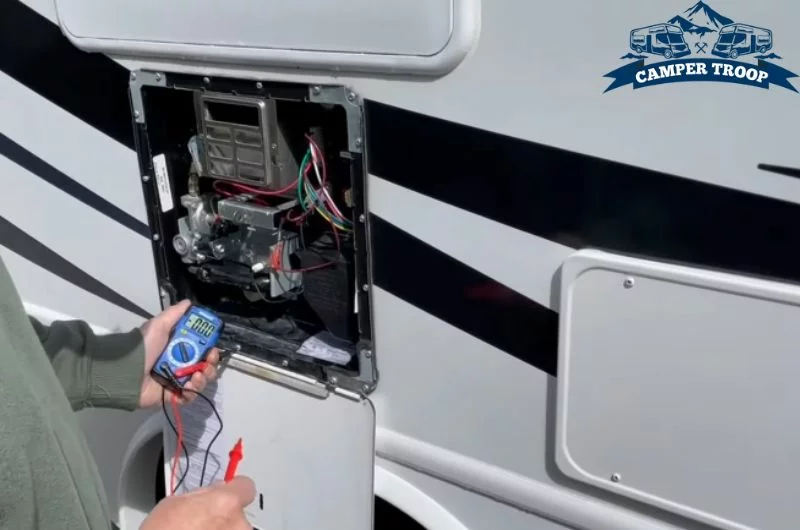
Step 4: Test the voltage
On Atwood/Dometic heaters, 120V power travels from the switch, through the ECO high-limit switch, then through the thermostat, and finally to the element. Use a multimeter to test for 120V at each point in that order. The first point with no voltage shows you where the break is.
If there’s no voltage reaching the heater at all, the problem is in the RV’s wiring, the switch, or the relay or control board. This is a good point to call a qualified RV technician or electrician.
Step 5: Test the thermostat and ECO switch
The thermostat turns the element on and off to hold the water temperature. The ECO is a safety device. It cuts power to the element if the water gets too hot. If either part fails open, the element never gets power.
Turn off the power. Then check each part for continuity with a multimeter while the water is cool. If there’s no continuity across the thermostat or ECO, replace that part. Power coming into a part but not going out tells you the same thing.
Read Also: What Does E1 Code On Dometic Thermostat Mean: How to Fix It?
Step 6: Inspect the heating element
If 120V reaches the element but the water stays cold, the element has likely burned out. Test it only with the power off and the tank full.
To test it, disconnect the element wires. Set your multimeter to ohms and touch the probes to the two terminals. A reading of open or infinite resistance means the element is bad. Your model’s manual lists the correct resistance range.
To replace the element:
- Turn off 120V power at the switch and the breaker.
- Turn off the water pump or city water.
- Let the water cool, then open a hot faucet or the pressure-relief valve to release pressure.
- Drain the tank.
- Remove the old element with the correct socket and install the replacement listed for your model.
- Refill the tank until a hot faucet runs steadily with no air.
- Only then turn the electric switch back on.
Step 7: Examine the wiring
Inspect the wiring to see if it is secure. Loose, melted, or corroded connections will stop your Dometic water heater from heating water. Look closely at the element and ECO terminals. If you find damage, repair or replace the wires and terminals as needed.
Read Also: RV Water Heater Drain Plug Size: Everything you need to know
When Should You Call an RV Technician?
Call a pro in any of these cases:
- The heater keeps locking out after a reset.
- No 120V reaches the heater, even though the breaker and switch are fine.
- Your model has a control board or relay you can’t test.
- You aren’t comfortable working on 120V circuits.
Tips to Help Your RV Water Heater Work Better On Electricity
- Never switch on the electric element until the tank is full. Make this part of your de-winterizing routine.
- Don’t expect to set a temperature. Many Dometic/Atwood heaters have a factory-set thermostat that owners can’t adjust. If yours is adjustable, the CPSC recommends 120°F to prevent scalds.
- Use a water heater tank insulator to reduce heat loss.
- Flush the tank regularly to clear sediment that can coat the element.
- Check the heater regularly for damage, leaks, drips, or loose wiring.
- Don’t add an aftermarket anode rod. Dometic warns that this can damage its aluminum tanks.
Read Also: 7 Easy Solutions For RV Water Heater Igniter Not Clicking
FAQs
How do you reset an Dometic RV water heater?
It depends on the model. Some Atwood/Dometic heaters have a manual reset button on the ECO high-limit switch behind the outside access panel. Others have no button. On those, let the water cool, turn the switch OFF for at least 30 seconds, then turn it back ON. If the lockout continues, contact a service center.
What causes a Dometic RV water heater not to heat?
On electric, the usual causes are no 120V power (switch off, tripped breaker or GFCI, no shore power), a tripped or failed ECO or thermostat, or a burned-out element. On gas, check the propane supply and the ignition.
Why did hot water stop coming in my Dometic RV water heater?
If you heat with propane, check your propane level first. The heater can’t heat water on gas if the tank is empty or very low. Also check that the bypass valves aren’t set to bypass the heater.
Why won’t the Dometic heater turn on in my RV?
The central heating on a Dometic RV heater may not operate due to a power drop, blown fuse, defective thermostat, or damaged or dirty control board. The sail switch is the most frequent cause of furnace ignition failure.
What are the signs that the Dometic RV water heater is going bad?
The main sign that the Dometic RV water heater is going bad is murky or rusty water. A coating on water heater tanks prevents corrosion, although it wears off over time. Rust occurs quickly as the coating starts to deteriorate. One indicator that the hot water tank is failing is rusty water.
At what temperature should my Dometic water heater be set?
Many Dometic and Atwood RV water heaters have a factory-set thermostat that you can’t adjust. If yours is adjustable, the CPSC recommends 120°F to prevent scalds. Water at 130°F can cause a serious burn in about 30 seconds, and 140°F water can do it in about 5 seconds.
Does my Dometic water heater have an Anode rod?
No. Dometic and Atwood water heaters have aluminum tanks, so they don’t use an anode rod. Dometic warns not to install an aftermarket anode rod because it can damage the tank. Glass- or porcelain-lined steel heaters, such as Suburban models, are different. They do need an anode rod.
How to flush a Dometic water heater?
Turn off the water heater switch and its breaker, and shut off the gas. Let the water cool. Turn off the water pump or city water, then open a hot faucet or the pressure-relief valve to release pressure. Remove the drain plug and let the tank drain. Refill the tank completely before you turn the electric element back on.
Read Also: What Size Socket Is The Best For Water Heater Element
Final Words
When a Dometic water heater works on gas but not electric, start with the simple checks: the switch, the breaker, the GFCI, and shore power. Then test along the power path (switch, ECO, thermostat, element) until you find where power stops. Always keep the tank full before you turn on the element.
If these steps don’t solve the problem, check your model’s manual or contact a professional RV technician.
Read Also: How to Know Your RV Water Heater Switch On or Off?