
Quick answer: If your RV converter is not charging the battery, test in this order: battery resting voltage, AC supply, then converter DC output. A healthy output generally reads 13.6 to 14.4 V, though 13.2 V can be normal float. A reading near 0 V points first to a fuse, open wire or loose ground.
Why Is My RV Converter Not Charging the Battery?
When an RV battery won’t charge on shore power, the cause is usually one of six things: no AC reaching the converter, a battery disconnect switched off, a blown reverse-polarity or inline fuse, a bad wire or ground, a worn-out battery, or a failed converter.
Use this rule: test the battery first, then the AC input, then the converter’s DC output. Replace the converter only after the other checks pass.
The order matters because a failing battery and a failing converter can both leave you with a battery that won’t hold a charge. The symptom alone can’t tell you which part is bad, but a meter can.
| Cause | Common symptom | Fix |
|---|---|---|
| No AC at the converter | Battery runs down while plugged in | Check the power source, shore cord and converter breaker |
| Battery disconnect off | Little or no 12 V power from the battery | Turn the switch on and retest |
| Blown reverse-polarity fuse | Battery isn’t charging, often after battery work | Correct any reversed cables, then replace the fuse with an exact match |
| Open inline fuse or wire | Output near 0 V at the battery wires | Find and repair the break in the circuit |
| Loose ground or connection | Low, zero or inconsistent reading | Clean and tighten the connection |
| Worn-out battery | Voltage drops again after recharging | Replace the battery |
| Failed converter | Zero output with good AC and good fuses | Call tech support or replace the converter |
What Should You Check Before Using a Multimeter?
Start with the simple faults. A camper battery not charging when plugged in sometimes has nothing wrong with its charging parts.
- Power source: Confirm the pedestal or generator is live and the shore cord is fully seated.
- Battery disconnect: Make sure the switch is on.
- Breaker and fuses: Check the converter’s AC breaker and the DC fuses at the distribution panel.
- Battery terminals: Look for loose, corroded or overheated connections. With power off, clean and tighten them. Have melted or heat-damaged cables replaced.
Can’t find the converter? See our [INTERNAL LINK: Forest River converter location article].
Safety warning: 120 V AC can cause serious injury. If you are unsure about testing live AC, stop and use a qualified RV technician.
How Do You Test an RV Converter With a Multimeter?
Measure the battery at rest, confirm AC is reaching the converter, then measure the converter’s DC output. The steps below follow common guidance and the WFCO WF-9800 manual. Test steps differ by converter, so follow the manual for your exact model.
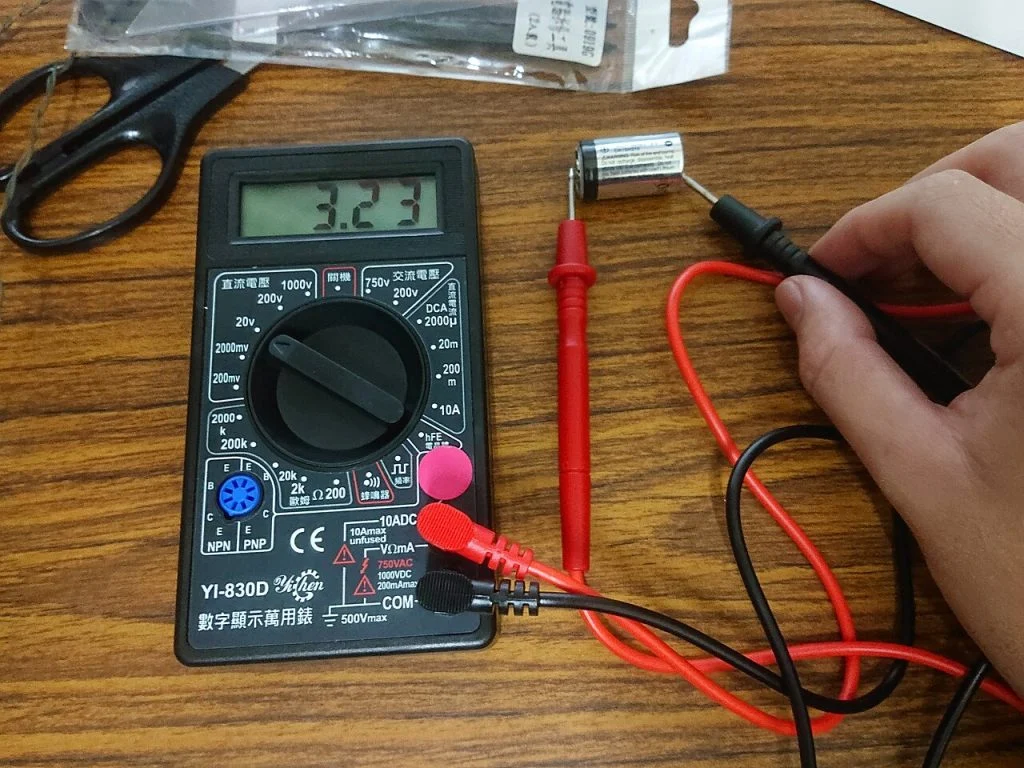
Tools you need
- Digital multimeter with AC volts, DC volts and continuity settings
- Your converter’s manual and model number
- Wrench or socket that fits the battery terminals
- Eye protection and electrical tape
Step 1: Test the battery
- Isolate the battery from every charging source. Cruise America says to turn off the inverter, engine and generator and disconnect all power sources before measuring each battery.
- Set the meter to DC volts.
- Touch the red probe to the positive post and the black probe to the negative post.
- Write down the reading. If you have more than one battery, test each one.
Step 2: Test AC input
- Restore shore or generator power and make sure the converter’s breaker is on.
- Set the meter to AC volts.
- If the converter plugs into a receptacle, measure at that receptacle. If it is hardwired, have a technician test it unless you are trained to work near live AC terminals.
- Compare the reading with your manual. WFCO’s WF-9800 output test calls for a 105-132 V AC source.
Step 3: Test converter DC output
- Turn off AC power and 12 V loads such as lights and fans.
- Disconnect the battery cables at the battery. Tape the ends so they cannot touch each other or the frame.
- Restore AC power to the converter.
- Set the meter to DC volts.
- Touch the red probe to the positive wire and the black probe to the negative wire.
- Record the reading and compare it with the table below.
This test includes the wiring between the converter and the battery. A near-zero reading at the battery wires does not prove the converter failed.
Progressive Dynamics PD9100 and PD9200 owners: Your isolation step is different. The Progressive Dynamics troubleshooting guide starts by using a 5/32 Allen wrench to loosen the screw and disconnect the negative battery wire from the converter’s negative output terminal.
[EDITOR: Confirm the Progressive Dynamics step against the full official page before publishing. Only the search excerpt was available.]
What Do Your Voltage Readings Mean?
Camping World says a correctly working RV converter should read 13.6 to 14.4 V DC at its output. Some models can also read lower during a normal float stage, so compare your result with your model’s specs.
| Reading | Likely meaning | Next step |
|---|---|---|
| Battery at rest: 12.3-12.9 V | Within the expected range | Test AC input and converter output |
| Battery at rest: below 12.3 V | Low or worn battery | Recharge, wait 2-3 hours and retest |
| Output: 13.6-14.4 V | General healthy converter range | Look at the battery and its connections |
| WF-9800 output: 14.4 V | Bulk stage, which can last up to four hours | Normal during bulk |
| WF-9800 output: about 13.6 V | Absorption stage; 13.6 V (+/-0.2) with no load passes WFCO’s test | Converter is working; check the battery and wiring |
| WF-9800 output: 13.2 V | Float stage for trickle charging | Often normal; confirm against the manual |
| Output: below 12.3 V | Problem in the charging path or converter | Check the disconnect, inline fuses and wiring connections |
| Output: 0.0 V or close to it | Open fuse, open wire or loose ground, or a failed converter | Check fuses and wiring before blaming the converter |
| Any other output reading | Not enough information to judge | Compare with your manual or call tech support |
Don’t replace a converter just because it reads 13.2 V. The WF-9800 has three charging stages: bulk at 14.4 V, absorption around 13.6 V and float at 13.2 V. On a converter with a float stage, 13.2 V may simply mean it has dropped to trickle charging.
Don’t assume 0 V means a dead converter, either. For a WF-9800 reading near 0 V, the manual lists an open inline fuse, an open wire between the converter and battery, a loose ground, or improper connection torque. Check those first.
How Do You Fix Blown Fuses and Bad Wiring?
Yes, a blown fuse can stop an RV converter from charging the battery, because it breaks the path between them. Find out why it blew before you replace it. Turn off AC power and disconnect the battery before handling fuses or wiring.
Reverse-polarity fuses
Location varies by model. On the WF-9800, the reverse-polarity fuses are on the front plate. For other converters, check the manual.
- Inspect each fuse for a broken or burned element.
- Remove the fuse and set the meter to continuity.
- Touch one probe to each blade. No continuity means the fuse is blown.
- If a fuse is blown, check cable polarity at both the battery and the converter.
- Correct any reversed connection, then install the new fuse.
WFCO says a reverse battery connection, even for a second, is the only reason these fuses will blow. Replace them only with the same type and amp rating. On the WF-9800, that means a Littelfuse Type 257 automotive-style (ATC) fuse.
Warning: A new fuse will not solve the cause if polarity is still reversed. Confirm the cables are correct first.
Inline fuses, wires and grounds
- Inline fuses: Trace the battery wire and look for a fuse holder. Not every manufacturer installs one. Test any fuse you find for continuity.
- Open wires: With the wire disconnected at both ends, test it for continuity. Look for cuts, crushed sections and burned insulation.
- Loose grounds: Follow the negative cable to its frame connection. It should be clean, tight and free of corrosion.
- Connection tightness: Check the converter terminals and tighten them to the torque listed in your manual.
How Can You Tell if the Battery Is the Real Problem?
A battery is the likely problem if it won’t hold its voltage after a full recharge. Camping World says a battery should hold a steady 12.3 to 12.9 V DC, which is a useful benchmark for a 12 V lead-acid battery.
If yours reads lower, recharge it, wait 2-3 hours and test it again. If it still won’t hold a charge, replace the battery rather than the converter.
Watch how the converter behaves, too. The WF-9800 manual warns that cycling between absorption and bulk could indicate a shorted battery cell or other issues.
Dim interior lights and slow vent fans can be signs of low 12 V supply. They are also listed among common signs of converter failure, but they don’t identify the bad part. Use the meter results to decide.
Why Won’t a Converter Charge a Lithium RV Battery?
A converter may not charge a lithium battery correctly if it isn’t set up for that chemistry. Battle Born says LiFePO4 batteries require different charging voltages and profiles than lead-acid batteries.
The converter must be lithium-compatible or adjustable to the correct settings. Improperly configured charging may cause the battery to disconnect under certain conditions.
The lead-acid benchmarks in this guide do not apply to judging a lithium battery. Use your battery maker’s voltage chart and cold-weather charging limits, then confirm that your converter can meet them.
When Should You Replace the RV Converter?
Replace the converter or seek service when the fuses and AC supply are good but DC output still reads zero. The WF-9800 manual says that result means the converter is not functioning properly.
Before you buy a new unit, confirm each of these:
- The battery was tested and can hold a charge.
- AC supply at the converter is within the range in the manual.
- Reverse-polarity and inline fuses passed a continuity test.
- Wiring, ground and connection tightness were checked.
- The output reading was compared with your model’s manual, including any float stage.
Next, contact the converter manufacturer’s tech support with your model number and meter readings. WFCO’s WF-9800 manual lists tech support at 1 (877) 294-8997.
If you do need a replacement, match it to the battery chemistry you use. If you plan to switch to lithium, choose a unit that is lithium-compatible or adjustable to your battery maker’s settings.
RV Converter Charging FAQ
What voltage should an RV converter put out?
A correctly working RV converter generally reads 13.6 to 14.4 V DC at its output. Some models read lower during a normal float stage. The WFCO WF-9800, for example, uses 14.4 V for bulk, about 13.6 V for absorption and 13.2 V for float. Compare your reading with your model’s manual.
How do I know if my RV converter or battery is bad?
Use a multimeter, because symptoms alone can’t separate the two. A lead-acid battery is the likely problem if it won’t hold 12.3 to 12.9 V after a recharge and a 2-3 hour wait. The converter is the likely problem if AC supply and fuses are good but DC output reads zero.
Can a blown fuse stop an RV converter from charging the battery?
Yes, a blown fuse can stop an RV converter from charging the battery because it breaks the path between them. Check reverse-polarity and inline fuses with a continuity test. Find out why the fuse blew, correct any reversed cables, and replace it only with the same type and amp rating.
Where are the reverse-polarity fuses on an RV converter?
The location of reverse-polarity fuses varies by converter model. On the WFCO WF-9800, they are on the front plate. For other converters, check the manual for your exact model. Before replacing a blown fuse, turn off AC power, disconnect the battery and confirm that the battery cables are connected with the correct polarity.
Does a 13.2 V reading mean my RV converter is bad?
No, 13.2 V does not automatically mean your RV converter is bad. On a converter with a float stage, it may simply mean the unit has dropped to trickle charging. The WFCO WF-9800 floats at 13.2 V. Confirm the expected float voltage in your model’s manual before replacing anything.
Does a 0 V reading mean the RV converter is dead?
No, a reading near 0 V at the battery wires does not prove the converter failed. The test includes the wiring between the converter and battery. For a WF-9800, the manual lists an open inline fuse, an open wire, a loose ground or improper connection torque as causes to check first.