If your RV’s 12-volt system has no power while plugged in, the usual causes are a battery disconnect switch left off, no shore power reaching the converter, a tripped converter breaker, a blown 12V or main battery fuse, or a dead battery. Check them in that order with a multimeter. Most fixes take minutes.
The 12-volt system powers lights, the water pump, vent and furnace fans, the stereo, 12V TVs and the refrigerator controls. An RV refrigerator running on LP gas still needs 12 volts for its controls, so a 12V failure can shut it down too.
Why Does My RV Have No 12-Volt Power When Plugged In?
Here are the common causes, from most to least likely.
1. The Battery Disconnect Switch Is Off
Many RVs have a battery disconnect switch that cuts the battery off from the 12V system. If it was turned off for storage or bumped by accident, the 12V system may have little or no power, even on shore power. Look for it near the entry door, in the battery compartment or on the control panel. Location varies by model, so check your owner’s manual.
2. Shore Power Is Not Reaching the Converter
The converter needs 120V AC to work. If power never reaches it, the 12V system runs only on the battery until the battery dies. Check these points:
- The campground pedestal breaker is on.
- The power cord is fully seated at both ends and not damaged.
- Your surge protector or EMS is not showing a fault or holding power off.
- The breaker that feeds the converter on the RV’s 120V panel has not tripped.
If the converter breaker keeps tripping, do not keep resetting it. Find out why, or have a technician check it.
3. A Blown 12V Fuse or Main Battery Fuse
RV 12V DC circuits are mainly protected by fuses. Breakers protect the 120V AC side, though some 12V circuits use resettable breakers. A blown 12V DC fuse can stop the converter from powering the 12V system and charging the battery.
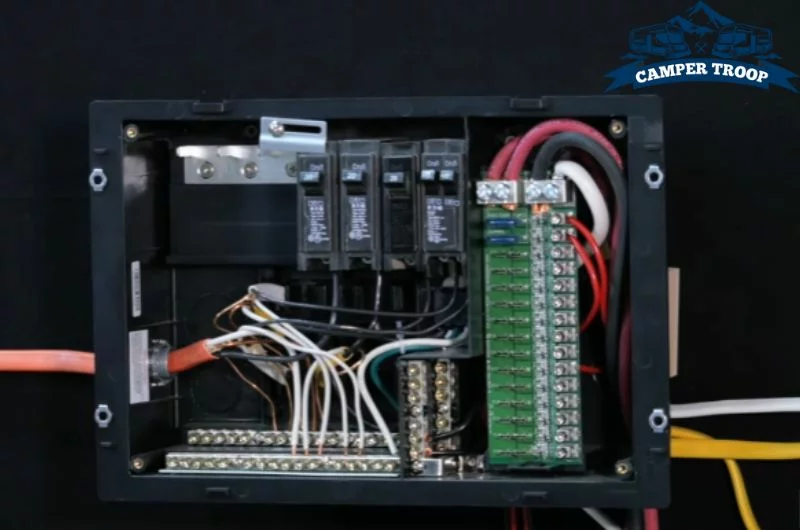
- 12V fuse panel: In many RVs, the blade fuses sit in the same distribution panel as the 120V breakers. A blown blade fuse has a broken or melted metal strip inside.
- Reverse-polarity fuses: Many converters have these on the converter itself. They blow if the battery is connected backward.
- Main battery fuse or auto-reset breaker: Often found in the positive battery cable near the battery. If it opens, the battery is cut off from the whole coach.
Always replace a fuse with one of the same amp rating. If it blows again right away, there is a short to find.
4. The Battery Is Discharged or Dead

A weak or dead battery can drag the system down, even on shore power. For flooded lead-acid batteries, recharge after each use and avoid going below 50% charge when possible. A full discharge can damage or kill the battery. Lithium batteries have different limits.
To check the charge, measure resting voltage at the battery terminals with a multimeter. For an accurate reading, let the battery rest at least 6 hours (ideally 24) with no charging and all loads disconnected. Trojan’s chart for a 12V flooded battery:
| State of charge | Resting voltage |
|---|---|
| 100% | 12.73V |
| 70% | 12.37V |
| 50% | 12.10V |
| 20% | 11.66V |
If you’ve charged the battery for a long time and it still won’t reach full charge, check the connections and, for flooded batteries, the fluid level. Low electrolyte usually stops a battery from holding a full charge. If those are fine, test with a known-good battery. If the good battery charges correctly, your old one needs replacement.
5. Loose, Corroded or Damaged Connections

Loose or corroded battery terminals can cut power even when the battery is fully charged. This is common with several batteries wired in parallel. Also check the ground wire from the battery to the frame and the converter’s ground. A corroded or broken ground can stop the whole 12V system.
You can clean battery terminals and tighten connections yourself. Use the manufacturer’s torque spec and do not overtighten.
Read Also: How to Get 12V Power From a Trailer Plug? (Multiple Methods)
6. The Converter Is Not Charging
A converter and an inverter are two different devices. A converter changes 120V AC shore power into 12V DC and charges the house battery. An inverter changes 12V DC battery power into 120V AC. Some RVs have a combined inverter/charger, but a standard converter does not make AC power.
To test the converter, plug in and measure voltage at the battery terminals. With the converter working, it should read about 13.6 to 14.4V DC. If it reads below 12.3V or 0.0V, check the battery disconnect switch, the inline fuse in the battery wire and loose connections. If all of those are good and 120V reaches the converter, the converter likely needs service.
Read Also: How to Reset Power Outlet Without Reset Button?
Will the 12V System Work Without a Battery When Plugged In?
Sometimes, but only partly. It depends on the converter. Camping World advises against running an RV without a battery, because 12V loads can draw more current than the converter alone can supply. With the battery removed, only small loads such as lights may work.
How Do I Fix an RV 12-Volt System That Won’t Work When Plugged In?
Work through these steps in order. Stop when power comes back.
- Confirm the pedestal breaker is on and the power cord is fully plugged in.
- Check your surge protector or EMS for a fault code.
- Reset the converter breaker on the RV’s 120V panel if it has tripped.
- Turn the battery disconnect switch on.
- Measure voltage at the battery terminals with a multimeter while plugged in.
- If it reads below 12.3V, check the main battery fuse or auto-reset breaker near the battery.
- Inspect the 12V fuse panel and replace any blown fuse with the same amp rating.
- Check the reverse-polarity fuses on the converter.
- Disconnect the battery, then clean and tighten the terminals and ground connections.
- Let the battery charge fully, then retest. Badly drained batteries can take several hours.
- Replace the battery if it still won’t hold a charge.
Read Also: Why Does My RV Have No Power From Battery? (Explained)
Stay Safe Around the Battery
Lead-acid batteries give off hydrogen gas while charging, so keep sparks and flames away. Wear eye and hand protection. Disconnect the battery before you work on cables or terminals.
Top Off Flooded Batteries With Distilled Water
Flooded batteries lose some water as they gas during charging. That is normal. Overcharging is the main cause of excess water loss, because it causes heavy gassing and heat and ages the battery faster.
Add distilled water after charging, unless the plates are exposed. In that case, add just enough to cover them before charging. Avoid regular tap water, which can damage the cells and shorten their lifespan.
AGM and lithium batteries are sealed and need no water. They also need a converter or charger with a compatible charging profile. A charger set up for flooded batteries may not charge them correctly.
Replace Dead Batteries
If the battery won’t hold a charge after you’ve checked the fuses and connections, replace it. Batteries are a significant investment, so match the type and size to your RV and your converter’s charging profile before you buy.
Read Also: RV Compartment Door Won’t Open | What to Do?
When Should I Call an RV Technician?
Call a qualified RV technician if you notice any of these:
- A burning smell, or melted or burned wiring
- A fuse or breaker that trips again right after you replace or reset it
- 120V reaches the converter, but it still puts out no 12V
- Any problem that needs work inside the converter or the distribution panel
Read Also: Why Bottom of Slide Bowing Out in My RV & How to Fix it?
FAQs.
Why is my RV not getting power?
Your RV may not get power because of dead or undercharged batteries, a battery disconnect switch left off, tripped breakers, a disconnected power source, blown fuses or a converter problem. Check these in order to find and fix the issue.
What runs off 12 volts in an RV?
In an RV, various devices and systems run off 12 volts, including overhead lights, water pumps, vent fans, furnace fans, range hood fans, LP gas leak detectors, stereos, 12-volt TVs, and refrigerators when operating in LP gas mode. These components rely on the RV’s 12-volt system for power.
How do I get my 12-volt battery to work again?
To get your 12-volt battery working again, check its voltage level and recharge it if it’s low. Ensure the battery connections are tight and free from corrosion. If the battery is still not functioning, it may be damaged and require replacement.
Final Words
Most 12-volt failures on shore power come down to a switch, a breaker, a fuse, a connection or a worn-out battery. If these checks don’t restore power, have an RV technician inspect the converter and wiring.
Safe travels!
Read Also: Hot and Neutral Reversed But Wired Correctly: How to Fix It?