Quick answer: Forest River converter location varies by model. Start behind or inside the breaker/fuse panel, since the converter may be built into that panel or sit close by. Then check near the shore power connection, around the dinette, and near small cooling vents. Your owner’s manual or the converter’s own documents can narrow it down.
Are you having a hard time locating the power converter on your Forest River RV? It can be frustrating to search everywhere without knowing the likely spots. This guide covers where to look, how to stay safe around the panel, and what to check before you replace the unit.

Where Is My Forest River RV Power Converter Located?
The location of the converter varies from one Forest River RV to another, so no single spot applies to every model. Work through these seven places in order. Looking is safe, but do not open the panel or touch any wiring until you have read the safety steps further down.
1. Behind The Breaker/Fuse Panel
Start at the breaker or fuse panel. The converter can be built into the panel or sit very close to that compartment, so this is a good first place to check.
But be careful. The panel has AC breakers and DC fuses with mounted wires, and WFCO warns that the components in its WF-8900 series can produce arcs or sparks. Careful wire removal alone is not enough. Follow the converter’s own manual or use a qualified technician.
2. Search For Fan/Vent
Different Forest River models put the converter in different places, so cooling hardware can be a useful clue.
Power converters generate heat and use fans or vents to cool down. Search for a small fan or vent in your Forest River RV. It can be a clue that the power converter is nearby.
In this way, you may find the converter as a part of the fuse panel or very near to the compartment.
3. Somewhere Near Your Shore Power And Batteries
Check the area between the shore power connection and the batteries. WFCO’s installation guidance says to mount its WF-8900 unit near both, so that area is worth a look if your RV has a similar unit.
Near does not mean inside the battery box. The same guidance says not to install the unit in compartments containing batteries or flammable materials. It also says the unit is not ignition protected and should not go in an LP compartment.
The converter may also be away from the panel. Some WFCO distribution centers use an external converter located elsewhere in the RV.
Read Also: Forest River 5th Wheels Best to Worst: What is the Quality Ranking?
4. Around The Dinette Or Kitchen Counter
Check around the dinette. Forest River’s tent camper manual places the converter at the back of the dinette, next to the pump switch.
That location is documented for tent campers, not for every model. On other floorplans, the dinette base and the cabinets beneath the kitchen counter are still reasonable places to look.
5. Find In Odd Places
If the usual spots come up empty, try other enclosed spaces. These are only places to check. They are not documented Forest River locations:
- Under the bathroom sink
- Under the 12V fridge
- Beneath the bed or couch
- Near a vent or fan
- In the pantry cupboard
- Behind or under removable drawers
Focus on spaces with vents or open airspace. A converter needs room to shed heat, as the clearance section below explains.
6. Listen For Sounds
Sound can help, but it is not a reliable way to find the converter on its own.
Do not turn off everything in your RV first. The WFCO WF-8900 series has a variable-speed cooling fan controlled by current, so turning off every load can make the fan quieter.
Listen while the unit is under load or when the converter charges the battery. If you hear a fan, follow the sound. If you hear nothing, that does not prove the converter is not nearby.
7. Still Missing? Search For Manuals
When the physical search fails, go to the paperwork. Some Forest River manuals give a general location, though they may not show the exact spot in your floorplan.
Look for the owner’s manual for your brand and model year. Then look for the component manual for your converter or distribution center. Forest River hosts some of these documents on its website, including WFCO operator manuals.
You can also ask Forest River. It directs owners to a brand-specific Contact Us link for customer service, and one brand’s contact form asks for the last 8 digits of the VIN. Have your VIN, brand, model, floorplan, and model year ready for Forest River or your dealer.
Read Also: 6 Common Problems with Forest River RV Roof [Get To Know All]
Does The Converter Location Depend On The RV Type?
Only partly, and you should not rely on a rule by RV type. The one specific location in the sources for this guide is the tent camper spot at the back of the dinette, next to the pump switch.
For travel trailers, fifth wheels, toy haulers, and motorhomes, use the same search order. Start at the panel, then check near the shore power connection and batteries. After that, use the manual for your exact brand and year.
How Do You Safely Access An RV Converter?
Remove every power source before you open the panel or touch the converter. The panel carries both AC and 12V DC circuits, so turning off one source does not make it safe.
- Unplug the RV from shore power.
- Shut off the generator.
- Turn off the inverter, if your RV has one.
- Isolate the batteries as your RV or converter manual directs. A battery disconnect switch may not cut every circuit.
- Read the converter’s manual before removing any cover or wire.
If the wiring is unclear or you do not have the manual, stop and call a qualified RV technician.
How do I know what power converter my Forest River RV has?
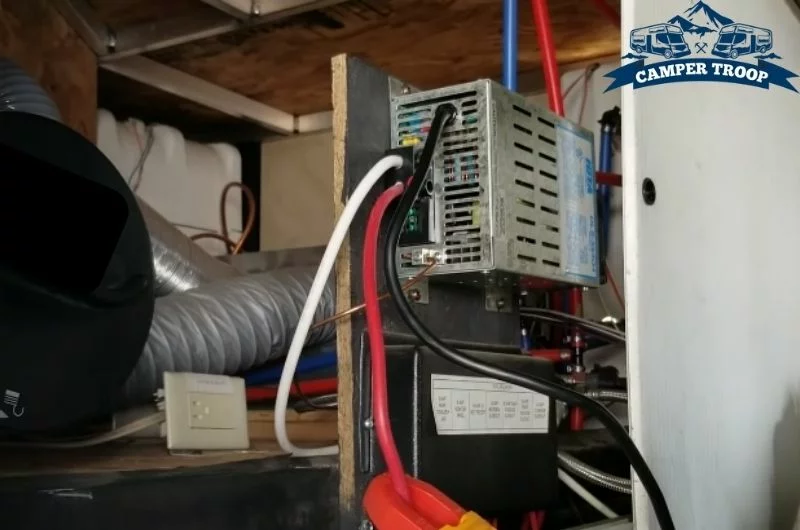
Look for the model number on the converter itself. Different Forest River models use different types of power converters, and you will need the exact model when upgrading or replacing an old or broken unit.
Your owner’s manual or component documents may help, but do not count on them to list the unit installed in your RV. If you cannot read a label, contact Forest River or your dealer with your VIN and model details.
What Is The Difference Between A Standalone Converter And A Power Center?
A standalone converter is a separate unit. A combined power center, or distribution center, groups the converter with the AC breakers and DC fuses. Not every distribution center has the converter inside, because some WFCO models use an external converter located elsewhere.
Two brands you may come across are WFCO and Progressive Dynamics. Forest River’s site hosts manuals for WFCO products such as the WF-9800 series power converter.
Read Also: 9 Common Forest River XLR Nitro Problems & How to Fix Them?
Do You Need A Converter If Your RV Is On Shore Power?
Yes. Shore power supplies AC, but your RV’s 12V components still need DC power. The converter changes AC power to DC power and charges the RV battery.
What Is The Difference Between An RV Converter And An Inverter?
A converter turns AC power into DC power. An inverter does the opposite and turns battery DC power into AC power. An inverter/charger combines inverter and battery-charging functions in one unit.
| Device | Power direction | Typical use |
|---|---|---|
| Converter | AC to DC | Runs 12V components and charges the battery from shore power or a generator |
| Inverter | DC to AC | Runs AC devices from the batteries |
| Inverter/charger | Both directions | Supplies AC from the batteries and charges them when AC power is available |
Can You Use A Battery Charger Instead Of An RV Converter?
Do not assume you can. The two are not automatically interchangeable. An RV converter also supports the 12V components while the RV is on shore power, so a charger may not do the same job. Ask a qualified RV technician before making that swap.
Does An RV Converter Work While Driving?
A converter needs an AC source to recharge the batteries, so driving alone does not power it. Forest River’s trailer manual says the converter recharges the batteries when the RV is on outside 110-volt power or running the generator.
Any battery charging from the engine while driving is a separate path that depends on how the vehicle and RV are wired. Check your manual or ask your dealer how your setup works.
How Do You Know If Your RV Converter Is Bad?
The main warning sign is that the batteries do not recharge while the RV has good AC power. These signs can also point to a converter problem:
- 12V lights or fans work poorly or stop working on shore power.
- The batteries keep running down even when the RV stays plugged in.
- The cooling fan does not run when the unit is under a heavy load.
- The converter shows signs of overheating, such as a burnt smell. Disconnect power and have it checked.
Worn batteries, blown fuses, and loose connections can cause similar symptoms, so test before you buy a new unit.
How Do You Test An RV Converter With A Multimeter?
Compare the DC voltage at the battery with AC power off and on. Use the output range listed for your exact converter, because models and charging modes differ.
- Find the output specification on the converter label or in its manual.
- Set the multimeter to DC volts.
- With shore power and the generator off, measure across the battery terminals and write down the reading.
- Connect shore power, wait a few minutes, and measure at the same terminals.
- Compare both readings with the specification.
If the reading rises into the listed range, the converter is likely sending power to the battery. If it does not change, check the fuses, breakers, and wiring next. Leave any testing inside the panel to a qualified technician.
What Should You Check Before Replacing A Converter?
Rule out the simple causes first. A failed power source or a blown fuse can look like a dead converter.
- Confirm the campground pedestal or generator is supplying power.
- Check the AC breakers at the panel, including any breaker that feeds the converter.
- Check the DC fuses at the panel.
- Make sure the battery disconnect is in the correct position.
- Look in the converter’s manual for any unit-specific fuse or reset procedure.
How Do You Choose A Replacement Converter?
Start with the model number on your current unit, then confirm these four points:
- Amperage: Match the current rating unless a technician confirms your wiring and fuses can handle more.
- Battery type: Make sure the unit supports your batteries. For example, the 45-amp Progressive Dynamics PD69RR works with lead-acid and lithium batteries.
- Charging profile: Confirm that the charging stages suit your battery chemistry.
- Physical fit: Measure the opening and decide whether you need a standalone unit or a panel-mounted replacement.
How Much Clearance Does A Converter Need?
Follow the clearance rules for your exact unit. WFCO’s WF-8900 manual says to allow two cubic feet of clear airspace, not to mount the unit in a zero-clearance compartment, and not to cover or block its ventilation openings. Keep stored gear away from the unit too.
How Much Does It Cost To Replace An RV Converter?
Part prices differ by converter model and amperage. These etrailer listings cover the part only, and the PD69RR price is as of November 2026:
| Converter | Details | Part-only price |
|---|---|---|
| Progressive Dynamics PD4045KA | Retail example | $273.80 |
| Progressive Dynamics PD69RR | 45-amp, lead-acid and lithium | $279.51 sale ($305.71 retail) |
| PD4560K18LS8 | 60-amp | $392.70 |
Labor depends on the shop and how hard the unit is to reach. Ask for a written quote that lists diagnosis, parts, and labor separately. Confirm the problem is the converter before you approve the work.
Frequently Asked Questions
Here are short answers to some of the most searched questions on this topic.
Can you use a battery charger instead of a converter in an RV?
Do not assume you can. The two are not automatically interchangeable. The converter converts the AC power to DC power to charge the battery of the RV, and the RV’s 12V components still need a converter on shore power. Ask a qualified RV technician before making that swap.
Will an RV work without a converter?
For the functionality of your RV, you may need a converter for many reasons. Even if you have connected your rig to the shore power, the converter is required for the 12V components of your RV.
Can I use a power converter in an RV while driving?
A converter needs an AC source, such as shore power or a generator, to recharge the batteries. Driving alone does not power it. Any battery charging from the engine is a separate path that depends on how the vehicle and RV are wired.
How much does it cost to replace a converter in a Forest River RV?
Part prices differ by converter model and amperage. Part-only examples at etrailer include $273.80 for the PD4045KA, $279.51 for the PD69RR, and $392.70 for the 60-amp PD4560K18LS8. Labor varies, so ask a shop for a written quote.
Read Also: 9 Common Forest River RV Electrical Problems & Their Easy Solutions
Wrapping Things Up
Whenever you need to know the Forest River RV power converter location, start at the breaker/fuse panel. Then check near the shore power connection, around the dinette, and near small vents.
If you still cannot find it, use the manual for your exact model and year, or contact Forest River or your dealer with your VIN.
Before you open the panel, remove all AC and DC power sources. If the wiring is unclear, call a qualified RV technician.
Read Also: How to Find Water Pump Location on Your Forest River RV?