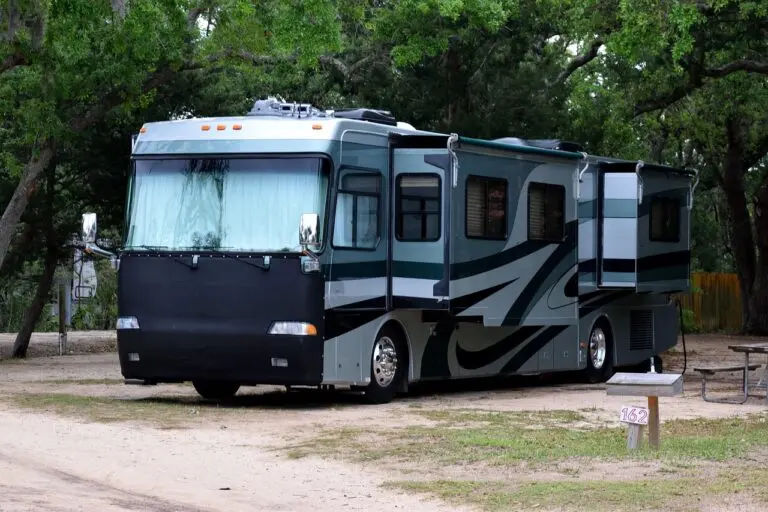
Quick answer: There is no single Forest River fuse panel location. It varies by model and year. In towables, check near the power converter, in interior cabinets, and in exterior storage compartments. Motorhomes usually have separate chassis and house panels. Start with your owner’s manual, which may show the exact spot.
Fuses and circuit breakers cut power when a circuit is overloaded or shorted, which protects your Forest River’s wiring and components. A blown fuse must be replaced, while a tripped breaker can be reset. Either way, you first need to find the right panel.
This guide covers where to look, how to tell which fuse failed, and when to stop and call a technician.
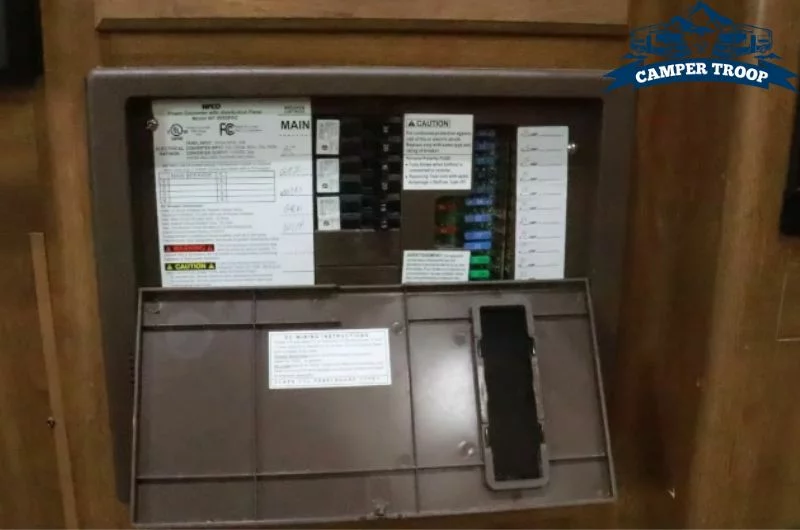
Possible Forest River Fuse Panel Locations
Fuse boxes in RVs can be placed in unusual locations, and your RV may have more than one panel or separate inline fuses. These are places worth checking. None is guaranteed for your model:
- Location 01- Low on the wall or base at the end of the bed, just above the floor
- Location 02- On or near the RV power converter
- Location 03- Cabinet in the kitchen area
- Location 04- Hidden power cabinet panel
- Location 05- Exterior storage compartment
- Location 06- Along with the power connection unit
- Location 07- Near the driver’s area of a motorhome, including low panels around the dash
Manufacturers often blend the fuse panel into the RV’s interior, so look for a plain cover, vent-like panel, or small door. If you still can’t find it, we recommend looking in the owner’s manual of your Forest River.
Where do you look in a towable vs. a motorhome?
Start with your RV type. Towables have no dashboard or steering column, so skip any advice that mentions them.
| RV type or system | Where to start | Best reference |
|---|---|---|
| Travel trailer or fifth wheel | Near the converter, interior cabinets, low wall panels, exterior compartments | Forest River owner’s manual |
| Motorhome house system | Near the converter or power center, interior cabinets, exterior compartments | Forest River owner’s manual |
| Motorhome chassis system | Driver’s area and engine bay | Chassis manufacturer’s manual |
What is the difference between chassis and house fuse panels?
Chassis fuses protect the driving systems, such as engine functions, headlights, and dash controls. House fuses protect the living area, such as interior lights, the water pump, and furnace controls.
If your headlights fail, check the chassis panel. If your cabin lights fail, check the house panel. For chassis fuse locations, use the manual from the company that built the chassis, because that company may not be Forest River.
Does the location change by Forest River brand?
Yes, it can. Layouts may differ across towable lines such as Cherokee, Rockwood, and Salem, and across motorhome lines such as Sunseeker and Georgetown. They can also change between floor plans and model years in the same line.
Don’t rely on a location given for a different model. Use the manual or wiring information for your exact brand, floor plan, and year.
Where is the converter on a Forest River travel trailer?
The converter location varies by floor plan, so check your manual first. In many RVs, the converter is built into or mounted near the main power center. Finding it can also lead you to the 12V fuses.
Read Also: Forest River RV Power Converter Location [Possible 7 Places]
What Is the Difference Between a Fuse and a Circuit Breaker?
A fuse is a one-time device. It blows when its circuit fails or overloads, and then it must be replaced. A circuit breaker is a switch that trips and can be reset.
They are separate devices, so a breaker handle that has moved does not mean a fuse has blown. It means that breaker has tripped.
How do the 120V AC and 12V DC panels differ?
Most RVs have two house electrical systems. They may share one power center or sit in separate places.
| System | Protection | Typical loads |
|---|---|---|
| 120V AC | Circuit breakers | Wall outlets, microwave, air conditioner |
| 12V DC | Fuses, usually | Interior lights, water pump, furnace controls, vent fans |
Where is the 12-volt fuse panel on a Forest River RV?
Look near the converter or main power center first. In many RVs, the 12V fuses sit beside the 120V breakers in one unit, often behind a single cover. If you only find breakers, check for a second panel or look in your manual.
How Do You Work on the Fuse Panel Safely?
Shut off every power source before you touch anything inside the panel. An RV can stay live from more than one source.
- Unplug the RV from shore power.
- Shut off the generator.
- Turn off the inverter, if your RV has one.
- Turn off the battery disconnect.
- Turn off the appliances and lights on the affected circuit.
Warning: A battery disconnect may not cut power to every 12V circuit. Treat all terminals as live. Do not remove the panel’s inner cover or touch the wiring behind it. Leave that work to a qualified RV technician.
How to open the Fuse panel?
Once you have identified the fuse panel, the next step is to open it. Here are easy steps to open it:
Step 01: Look if it’s a push and pull system or a screw system.
Step 02: If push and pull system, push the cover and let it go. It will open up. Unscrew with a screwdriver if it is one of those old systems!
Step 03: Open the cover, and now you can access your fuse panel!
Read Also: 9 Common Forest River RV Electrical Problems & Their Easy Solutions
How Do You Tell Which Fuse Is Blown?
Match the item that stopped working to its label on the panel or fuse chart, then inspect or test that fuse first. The chart is often printed on the panel door or included in the manual.
Labels vary by RV, but they often name a load or area, such as lights, water pump, furnace, or slide. If several items failed at once, look for a fuse that feeds all of them. Labels can be vague or out of date, so test nearby fuses if the first one is good.
What types of fuses do RVs use?
- ATO/ATC blade fuses: Standard-size plastic fuses with two metal prongs.
- Mini blade fuses: A smaller version of the blade fuse. They are not interchangeable with standard blades.
- Inline fuses: Fuses in a holder on the wire itself, away from the main panel. These are a common reason one item stays dead when the panel fuses look fine.
How can you tell if a fuse is blown by looking at it?
Look for a visible gap in the wire or a black or metallic smear inside the glass. On a blade fuse, look through the plastic for a broken metal strip or dark marks.
A fuse that looks fine can still be bad. Some fuses contain sand or another filler that hides the wire, so they need a multimeter test.
How do you test a fuse with a multimeter?
- Turn off the equipment or vehicle.
- Disconnect the fuse from its main supply and remove it.
- Set the multimeter to continuity.
- Touch one probe to each end of the fuse. Polarity does not matter.
- Read the result. A beep means the fuse is good. No beep and a large resistance reading mean the connection is broken.
Can you use a test light instead?
Yes, on 12V blade fuses. This is the one check that needs the 12V system on. Clip the test light to a good ground, then touch the probe to the small metal test points on top of the fuse. If the light comes on at both points, the fuse is good. If it comes on at only one, the fuse is blown. If it stays off at both, that fuse isn’t getting power. Do not use a 12V test light on 120V AC circuits.
How Do You Replace a Blown RV Fuse?
Replace it with a new fuse of the exact same type and amp rating.
- Shut off power using the safety steps above.
- Pull the blown fuse straight out with a fuse puller or small pliers.
- Read the amp rating printed on the fuse and compare it with the panel label.
- Press in a new fuse of the same type and rating until it seats fully.
- Restore power and test the circuit.
Warning: Never install a higher-amp fuse to stop repeat failures, and never bypass a fuse with wire or foil. The fuse is meant to fail before the wiring overheats.
How Do You Reset a Tripped Circuit Breaker?
Find the breaker with its handle off or between ON and OFF. A handle in the middle position has tripped. Push it fully to OFF, then back to ON. Turn off large loads on that circuit first.
Why won’t a circuit breaker switch turn back on?
The most common fixable cause is skipping the full OFF position. If you did that step and the breaker still won’t stay on, the circuit may still be overloaded or shorted, or the breaker may be faulty.
Unplug devices on that circuit and try once more. Never hold or tape a breaker in the ON position. If it trips again right away, leave it off and have the circuit checked.
What Should You Do If a Fuse Keeps Blowing or a Breaker Keeps Tripping?
Treat a repeat failure as a sign of a problem, not a bad fuse. Use this rule to decide what to do next:
- Fails only when many items run: The circuit is probably overloaded. Run fewer items at once.
- Fails when one item turns on: Unplug or shut off that item, then have it checked.
- Fails with everything off: There may be a short in the wiring. Stop replacing fuses and call a qualified RV technician.
- Burning smell, heat, melted plastic, or scorch marks: Shut off all power and call a qualified RV technician before using the system again.
What To Do If You Can’t Find The Fuse Panel Location In Your Forest River?
If you are still looking for the fuse panel location in your Forest River, there are a few steps you can take to locate it.
- First, consult your owner’s manual, along with any component manuals that came with your RV. They may show the fuse panel location or include a fuse chart.
- If you cannot find the manual, check Forest River’s official website for owner resources, or search online for a diagram of the RV’s fuse panel. Make sure any diagram matches your exact model and year.
- You could also contact Forest River’s customer service for assistance. Use the contact details on the company’s official website, and have your model, year, and VIN ready.
- Finally, you can check the RV’s wiring harness for a fused lead that may lead you to the fuse panel. You might need some expert help if you can’t understand it properly!
Read Also: How to Find Water Pump Location on Your Forest River RV?
FAQs.
Here are answers to some frequently asked questions about forest river fuse panels which might be helpful to clear your doubts!
How can you tell if your forest river fuse has blown?
Look for a visible gap in the fuse wire or a black or metallic smear inside the glass. Some fuses hide the wire and need a multimeter test. A breaker is a separate device. If its handle is off or between “on” and “off,” the breaker has tripped. Flip it fully to “off” before flipping it back to “on.”
How does a forest river-blown main fuse appear?
First, you should examine the fuse wire. The fuse has blown if there is a visible gap in the wire or a black or metallic smear within the glass. When you detect a blown fuse on your forest river fuse panel, you must replace it.
Will an amp still turn on if a fuse blows in a forest river?
If you see that the fuse is present and blown, the amp will not turn on since the mains voltage circuit is open. Changing the fuse may or may not solve the problem. It also depends if there are other issues or not.
Can you replace a forest river with a blown fuse on its own?
Fortunately, replacing a blown fuse is a reasonably simple do-it-yourself home repair. All you need is a simple understanding of your fuse box and a trip to the hardware store, and you’ll be back at work. Always use adequate safety precautions when working with electricity.
How much does it cost to repair a forest river blown fuse?
Fuse prices and labor rates vary by fuse type, shop, and location. If you have a professional do the work, you may pay labor fees on top of the part, so contact the shop ahead for a repair quote.
Read Also: Forest River Battery Disconnect Switch Location and Purpose
Final Thoughts
The fuse panel in a Forest River RV is an important safety feature. It provides the necessary protection to ensure that the electrical systems in your RV are operating safely and correctly.
Your Forest River RV’s wiring is protected by the fuse panel from damage that could result from an overload, short circuit, or other electrical problems.
Without the fuse panel, your Forest River RV could be at risk of electrical fires, malfunctioning electrical systems, and other dangerous situations.
So, shut off all power before you work on the panel, and always use the correct fuse. We recommend taking fuse panel issues seriously and taking immediate action!
Read Also: Forest River Slide Out Seals: Types & Replacement Guideline