Quick answer: Forest River battery disconnect switch location varies by model and year. Start near the batteries and propane tank rack, then check the control panel, engine area, and entry door. Your RV may not have one. To confirm a switch is real, unplug shore power and test whether 12V power goes off.
RVs are great tools for camping or a nomadic lifestyle. However, finding an important switch can be hard without the right documents. It is often frustrating for RV owners to look for key parts like a battery disconnect switch or water heater reset button.
Your owner’s manual may not show the exact switch location, so you may need to do some searching. But first, what does this switch do?
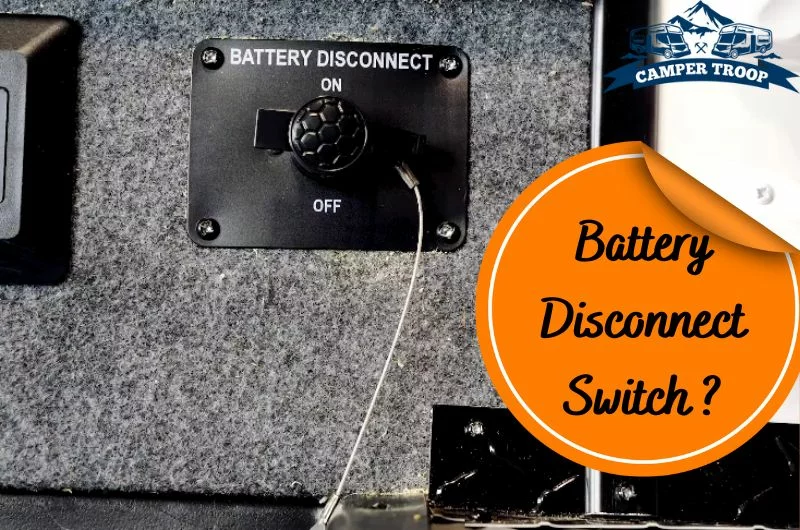
What Does Forest River Battery Disconnect Switch Do?
A battery disconnect switch lets you separate the battery from some or all of your RV’s 12V circuits. This can reduce battery drain when the RV is not in use, but it cannot eliminate it. Batteries still self-discharge, and flooded lead-acid batteries lose about 5% to 15% per month.
Depending on the wiring, the switch may interrupt the positive or negative DC line. Either way, its job is to break the link between the battery and the 12V devices on that circuit, such as lights or water pumps.
Moreover, a drained RV battery can be a huge pain to deal with. The battery disconnect switch helps by letting you take the battery off those circuits without removing cables.
So, the reasons to use a battery disconnect switch in your Forest River RV are:
- Reducing battery drain when the RV is parked for a long time
- Disconnecting connected circuits without removing battery cables
- Shutting off connected 12V circuits during storage or basic electrical work, after you confirm the power is off
As you can see, the switch is handy for an RV or motorhome owner. However, you have to find it first!
Read Also: 9 Common Forest River RV Electrical Problems & Their Easy Solutions
Which Battery Does The Disconnect Switch Control?
It depends on how your RV is wired. Do not assume the switch controls every battery on board.
- House battery: Powers living-area 12V items, such as lights, fans, and the water pump.
- Chassis or starting battery: Starts a motorhome engine and supports its vehicle systems.
A motorhome usually has both battery types and may have separate switches. A travel trailer or fifth wheel has no engine to start, so its switch normally relates to the house battery. A motorized toy hauler follows the motorhome setup, while a towable toy hauler follows the trailer setup.
Where Is The Forest River Battery Disconnect Switch Located?
There is no single location for every Forest River RV. Because the switch can be tough to find, here are the common places to check. Use them as starting points, not as exact specs for your model.
| RV type | Where to start | What to confirm |
|---|---|---|
| Motorhome | Battery compartment, propane area, control panel, engine area, driver’s seat area | Whether the switch controls the house battery, chassis battery, or both |
| Travel trailer | Near the batteries, propane rack, front compartment, entry door | Whether breakaway brakes still have power |
| Fifth wheel | Front storage area, battery compartment, control panel, entry door | Whether breakaway brakes still have power |
| Toy hauler | Use the motorhome or towable list that matches your RV | Which loads stay powered with the switch off |
1. Behind The Propane Tanks
Some Forest River RVs may have the battery disconnect switch behind the propane tanks.
Also look underneath the propane tank rack. The switch can be easy to miss if it sits low or behind hoses and wiring.
If your batteries are close to this area, make the propane rack one of your first stops. Do not disturb propane lines or fittings while you search.
2. On The Control Panel Of Forest River
Some RVs have a battery control on a panel with other switches. Look for a label such as “Battery Disconnect,” “Battery Cut-Off Switch,” “House Battery,” or “Chassis Battery.”
Be careful with a switch labeled “AUX Battery.” That label does not prove it is a disconnect. On some motorhomes, an auxiliary switch may link batteries to help with starting. Check your documents, then use the test below to learn what it does.
3. Around or Near The Engine
If you have a second-hand RV or motorhome, a previous owner may have added a switch.
So, after checking the propane area and control panel, look for places where an owner could have reached the battery wiring easily.
On a motorhome, check around the engine and chassis battery. An added switch may have newer cables or connectors than the wiring around it.
4. Close To The Front Door
A rocker switch near the entry door may turn several 12V items on or off together. It may not be labeled as a battery disconnect switch.
Owners often call this a “salesman switch” because one flick can bring selected lights and devices on at once. Test it before you rely on it for storage.
5. Along The Battery Cables Or Under The Driver’s Seat
If you still cannot find it, trace the main cables from the battery without pulling on them. A large switch with heavy cables on two posts is a good clue. On motorhomes, also check under the driver’s seat and in nearby utility compartments.
Where Can You Get Model-Specific Information?
Start with the documents that came with your RV, including the converter and battery manuals. If they do not answer the question, ask a Forest River dealer or Forest River support for the wiring diagram. Have your exact model, model year, and VIN ready.
Read Also: How to Find Water Pump Location on Your Forest River RV?
How Can You Confirm It Is The Real Battery Disconnect?
Test whether the switch removes 12V power when no charging source is active. Otherwise, a converter or solar system can make the result misleading.
- Unplug shore power. Turn off the generator and inverter.
- Isolate solar charging if your system has a way to do so.
- Turn on a 12V interior light and the water pump.
- Move the suspected switch to Off. Note what stops working.
- Set a multimeter to DC volts and check the main 12V feed at the fuse panel. A full disconnect should bring that reading close to 0V.
- Check the battery terminals. They will still show voltage, which is normal.
- On a motorhome, check whether dash power changes. This helps show whether the switch affects the chassis battery.
Is The Salesman Switch Useful As A Battery Disconnect?
It is useful for turning off selected items, but do not treat it as a true battery disconnect unless your test proves it cuts the main 12V feed. Devices wired ahead of the switch can keep drawing power.
What Stays Powered When The Switch Is Off?
Anything wired directly to the battery, or on the battery side of the switch, can stay powered. Check these items on your RV:
- LP and CO detectors
- Solar charge controllers
- Inverters
- Breakaway brake circuits on towables
- Aftermarket accessories connected at the battery post
Safety warning: If the switch turns off your LP or CO detector, do not sleep in the RV or use propane appliances with it off.
When Should You Use The Forest River Battery Disconnect Switch?
The main reason to disconnect the battery is when you park the RV for an extended time and no suitable charger is maintaining it. This reduces the load on the battery, but you still need to check its charge.
Batteries self-discharge over time even with no electrical drain. Small drains can speed up discharge, and a lead-acid battery left at low charge can develop sulfation.
Freezing conditions can also harm a battery’s health and shorten its lifespan.
Do not count on the switch for theft prevention. A switch that controls only the house battery will not stop a motorhome engine from starting.
Use the On position when you need battery power at camp. Use Off for storage or service only after you know which systems it affects.
Read Also: How to Find Fuse Panel Location on Your Forest River RV?
Should The Switch Stay On While Towing?
Leave it on while towing unless your RV’s documents or wiring diagram confirm the breakaway system still has power with it off. A breakaway system applies the trailer brakes if the trailer separates from the tow vehicle, and it needs a working power source.
Motorhome owners should also check their manual before switching anything off for travel. Learn what the switch controls first, including steps, slides, detectors, and other 12V systems.
Should You Disconnect Your RV Battery When Plugged Into Shore Power?
Not always. The right choice depends on your battery type, converter, and wiring. Leave the switch on if that is the only way your converter can charge the battery and your converter’s manual allows long-term connection.
Wiring varies. On some RVs, the converter can still power 12V items while the switch prevents battery charging. To check yours, measure battery voltage before and after plugging in. A rise suggests the battery is receiving a charge. Repeat the check with the switch on and off.
A converter with a storage mode may be able to maintain lead-acid batteries, but confirm that in its manual. If you have flooded batteries, check their water level during long-term shore power use.
How Should You Store Lead-Acid And Lithium RV Batteries?
Check the battery during storage instead of relying on the switch alone. Lead-acid and lithium batteries have different needs.
| Storage factor | Lead-acid | Lithium |
|---|---|---|
| When to recharge | At 70% state of charge, about 12.42V open circuit for a 12V battery | Follow the battery maker’s instructions |
| Main concern | Low charge can cause sulfation | Charging in freezing temperatures |
| Cold-weather rule | Keep it charged to lower freezing risk | Do not charge below 32°F (0°C) |
Battery University advises recharging stored lead-acid batteries at 70% state of charge. U.S. Battery says lithium batteries should not be charged below 32°F (0°C). Remember that solar and shore power can both act as chargers.
Will A Lead-Acid RV Battery Freeze In Winter?
It can if it is discharged. A fully charged flooded lead-acid battery has a freezing point below -80°F, while a discharged one can freeze at 20°F or higher. Keeping the battery charged is your best protection in winter storage.
Why Is There No 12V Power After Turning The Switch On?
Start with the battery, then work toward the fuse panel. Keep metal tools from bridging live terminals.
- Measure battery voltage. Charge the battery if it is low.
- Make sure you moved the correct switch, then cycle it off and on.
- Look for loose, corroded, or damaged cables at the battery and switch.
- Inspect the main fuse or breaker near the battery and the 12V fuse panel.
- With the switch on and a 12V light running, measure DC volts across the two switch posts. A good closed switch should read close to 0V. A reading near battery voltage suggests an open or failed switch.
- Call an RV technician if the switch tests good and power still does not reach the panel.
How Do You Find A Parasitic Battery Drain?
A parasitic drain is a load that keeps using battery power when the RV seems to be off. Possible sources include detectors, stereo memory, inverter standby power, appliance control boards, and aftermarket accessories.
- Unplug shore power and turn off the generator, inverter, and solar charging if possible.
- Turn off all normal 12V loads.
- Measure DC current with a clamp meter, or connect a multimeter in series at the battery cable. Do not exceed the meter’s amp rating.
- Give control boards a few minutes to settle, then record the reading.
- Pull one 12V fuse at a time. A clear drop in current points to that circuit.
- If no fuse changes the reading, look for devices wired directly to the battery.
How Do You Install An Aftermarket Battery Disconnect Switch?
Install one yourself only if you are comfortable working with high-current DC wiring. Otherwise, hire a qualified RV technician. Get professional help if your system has a large inverter or if the battery maker has special wiring rules.
- Map every wire at the battery. Decide which loads the switch should isolate and which safety devices must stay powered.
- Choose a DC-rated switch. Its voltage and continuous current ratings must exceed your system’s maximum, including any inverter load.
- Turn off shore power, generator, inverter, and solar charging. Then disconnect the battery. Negative-first removal is common practice, but follow your manual if it differs.
- Mount the switch in a dry, reachable spot. Keep it away from vented battery gases because a switch can create a spark.
- Use cable at least as large as the original, with proper lugs and secure crimps.
- Keep the required fuse protection close to the battery and size it to protect the cable.
- Reconnect the battery and tighten all connections to the maker’s specs.
- Use the confirmation test above, then verify detector and breakaway power.
FAQs.
We answered some of the web’s most commonly asked questions about the Forest River battery disconnect switch location. Read below to check if this section answers some of your questions.
Do I need to disconnect the Forest River battery if my RV is connected to shore power while in storage?
It depends on your battery, converter, and wiring. A converter with a storage mode may be able to maintain lead-acid batteries, but confirm that in its manual. Also test whether the battery receives a charge with the switch on or off.
Should the Forest River Battery Disconnect Switch be on or off?
Use the On position when you need battery power in the RV. On a typical switch, On connects the battery to the switched circuits and Off disconnects it. Towable owners should confirm the breakaway system has power before towing.
Why does my Forest River RV battery drain when nothing is on?
Batteries self-discharge even with no electrical drain. A faster loss may point to a parasitic drain, such as a detector, control board, or accessory that keeps using power.
A disconnect switch can reduce drain from the circuits it controls, but it cannot stop self-discharge.
Do all Forest River motorhomes come with a disconnect switch?
Do not assume that every model has one. Equipment can vary by model and year.
If you have checked the common places in this article, confirm with your owner documents, the wiring diagram, or a Forest River dealer.
Read Also: Forest River Slide Out Seals: Types & Replacement Guideline
Conclusion
The Forest River battery disconnect switch can be hard to find because its location varies. Start near the batteries and propane rack, then test any switch you find before relying on it.
If you cannot find a built-in disconnect switch, consider a properly rated aftermarket switch or manually disconnect the battery. When disconnecting manually, follow your owner’s manual. Removing the negative cable first is common practice.
Also, turn off electrical appliances when storing your RV and check the battery’s charge regularly. Small maintenance tasks can help you avoid bigger battery problems later.
Read Also: Forest River Water Pump Not Working: Reasons And Solutions