Quick answer: A Forest River water pump can stop working because of a power problem, an empty tank, a closed or misset valve, a clogged strainer, a suction-side air leak, a bad pressure switch, or freeze damage. Start with the symptom: a silent pump suggests a power fault, while a running pump with no water suggests a plumbing problem.
The fresh water pump moves potable water from the tank to your faucets, shower, and toilet whenever you are not connected to city water. When it fails, you lose running water from the tank. Many pump problems can be traced with simple checks and basic tools.
This guide explains why a Forest River water pump stops working, how to narrow down the cause, and how to fix it.
Why Is My Forest River Water Pump Not Working?
The cause depends on what the pump does when you turn it on. Open a cold faucet, switch on the pump, and match the result to this table.
| What you notice | Likely causes | Check first |
|---|---|---|
| Pump is silent | Low battery, switch off, blown fuse, bad connection, failed pressure switch, bad motor, seized or frozen diaphragm | Battery, pump switch, and fuse |
| Pump runs but no water comes out | Empty tank, wrong valve position, clogged strainer, suction-side air leak, kinked line, debris in valves | Tank level and valve positions |
| Pump runs with faucets closed | Outlet-side leak, leaking toilet or valve, debris holding valves open, faulty pressure switch | Visible leaks and the toilet valve |
| Pump cycles on and off rapidly | Restricted line, outlet-side leak, debris in valves, faulty pressure switch | Plumbing leaks and the strainer |
| Pump is noisy | Loose mounts, loose plumbing, restricted lines, loose pump hardware | Pump mounts and fittings |
| Fuse or breaker keeps tripping | Grounded circuit, wrong wire size, bad motor, seized or frozen diaphragm | Wiring and signs of freeze damage |
What Should You Do Before Working on the Pump?
Cut the 12V power and relieve the water pressure before you touch the pump or its plumbing.
- Turn the water pump switch off.
- Disconnect 12V power to the pump. Use the battery disconnect or remove the pump fuse.
- Open a faucet to release pressure in the lines.
- Close the tank shutoff valve if your RV has one.
- Put towels or a shallow pan under the pump to catch water.
Voltage tests need the power on. Restore power only for the test, and keep loose tools and bare wire ends away from metal surfaces.
Which Water Pump Does Your Forest River RV Have?
The only reliable way to know is to read the label on the pump. The pump can differ by model and floorplan, so write down the brand, model number, voltage, and fuse rating before you buy parts. Your owner’s manual or a Forest River dealer can also help if the label is worn.
Common RV fresh water pumps, such as the SHURflo 2088 and 4008, are diaphragm pumps. A flexing diaphragm and one-way valves move the water. A pressure switch turns the pump on when pressure drops and off when pressure builds back up.
Where Is the Water Pump Located on a Forest River RV?
There is no single location for every Forest River RV because layouts differ. Use these steps to find yours:
- Check the owner’s manual or plumbing diagram for your model.
- Open a faucet, turn on the pump, and follow the sound.
- If the pump is silent, find the fresh water tank and trace the outlet line. It leads to the pump inlet.
- Look behind access panels in nearby storage bays, cabinets, and under-bed compartments.
12 Common Reasons Behind Forest River Water Pump Not Working
RV water pump problems have both electrical and non-electrical causes. Many involve plumbing or mechanical issues, such as clogged strainers, air leaks, loose hardware, debris in valves, diaphragm damage, and freezing. Here are the common reasons, along with their solutions:
1. Empty Fresh Tank
The first thing to check is the fresh water tank. The water in the tank is not unlimited, so it will run out periodically depending on your usage.
The water gauge might not show the correct level all the time. When the tank is empty, water delivery stops, but the motor can keep running. The pump may run or sputter with no water coming out.
To fix this problem, fill the tank with clean, fresh water. If the pump still does not deliver water, follow the priming steps later in this guide. If necessary, fix the water gauge as well for accurate updates.
2. Tank or Winterization Valve in the Wrong Position
A closed tank valve can block the pump’s water supply. A winterization valve left in the antifreeze position can make the pump draw from the wrong source. This is especially likely on the first trip after storage.
Find the valves near the pump or water heater and set them for normal use. Layouts vary, so check the labels or your owner’s manual. Also make sure the water heater bypass is set correctly before you use hot water.
3. Lack of Power Supply
If the water pump is not working at all, the motor may not be receiving enough power. A battery that does not hold enough charge will not run the water pump, so check the battery early in your troubleshooting.
RV batteries lose charge during storage, and self-discharge speeds up at higher temperatures. Cold weather is a different problem. It temporarily reduces the capacity a battery can deliver. Either way, a battery left unused still needs periodic charging.
To fix a battery that cannot provide enough power, the main course of action is to charge it.
Connect the correct battery charger and let the battery charge completely. Disconnect the charger and try turning on the water pump again. Also make sure the battery disconnect switch is on.
Read Also: How to Find Fuse Panel Location on Your Forest River RV?
4. Pump Switch Off or Faulty
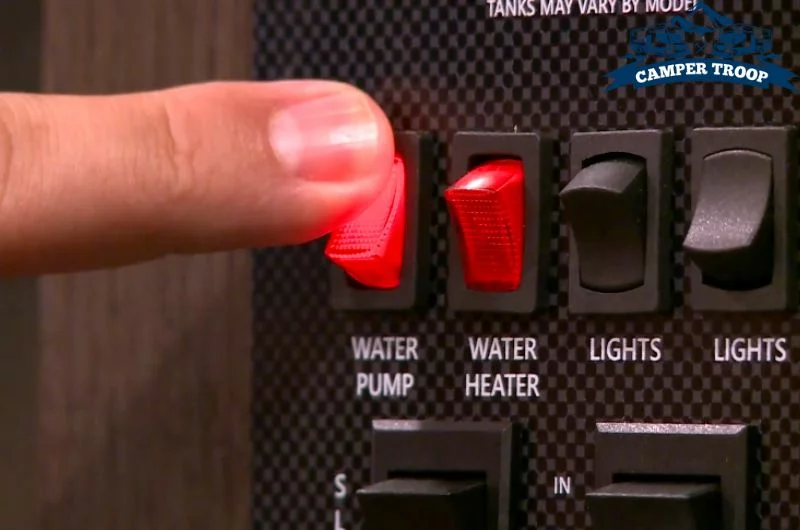
Check the water pump switch at the control panel. If your RV has more than one pump switch, try each one. If one switch works and another does not, the pump is getting power and the fault is likely in that switch or its wiring.
If no switch starts the pump, use the multimeter test below to find where power stops.
5. Broken Fuse
A fuse opens when current exceeds the fuse’s own rating for long enough to melt its metal element. The rating is chosen so the fuse protects the circuit and its wiring. A blown fuse cuts power to the pump.
Find the pump fuse or breaker using the panel label or your owner’s manual. Look for a broken metal strip inside the fuse, or test it with a multimeter. Then replace it with a new fuse of the same amp rating.
Never install a larger fuse to stop it from blowing. A larger fuse may no longer protect the wiring.
A fuse that blows again points to a problem in the circuit or pump. Check for an open or grounded circuit, incorrect wire size, a bad motor, or a seized or frozen diaphragm.
Read Also: Forest River Battery Disconnect Switch Location and Purpose
6. Loose Electrical Connections
A loose, corroded, or damaged wire can stop power from reaching the pump. A poor ground connection can do the same thing. Use a multimeter set to DC volts to find the point where voltage disappears.
How to test for 12V at the pump:
- Set the multimeter to DC volts.
- Turn on the pump switch and open a cold faucet.
- Touch the black probe to the pump’s ground connection and the red probe to the positive feed, before the pressure switch. Wire colors can vary, so use your wiring diagram if you are unsure.
- Read the voltage. Expect about 12V. Voltage should be within about 10% of nominal, so a reading below about 10.8V on a 12V system is too low.
- If you read about 12V and the pump is silent, test the pressure switch next. If the switch is good, suspect the motor or a seized diaphragm.
- If you read no voltage, keep the red probe in place and move the black probe to a clean chassis ground or the battery negative. If you now read about 12V, the pump’s ground connection is bad.
- If you still read no voltage, work back toward the battery. Check the pump switch, fuse, and battery disconnect. The fault lies between the last point with voltage and the first point without it.
Turn the power off again, then secure the loose connection once you have found it. If the wires are damaged or worn out, replace them with wire of the correct size.
While you are there, check the pump hardware too. Vibration from driving can loosen plumbing, strainers, and pump hardware.
Read Also: Forest River Slide Out Seals: Types & Replacement Guideline
7. Failed Pressure Switch
A failed pressure switch can keep the pump from starting or keep it from shutting off. Suspect it when the pump has good voltage but stays silent, or when it keeps running and you cannot find a leak.
- Turn off 12V power and open a faucet to release all pressure.
- Label and disconnect the wires at the pressure switch.
- Set the multimeter to continuity and touch one probe to each switch terminal.
- With no water pressure, a demand-pump switch should normally show continuity. No continuity suggests a bad switch.
Replace the switch with one that matches your pump’s model number and pressure rating. Follow the pump maker’s instructions for your model.
8. Clogged Inlet Strainer
The strainer catches debris before it reaches the pump. When it clogs, the pump may struggle to draw water, lose prime, or get noisy.
- Turn off power, relieve pressure, and close the tank valve if you have one.
- Remove the strainer bowl or housing on the inlet side of the pump.
- Rinse the screen and bowl with clean water.
- Inspect the seal or O-ring, and replace it if it is cracked or flattened.
- Reinstall the strainer snugly, without overtightening the plastic parts.
9. Air Leak on the Suction Side
The pump pulls water from the tank through the inlet line. A small opening on this side lets the pump pull in air instead, so it may sputter or fail to prime.
Check every fitting between the tank and the pump, including the strainer seal. Tighten loose fittings and replace cracked hoses or bad seals. Also look for kinked lines.
10. A Broken Pipeline
Any of the water lines and fittings can get damaged over time. As a result, water flow gets restricted and water can leak out. Holes and cracks can majorly affect how well the pump delivers water.
To fix a broken line, first turn off the pump and find the exact location of the damage. Once you find it, use the correct pipe fittings to repair the damaged section.
If the damage is too much to repair with fittings, replace that section of line.
11. Worn Out Pump Parts
Parts inside the pump can wear out or fail over time. Common RV pumps are built around a diaphragm and valves, so the typical wear items are the diaphragm, check valves, pressure switch, and drive assembly.
The diaphragm is a flexible mechanical membrane, typically made of rubber, thermoplastic, or Teflon. It can be ruptured, pinched, punctured, or seized by frozen water. A damaged diaphragm or stuck valve can reduce or stop water flow.
Clean out any debris in the valves first. If a part is damaged, look for a repair kit or replacement part that matches your pump’s model number. Use a professional if you are not comfortable opening the pump.
12. Freeze Damage
Water left inside the pump can freeze and seize the diaphragm or crack the pump head. Look for cracks, leaks at the pump head, or a pump that will not start after cold weather.
Let a frozen pump thaw before you run it. Inspect it for damage before restoring power. A cracked pump head usually means you need a new head or a new pump.
Why Does My RV Water Pump Run but No Water Comes Out?
A pump that runs without delivering water has power but cannot draw water. Check for an empty tank, a closed or misset valve, a clogged strainer, a suction-side air leak, a kinked line, and debris in the valves. If all of those are fine, the diaphragm may be damaged.
How Do You Prime an RV Water Pump?
A self-priming diaphragm pump draws water up from the tank once it is running, so you normally do not need to add water to the pump. Refilling the tank does not prime the pump by itself. Follow these steps:
- Add enough water to the fresh tank to cover the pickup line.
- Set the tank and winterization valves for normal use.
- Confirm the strainer is clean and the inlet fittings are tight.
- Open a cold faucet.
- Turn on the pump. Expect sputtering at first, followed by a steady stream.
- If no water appears after a short run, turn off the pump. Do not leave it running dry while you search for the problem.
- Once cold water flows steadily, open the hot side and other faucets one at a time to bleed air, including air in the water heater.
- Close all faucets. The pump should build pressure and shut off.
If the pump still will not prime, recheck for a clogged strainer, air leaks in the inlet plumbing, kinked lines, debris in the valves, and air in the water heater.
Why Does My RV Water Pump Keep Cycling On and Off?
A pump that cycles or keeps running with the faucets closed is often responding to lost pressure or a control fault. The pump itself may not be bad. Possible causes include:
- A leak on the outlet side of the pump
- A leaking toilet or valve
- Debris holding the pump valves open
- Swollen rubber parts in the pump
- A loose drive assembly or pump head
- A faulty pressure switch
- A by-pass set above the shut-off pressure
Start with the easy checks. Look under sinks, around the water heater, and at the toilet valve. Then inspect the pump and pressure switch.
How Can You Tell if Your RV Water Pump Is Bad?
A pump is likely bad when it fails after you have ruled out power, valves, the strainer, and plumbing leaks. Warning signs include a pump that will not start, will not prime, cycles rapidly, keeps running with faucets closed, leaks, or makes unusual noise.
These signs often have other causes. Check for loose mounts or plumbing, restricted lines, outlet-side leaks, debris in the valves, and a faulty pressure switch before you replace the pump.
Should You Repair or Replace the Pump?
Repair the pump when one identifiable part has failed and that part is available for your model. Replace it when the damage is extensive or the repair would cost nearly as much as a new pump.
| Situation | Better choice |
|---|---|
| Debris in the valves or a dirty strainer | Clean it |
| Loose wire, fitting, or mount | Tighten or repair it |
| Failed pressure switch and a matching part is available | Replace the switch |
| Worn diaphragm or valves and a matching kit is available | Compare kit and labor cost with a new pump |
| Motor will not run with good voltage and ground, and the diaphragm is not seized | Replace the motor assembly or pump |
| Cracked housing or several failed parts | Replace the pump |
How Much Does It Cost to Replace an RV Water Pump?
The cost depends on the pump model, the seller, and shop labor rates. For an accurate number, use the model number on your pump to price a matching replacement and a repair kit. Then ask a repair shop for a written labor estimate. A replacement should match your original pump’s voltage and be suitable for your plumbing and fuse size.
How Long Does an RV Water Pump Last?
There is no dependable fixed lifespan for every Forest River water pump. Service life depends on the pump model, how often it runs, how clean the water system stays, and whether the pump is protected from freezing. Fixing leaks quickly also keeps the pump from cycling more than it should.
How Do You Protect the Pump From Freezing?
Completely draining the pump is described as the best protection for SHURflo RV pumps. Never put automotive antifreeze in a potable water system.
- Drain the fresh water tank and water heater as your owner’s manual directs.
- Open the faucets and low-point drains.
- Remove the pump’s inlet and outlet lines, if your setup allows it.
- Run the pump briefly to push out the remaining water, then turn it off.
- Empty the strainer bowl.
- Follow the rest of your RV’s winterizing procedure. If it calls for antifreeze, use only a product labeled safe for potable water systems.
Is the Water Pump Covered by Warranty?
Coverage depends on your RV’s age, your warranty documents, and the pump maker’s terms. Contact your Forest River dealer first if the RV is still under warranty. Otherwise, contact the pump manufacturer with the model number and proof of purchase.
Ask before you open or replace the pump, since unapproved repairs may complicate a claim. Keep in mind that freeze damage voids the warranty on SHURflo RV pumps.
Can You Use City Water if the Pump Fails?
Yes, if you have a campsite hookup and your plumbing is not leaking. A city water connection supplies pressurized water from outside the RV, so the pump is not needed. Turn the pump off, use a drinking-water hose and a pressure regulator, and check for leaks after you turn on the water.
Do not use this workaround if a line is broken. Shut off the water until the leak is repaired.
When Should You Call an RV Technician?
Call a technician when:
- The fuse keeps blowing and you cannot find the cause.
- You find melted or burned wiring.
- A leak is hidden behind walls or under the floor.
- The pump still fails after the checks in this guide.
- The RV is under warranty and the repair needs authorization.
FAQs.
This section will answer all the rest of the questions you might have about your Forest River water pump. I have gathered all the most frequently asked questions here for your convenience.
What Are The Signs Of A Bad Forest River Water Pump?
Before completely failing, the water pump might show some symptoms of trouble. Possible signs are-
1. Makes excessive noise
2. Will not start or will not prime
3. Cycles on and off rapidly
4. Keeps running with the faucets closed
5. Leaks water
These signs often have other causes. Check for loose mounts or plumbing, restricted lines, outlet-side leaks, debris in the valves and a faulty pressure switch before replacing the pump.
Why Is My Forest River Water Pump Not Turning On?
A pump that will not turn on may have a low battery, a switch that is off, a blown fuse or tripped breaker, a bad connection or ground, or a failed pressure switch. A bad motor or a seized or frozen diaphragm can also stop it. An empty tank or clogged line stops water delivery, but the motor can keep running.
How Long Does a Forest River RV Water Pump Last?
There is no dependable fixed lifespan for every Forest River RV water pump. Service life depends on the pump model, how often it runs, how clean the water system stays and whether it is protected from freezing.
Do I Need to Prime The Forest River RV Water Pump?
A self-priming diaphragm pump draws water up from the tank once it is running, so you normally do not need to add water to the pump. Refilling the tank does not prime the pump by itself. Fill the tank, open a cold faucet and turn on the pump. If it will not prime, check for a clogged strainer, air leaks in the inlet plumbing, kinked lines, debris in the valves and air in the water heater.
How Do I Know If My Water Pump Needs To Be Replaced?
Rule out power, valve, strainer, plumbing and pressure switch problems first. Consider replacing the pump if the motor will not run with good voltage and ground, the housing is cracked, several parts have failed or a repair would cost nearly as much as a new pump. Coolant leaks, radiator steam and engine overheating are not symptoms of a fresh water pump problem.
Read Also: Why Is The Forest River Furnace Not Working?[With Solutions]
Conclusion
Without a working water pump, you lose running water from your fresh tank. Start with what the pump is doing, then work from the simplest checks to the more involved ones.
Check the tank, valves, battery, switch, and fuse before you buy parts. Then move on to the wiring, pressure switch, strainer, and inlet plumbing. Replace the pump only after those checks point to the pump itself.
To avoid problems, charge the battery periodically during storage, keep the strainer clean, and fix leaks quickly. Before freezing weather, drain the pump completely and winterize the water system.
Read Also: Forest River Slide Out Adjustment Guide | Follow These 9 Easy Steps