To keep bugs out from under your RV awning, hang a fine-mesh net or zip-on screen room from the awning and seal the gaps at the sides and ground. Pick mesh fine enough for the bugs where you camp, and pair the net with an EPA-registered repellent. Retract the awning, with the net, before high wind.
A mosquito net will help you block bugs, reduce the intensity of sunlight, and make the space cozy and more private. It also cuts down on swatting insects and spraying.
What Is a Mosquito Net for an RV Awning?
An RV awning is a shade system that attaches to the outside of the vehicle. You extend it to create a small outdoor living space at camp.
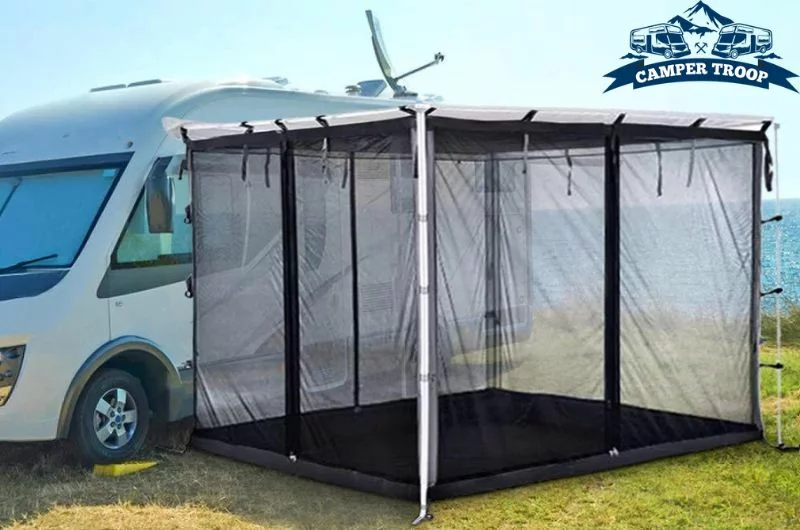
A mosquito net for an RV awning is a mesh screen that hangs from the awning and encloses that space. Its main job is to keep mosquitoes and other bugs out.
The mosquito nets for RV awnings are usually available as netting panels. You can attach them to the awning structure with a fastening mechanism, such as hooks, Velcro, magnets, etc.
What are the Benefits of a Mosquito Net for RV Awning?
Attaching a mosquito net to your RV awning can make the campsite more comfortable. Plus, you don’t have to worry about bugs falling into your food while having a nice outdoor dinner.
Fewer Bites and Lower Disease Risk:
Bugs can be a major mood-killer when you enjoy your time in the wild. Mosquitoes can also spread diseases such as dengue. But at a typical campsite in the continental US, the risk is low. CDC says most dengue cases in the 49 continental states are in travelers infected elsewhere. Limited local spread has occurred in Florida, Hawaii, Texas, Arizona and California. Dengue is common in Puerto Rico, the US Virgin Islands and American Samoa. Local malaria spread in the US is rare, with about 10 cases reported in 2023.
A net is a useful physical barrier, but it works best alongside a repellent, not instead of one. CDC recommends EPA-registered insect repellents. Use both: a net or screen room for the awning area, plus repellent on your skin as the label directs.
Read Also: Make Your Own RV Awning Room: A Comprehensive Guide!
Sun Protection:
The sun can be pretty scorching in some areas. A properly colored mesh net reduces the sunlight reaching your awning area, while you still keep a clear view of the outdoors.
Privacy and Coziness:
A mosquito net is a simple way to define your space outside the RV. The net acts like a barrier or fence for your temporary yard space. It marks your area for other campers and the woodland critters.
It also makes the whole setup feel cozier and more home-like, and it adds privacy, since passersby can’t see in as easily.
Read Also: 10 Top Bathroom Storage Ideas For RV You’ll Absolutely Love
Better Dining Experience:
The scent of food attracts insects. If you’re having a meal or barbecue under the awning, a net keeps bugs off your plate and out of the conversation.
Ready-Made Screen Room or DIY Netting: Which Is Better?
A zip-on screen room is worth it if you camp often in buggy areas and want a tight fit with less setup work. DIY netting makes sense for odd setups, occasional use, or if you want to build it yourself.
| Option | Pros | Cons |
|---|---|---|
| Ready-made screen room or zip-on enclosure | Sized for the awning, fewer gaps, faster setup | Must match your awning brand, model and length; usually costs more |
| DIY netting panels | Fits unusual setups, can cost less depending on materials | More measuring and sewing, gaps are more likely |
Before you buy a screen room, check that it is made for your awning brand (for example Dometic, Lippert/Solera or Carefree) and your awning length. Can you attach a screen room to any RV awning? Not always, so confirm the fit with the maker. Campground rules on enclosures and ground stakes vary, so ask at check-in.
How Do You Choose the Right Mesh?
Match the mesh to the smallest bug where you camp. Standard mosquito mesh stops mosquitoes, but no-see-ums (sandflies, midges) can pass through it.
- Mosquitoes: standard mosquito netting is enough.
- No-see-ums: Sea to Summit says they need mesh with at least 1,200 holes per square inch. Its standard headnet mesh has about 500. Other sellers list no-see-um netting at 552 to 800 holes per square inch, so check the stated count.
- Trade-off: finer mesh blocks more bugs but also lets less breeze through.
- Sun: if the net will stay up in strong sun, look for fabric sold as UV-treated.
What Types of RV Awnings Can a Mosquito Net Be Used On?
RV awnings come in many forms. They can be retractable or fixed and made of acrylic or vinyl. The type affects which net works best.
Retractable Awnings
Retractable awnings are either manual or powered. You open a manual awning by pulling its strap with an awning rod. A powered awning runs on a 12V motor and has a manual override if the power fails, so you can still close a retractable awning. Velcro or zipper attachments are easy to remove when you need to roll the awning up.
However, retractable awnings are vulnerable to strong winds. So, provide some support and secure the attachment points of the mosquito net to keep everything steady.
Vinyl Awnings
Waterproofing and scratch resistance make vinyl awnings a popular choice for many RV owners. The material is durable and doesn’t fade easily.
You can use a mosquito net with floors to go with your vinyl awnings. This will prevent the entry of crawling insects into your awning space. However, the floors can trap heat and make the area too warm.
Read Also: 5 Reasons Why RV Roller Shade Won’t Stay Down: How to Fix?
Acrylic Awnings
Acrylic awnings suit you if breathability and light weight are your priorities. They also come in bright colors.
You can complement your lightweight acrylic awning with a similarly breathable mesh mosquito net. The combination can create a colorful and well-ventilated awning area.
Fixed Awnings
Some RV owners prefer fixed awnings for their sturdiness. They are good protection against rain and snow. However, they lack flexibility. Mosquito nets with flaps or openings work well with fixed awnings.
Slide Out Awnings
This kind of awning opens by rolling along with the RV’s slide-out. You can use a tent-style mosquito net with these awnings. Here, the slide-out can provide nice support to set up the net.
Read Also: Why RV Toilet Won’t Stop Running? – Here’s How to Fix It!
How to Properly Install a Mosquito Net for an RV Awning?
A poorly installed net leaves gaps and can blow loose. Follow these steps:
- Step 1: Collect all the necessary tools to install the net. These include hooks, ropes, velcro, magnets, scissors, and the net.
- Step 2: Use a tape measure or string to calculate your awning’s dimensions and target area. Then cut and shape the net accordingly.
- Step 3: Select the spot on the awning’s edge from where you want to hang the net and attach the hooks. They should be spaced evenly. Pull them to test the firmness of the attachment. You need strong hooks to hold the net’s weight.
- Step 4: Use loops or ties to hang your mosquito net from the hooks. Sew the loops to the net’s edge. You can also use clips to attach the net to the hooks.
- Step 5: Check the tautness of the net and ensure you’ve covered the entire area.
- Step 6: Attach the mosquito net to the sides and bottom of the RV with the magnet or velcro strips. This eliminates all the possible gaps that might allow bugs to enter the space.
When you pack up, take the net down before you retract the awning. Let it dry fully, then fold and store it.
Read Also: RV Compartment Door Won’t Open | What to Do?
Should You Retract Your RV Awning in the Wind?
Yes. Lippert advises retracting the awning fully during high wind, heavy rain or long times away from the RV. A net adds surface area, so it can catch wind like a sail and put more strain on the awning.
- Wind damage can be costly. A Dometic WeatherPro awning guide says wind and rain damage is not covered by the warranty.
- Lippert’s optional wind sensor can retract the awning automatically. Sensitivity runs from level 1 (needs more wind) to level 3 (needs less wind). You must reset the setting each time the awning retracts.
- Don’t leave the net and awning up when you leave camp for the day.
Is It Safe to Use DEET Around Your Campsite?
Yes, when you follow the label. EPA-registered repellents work outdoors and are meant to be safe when used as directed. How long they last depends on the active ingredient and its strength, plus sweating, water and air temperature. Products with 20–30% DEET typically protect for many hours.
Don’t breathe in the spray, don’t spray in enclosed areas, and don’t use it near food. Reapply as the label directs.
Common Mistakes to Avoid When Installing a Mosquito Net for RV Awning
These mistakes lead to nets blowing away or bugs getting in:
- Not measuring the awning beforehand. Later, you might find that you don’t have enough net to cover the area.
- Attaching the net loosely can cause it to blow away. So, always tighten it with extra ropes.
- Leaving too much slack can create a gap or make it flap in the wind
- If there is too little slack, the net might stretch and tear
- Cutting excess fabric or mesh without adequately securing the net first
- Forgetting to clean the mosquito net regularly.
FAQs
How do I prevent mold on the mosquito net of my RV awning?
The key to preventing mold on the net is to keep it clean and dry. So, never store a damp or wet net. Allow it to dry first. To keep it clean, spray a mildew-resistant solution.
How do I make the mosquito net more resistant to sun damage?
Choose netting sold as UV-treated, and take the net down when you aren’t using it so it spends less time in direct sun.
Why do I keep finding bugs, although my RV’s mosquito net has no gaps?
Check two things. First, the bugs may be crawling in under the bottom edge, so a net with a floor helps more than tucking the net to the ground. Second, tiny biters like no-see-ums can pass through standard mosquito mesh, so you may need a finer mesh.
Conclusion
A mosquito net can greatly increase the comfort of the space outside your RV. Install it carefully, pair it with a repellent, and take it down with the awning when wind picks up. Always dry the net before you store it.
Read Also: 6 Reasons Why an Awning Window Won’t Close All The Way