Most RVs with a dead microwave have a power problem, not a broken microwave. Check the power source, the RV’s breaker, and any tripped GFCI outlet first, because those take minutes and need no tools. If power is fine, the fault is likely inside the unit: a blown fuse, a bad door switch, or a failed magnetron.
Internal parts sit next to high-voltage components that can be lethal, so most owners should hand those repairs to a technician. Here is how to work through the checks in order.
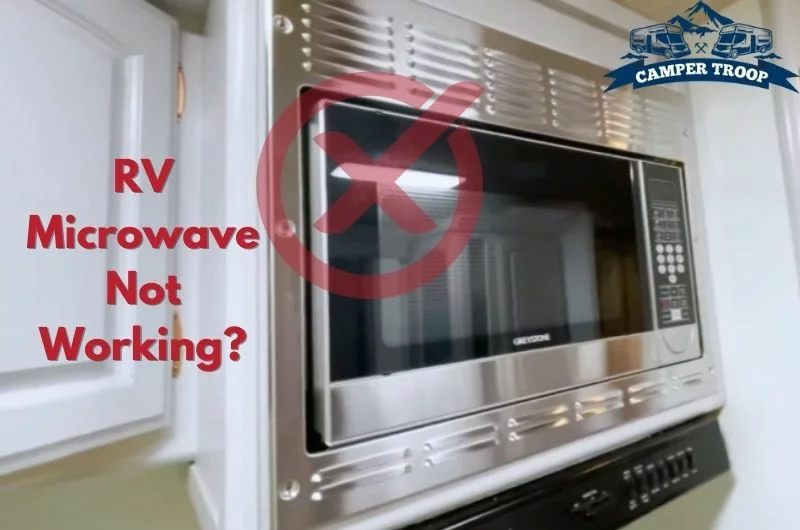
Why Is the RV Microwave Not Working?
These are the usual causes, listed roughly from most likely and easiest to check to least likely and hardest to fix:
- No 120V AC power from shore power, the generator, or the inverter.
- A tripped breaker in the RV’s 120V AC distribution panel.
- A tripped GFCI outlet on the same circuit.
- A bad outlet or a damaged or loose microwave cord.
- Poor venting that lets the unit overheat.
- A blown microwave fuse inside the unit.
- A bad door switch.
- A faulty magnetron.
- Incorrect installation.
What Do Common Symptoms Point To?
- Dead display, nothing works: power source, breaker, GFCI, outlet, cord, or the internal fuse.
- Runs but won’t start when the door closes: a door switch.
- Light, fan, and turntable run but food stays cold: a high-voltage part such as the magnetron. Call a technician.
- Shuts off during use: overheating from blocked vents, or a breaker tripping from too much load.
- Sparks or arcing inside: stop using it and have it inspected.
- Error code on the display: look up the code in the owner’s manual for your model.
If you have a convection microwave or a combo unit, the same power checks apply first. For problems with convection mode only, check the manual or the manufacturer, since these units have extra parts.
Read Also: RV Refrigerators Not Cooling In Hot Weather – How To Fix?
Is It Safe to Open an RV Microwave?
Not without training. A microwave’s high-voltage capacitor can hold a dangerous, possibly lethal charge for minutes or longer after you unplug it, especially in a unit that isn’t working. It must be safely discharged and checked with a meter before anyone touches anything inside.
Do the outside checks yourself: power, breaker, GFCI, outlet, cord, and vents. If those are fine, stop and call a qualified appliance or RV technician for the fuse, switches, and magnetron.
How to Fix a RV Microwave Not Working Problem?
Work through these checks in order. Most problems are solved in the first three.
Check the Electrical Power Supply to the Microwave
RV microwaves run on 120V AC. They will not run on 12V DC battery power alone. You need shore power, a running generator, or an inverter that is switched on and large enough to handle the microwave.
- Make sure the RV is plugged into a working pedestal, or the generator is running.
- If you use an inverter, confirm it is on and rated for the microwave’s draw (check the microwave’s label).
- Test another 120V outlet or appliance. If nothing works, the problem is the power source, not the microwave.
Read Also: 3 Prominent Reasons Why RV Furnace Runs with Thermostat Off
Flip Microwave Circuit Breaker off and Back On
A tripped circuit breaker cuts all power to your RV microwave. Check it whenever the microwave shows no power.

Source: https://youtu.be/8i3iYtQOih4
The microwave’s breaker is in the RV’s own 120V AC distribution panel, not a home breaker box. Use the owner’s manual to find which breaker serves the microwave.
- Turn off the appliances on that circuit.
- Find the microwave breaker in the RV’s distribution panel.
- Reset it by hand: push it fully off, then back on.
- Try the microwave again.
This only helps if a tripped breaker was the problem. If it trips again, the circuit is overloaded or has a fault.
Why Does the Breaker Trip When I Use the Microwave?
Usually because too many high-draw appliances are running at once. Running the air conditioner and microwave at the same time can overload an RV circuit, especially on 30-amp service. Most RVs have 30- or 50-amp service, and the amp draw on a circuit should stay below that breaker’s rating.
Turn off the AC, electric water heater, or space heater while the microwave runs. If the breaker still trips with only the microwave on, have the circuit or the microwave checked.
Check for a Tripped GFCI Outlet
RV GFCI outlets are required in the bathroom, on the exterior, and within six feet of a water source. Some RVs share a circuit between a GFCI and other outlets, so a trip can cut power elsewhere. If one trips, unplug everything connected to it and press the Reset button, usually marked “R.”
Check and Replace the Bad Electric Outlet
If the outlet the microwave plugs into is bad, the microwave gets little or no power. A power surge can damage an outlet.
Plug a small appliance into that outlet to test it. If it is dead, damaged, or shows burn marks, have it repaired before using the microwave.
Read Also: Why RV Furnace Shuts off After 30 Seconds & How to Fix it?
Check and Replace the Broken Cord Microwave Cord
A damaged, broken, or loose power cord means no power reaches the microwave.
Make sure the cord is fully plugged into the RV outlet. Then look for cuts, crushing, or melted spots. If the cord is damaged, stop using the microwave and have the cord replaced by a technician, since it connects to the inside of the unit.
Ensure Smooth Ventilation for the Microwave
An overheated microwave can shut off or stop working. In most cases, an RV microwave overheats because of poor ventilation.
Keep the vents clear of clutter and grease, clean the unit regularly, and make sure the vent fan runs. Let it rest between long cooking sessions.
Check and Replace the Bad Fuse
An electrical overload or short circuit can blow the microwave’s fuse. When this happens, the microwave won’t have any electrical power.
Microwaves have a main line fuse inside the unit, and some also have a controller or monitor fuse. The RV’s distribution panel holds the breaker for the circuit, not the microwave’s fuse. A technician can check the fuse with a multimeter after unplugging the unit and discharging the capacitor. A blown fuse often points to another failed part, so it is worth finding out why it blew.
Check and Replace RV Microwave Bad Door Switch
If a door switch fails, the microwave thinks the door is open and won’t start.
Microwaves usually have three door interlock switches: primary interlock, door sensing, and interlock monitor. The exact number varies by model, so check the model’s service manual. Testing them means opening the case, so the unit must be unplugged and the high-voltage capacitor safely discharged and checked with a meter first. This is a job for a technician unless you are trained in microwave repair.
Read Also: RV AC Unit Humming But Fan Not Running – Why & How To Fix?
Why Does My RV Microwave Run but Not Heat?
If the light, fan, and turntable work but food stays cold, the high-voltage circuit is the likely problem. The magnetron inside the microwave makes the heat, and a failed magnetron is a common cause.

Source: https://youtu.be/A631Jb4rT9s
Magnetron diagnosis and replacement means working on the high-voltage circuit, which can be lethal. Most RV owners should leave it to a qualified appliance or RV technician. The video below shows what the check involves, so you know what a technician will do.
A magnetron part alone costs about $50 to $200. Professional replacement usually runs about $100 to $400 installed, and most estimates fall between $100 and $300.
| Components | Replacement Cost |
| Magnetron (part only) | $50-$200 |
| Magnetron (professionally installed) | $100-$400 |
| Fuse, door switch, or cord | Varies by model; ask a technician for a quote |
Should You Repair or Replace an RV Microwave?
Compare the repair quote with the price of a new unit that fits your cabinet. If the repair costs close to what a new microwave costs, or the unit is old and has failed before, replacing it usually makes more sense. A cheap part on a newer unit is usually worth repairing.
Before paying for anything, check the warranty. Contact the RV manufacturer or the microwave maker with the model and serial number from the unit’s label. You will also need that number to order the correct parts or a replacement that matches the cabinet cutout.
How to Replace an RV Microwave if It Cannot Be Fixed?
Have a technician confirm the unit can’t be fixed first. Then follow these steps:
- Step 1: Unplug the power cord of your microwave.
- Step 2: Remove the screws and bolts that hold the microwave.
- Step 3: Remove the microwave away from the cabinet with the help of a person.
- Step 4: Place the paper template of the new microwave inside the cabinet.
- Step 5: Put the new microwave in place in accordance with the manufacturer’s instructions.
- Step 6: Plug and test the new microwave.
This video shows the replacement process in an RV.
FAQs
Here are answers to a few common RV microwave questions.
How to Avoid RV Microwave Overheating?
Microwave overheating is something you shouldn’t tolerate as an RV owner. The best thing you can do here is to check whether your RV has proper venting. Additionally, you should have regular intervals while using the microwave for an extended period.
How Do You Reset Your RV Microwave?
Reset steps vary by model, so check your owner’s manual first. If the microwave lost power, reset the tripped breaker in the RV’s 120V distribution panel or the tripped GFCI outlet on that circuit. If it trips again, have the circuit or microwave checked.
How Much Does It Cost to Replace a Bad RV Microwave?
The cost depends on the type and size of microwave your RV needs, plus labor if you hire a technician. Use the model number to find a unit that matches your cabinet cutout, and compare that price with any repair quote.
Read Also: What To Do When Rv Furnace Clicking But Not Lighting?
Final Words
Start with the easy outside checks: power source, RV breaker, GFCI, outlet, cord, and vents. Those fix most dead microwaves.
If the problem is inside the unit, stop there. The high-voltage capacitor can stay charged after unplugging, so leave the fuse, switches, and magnetron to a qualified technician.