Your RV transfer switch is wired between the shore power inlet, the generator, and the main breaker panel. Physically, some coaches mount it on or right next to the power center, and others put it in a separate bay or cabinet. The fastest way to find it is to trace the shore power cable from its inlet.
The switch decides whether your RV runs on shore power or generator power. Because every coach is laid out differently, it can be hard to find when you need to check or replace it. Here’s where to look and what to do once you find it.
What Is an RV Transfer Switch?
An RV transfer switch is an electrical device that picks the power source for your RV’s 120V (or 120/240V) system. It feeds either shore power or generator power to the breaker panel, never both at once.
With an automatic transfer switch (ATS), both the shore cord and the generator connect directly to the switch. A logic control system then selects the source on its own. You don’t have to plug your shore cord into a separate box to use the onboard generator.
Read Also: RV Slide Out Relay Location: Everything You Need to Know!
Where Is an RV Transfer Switch Located?
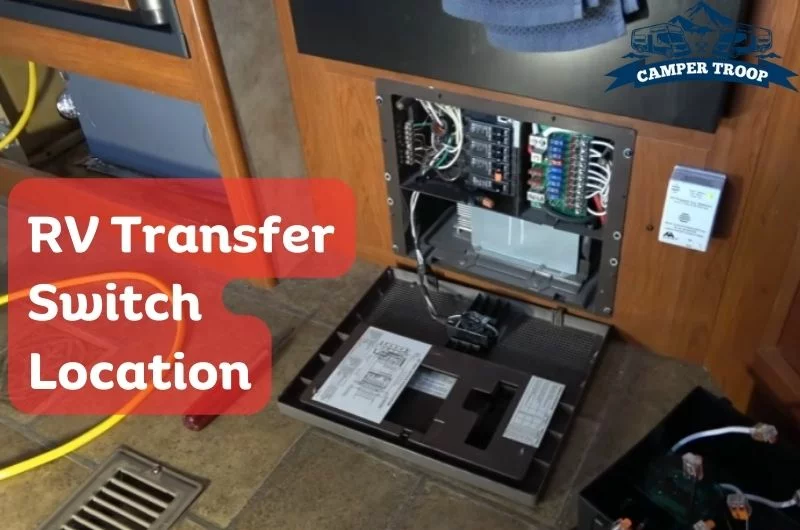
Electrically, the transfer switch always sits upstream of the main breaker panel. Physically, it varies by model and year. Some coaches mount it on or right next to the power center. Others put it in a separate storage bay, cabinet, or compartment.
Your RV type also matters. Motorhomes with a built-in generator usually have a transfer switch. Generator-ready trailers and fifth wheels may have one waiting for a future generator. Trailers without a generator may not have one at all.
How to Find It Step by Step
- Check your owner’s manual or wiring diagram for the switch location.
- If the manual doesn’t show it, contact the RV manufacturer with your model and year.
- Find where the shore power cord enters the RV or is stored.
- Follow that heavy cable inside until it meets a metal box. That box is usually the transfer switch.
- If you have a generator, trace its output cable too. Both cables should end at the same box.
- Look at the box label for the brand and model number. Progressive Dynamics, Southwire/Surge Guard, and Parallax are common in RVs.
If you can’t trace the cables, check common hidden spots: under the bed platform, under a bathroom vanity drawer, near the generator compartment, or behind a screwed-on access panel. Don’t open the switch box itself while any power source is connected.
Read Also: Where Is the Air Governor Located & How Does it Work?
What Types of Transfer Switches Do RVs Use?
You may see transfer switches sorted into manual, non-automatic, and automatic. That split comes from home and commercial standby systems (NEC Article 702). RVs usually have one of two setups.
Automatic Transfer Switch
This is a relay- or contactor-type switch. Shore power and generator both wire into it, and its logic control picks the source on its own. You don’t press a lever or a button.
Manual Setup
Some RVs have no true transfer switch. Instead, you plug the shore cord into a generator receptacle inside a compartment when you want generator power. Others use a manual selector switch that you flip yourself.
What Size Transfer Switch Does Your RV Need?
The switch rating must match your RV’s service. For example, Progressive Dynamics makes the PD5100 series for 30-amp / 120 VAC RVs. Its PD52 series is for 50-amp / 240 VAC RVs and has a 70-amp neutral rating. The wire gauge must also match the service size.
Read Also: RV 12-volt System Not Working When Plugged In: How to Fix?
How Long Does an RV Transfer Switch Take to Switch to the Generator?
An ATS doesn’t switch the moment the generator starts. Progressive Dynamics’ PD52 troubleshooting guide says there is a 20–45 second delay before the switch moves the RV onto generator power. This gives the generator time to stabilize. It is normal, not a fault.
How Do You Know If Your RV Transfer Switch Is Bad?
Watch for these signs:
- No power on generator, shore, or both, even though the source is working.
- No switchover well after the normal delay has passed.
- A chattering or buzzing relay.
- A burning smell, or burnt or loose terminals in the box.
A technician confirms the problem with a multimeter by checking voltage going into the switch and voltage coming out. If input is present but output isn’t, the switch is likely at fault. Because this means measuring live 120/240V terminals, leave it to a qualified person if you aren’t trained. On the PD5100, a failed circuit board can be swapped without removing the whole unit, thanks to its quick-change board.
Installing or Replacing an RV Transfer Switch
This is not a simple DIY job. A transfer switch carries 120/240V AC, and live terminals can cause a serious shock. The manufacturer’s manual says a licensed electrician or qualified RV technician should install it. RV wiring also falls under NEC Article 551.
If you hire someone, this is how a safe replacement should go:
- Unplug the shore power cord.
- Shut off the generator and lock it out so it can’t start.
- Turn off the inverter, if your RV has one.
- Disconnect the batteries.
- Confirm with a meter that no voltage is present.
- Label every wire before removing the old switch.
- Mount a new switch with the same amp rating as your RV’s service.
- Reconnect the wires to match the labels, including the ground, then tighten all terminals.
- Restore power and test on both shore power and generator.
Final Words
Start with your manual, then trace the shore power cable to find your transfer switch. If you notice burning smells, loose terminals, or no power from a working source, call a qualified RV technician. The same goes if you still can’t find your RV transfer switch location.
Read Also: How to Reset Power Outlet Without Reset Button?
Frequently Asked Questions
Why won’t my RV switch over to generator power?
First, wait. An automatic transfer switch normally waits 20 to 45 seconds after the generator starts before it switches over. If nothing happens well after that delay, the switch may be failing. A qualified technician can confirm this by checking whether voltage reaches the switch but doesn’t come out of it.
Does every RV have an automatic transfer switch?
No. Motorhomes with a built-in generator usually have one. Generator-ready trailers and fifth wheels may have a switch installed for a future generator. Trailers without a generator may have none. Some RVs use a manual setup instead, where you plug the shore cord into a generator receptacle or flip a selector switch yourself.
How do you test an RV transfer switch with a multimeter?
A technician measures the voltage going into the switch and the voltage coming out. If input voltage is present but there is no output, the switch is likely bad. This test means measuring live 120/240V terminals. If you aren’t trained to work on live AC circuits, leave it to a qualified person.
Is it safe to open the RV transfer switch box?
Only after all power is off. Never open the box while any source is connected. Unplug the shore cord, shut off and lock out the generator, and turn off the inverter if you have one. Then disconnect the batteries and confirm with a meter that no voltage is present.
Can I replace an RV transfer switch myself?
It isn’t a simple DIY job. The switch carries 120/240V AC, and live terminals can cause a serious shock. Manufacturers say a licensed electrician or qualified RV technician should install it. RV wiring also falls under NEC Article 551. The new switch must match your RV’s amp rating.