If your outlet tester says hot and neutral are reversed but the outlet looks wired correctly, the fault is often upstream, at another outlet, a junction box or the panel. In an RV, it can also come from the campground pedestal. Confirm the reading with a meter, then move the miswired wires to the correct terminals with the power off.
What does “hot and neutral reversed but wired correctly” mean?
Reversed polarity means the hot wire ends up on the outlet’s neutral terminal and the neutral wire on the hot terminal. When wires are reversed but the outlet in front of you looks right, the swap happened somewhere else on the circuit. That can be at an earlier outlet, a junction box, or the panel. In an RV, it can be at the shore power pedestal.
This fault often shows up where outlets or fixtures were replaced by someone without electrical training.
Why is reversed polarity dangerous?
A device plugged into a reversed outlet still gets normal voltage, about 120 V. The danger is that the device’s switch now opens the neutral instead of the hot. So parts like heating elements or a lamp’s metal socket stay at 120 V even when the device is turned off.
The main risk is electric shock. For example, you could get shocked touching the metal shell of a lamp socket while changing a bulb, or touching the elements of a switched-off appliance.
How do you confirm reversed polarity?
Start with a plug-in outlet tester. Its lights will show “hot/neutral reversed” if polarity is wrong. A tester can only flag reversed polarity reliably on a properly grounded three-prong outlet. On an ungrounded outlet, it can’t tell whether polarity is correct.
To confirm, use a multimeter set to AC volts. Compare your readings to this table, based on Fluke’s receptacle guidance:
| Test | Correct wiring | Hot and neutral reversed |
|---|---|---|
| Hot to neutral | About 120 V (108–128 V) | About 120 V |
| Hot to ground | About 120 V | A few volts |
| Neutral to ground | Near 0 V (up to 2–3 V under load) | About 120 V |
Note that hot to neutral reads about 120 V either way. That’s why you need the readings to ground to spot the problem.
What safety precautions should you take?
- If you are not comfortable working on wiring, call an electrician before making any changes. Improper wiring can cause electrocution.
- Turn the power off at the breaker or fuse box before touching any wires. In an RV, also unplug from shore power and turn off the inverter.
- Confirm the power is off with a tester. Ordinary rubber gloves are not rated for electrical work. Only voltage-rated insulating gloves protect against shock, so work only on circuits you’ve verified are dead.
Read Also: How to Reset Power Outlet Without Reset Button?
Hot and Neutral Reversed But Wired Correctly: How to Fix It?
The fix is simple only when the outlet itself is miswired. If the outlet’s terminals look correct but the tester still shows reversed polarity, you’ll need to trace the wiring upstream.
Step 1: Turn off the Power Supply
Turn off the breaker for that circuit. In an RV, unplug from shore power and turn off the inverter. Unplugging the appliances from the outlet does not turn off its wiring.
Check with a tester that the outlet is dead before you move on.
Step 2: Remove the Outlet From Its Box
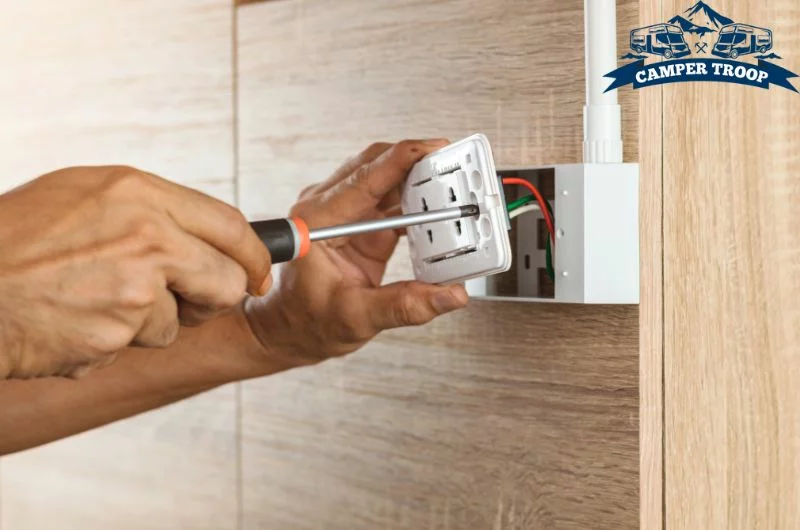
Take off the cover plate. Remove the screws that hold the outlet in the box, and gently pull the outlet out so you can see the wires.
Read Also: How to Replace an RV Shower Pan? [Step By Step Process]
Step 3: Identify the Wires
Check each wire against the standard color and terminal rules:
- Hot (black) goes to the brass screw.
- Neutral (white) goes to the silver screw.
- Ground (bare or green) goes to the green screw.
Also check wires pushed into the back holes of the outlet (back-stabbed). A swap there is easy to miss.
Step 4: Change the Wires Accordingly
If the outlet is miswired:
- Disconnect the hot and neutral wires from their terminals.
- Connect the hot (black) wire to the brass terminal and the neutral (white) wire to the silver terminal.
- Put each wire under its terminal screw and tighten it, or use the outlet’s approved clamp or back-wire holes. Wire nuts are only for joining wires to each other, such as for pigtails.
Step 5: Trace the Fault Upstream if the Outlet Looks Right
If the outlet is already wired correctly, the swap is earlier on the circuit. With the power off, check the outlets that feed this one, then any junction boxes, then the panel. This tracing often takes an electrician.
Step 6: Reinstall the Outlet and Retest
Push the outlet back into the box, screw it in and replace the cover plate. Turn the power back on. Retest with your outlet tester and multimeter. Neutral to ground should now read near 0 V.
Read Also: Where Is the Air Governor Located & How Does it Work?
How do you check an RV pedestal for reverse polarity?
Test the campground pedestal before you plug in. With a meter, hot to neutral and hot to ground should both read about 108–128 V. If neutral to ground reads about 120 V, polarity is reversed and you should not plug in. A floating ground at the pedestal can also cause a “hot skin” condition, where the RV body becomes energized.
Does an RV surge protector protect against reverse polarity?
A basic surge protector does not. It only guards against high-voltage surges. An EMS (electrical management system) also protects against reverse polarity, open neutral, open ground and low voltage. It can refuse to pass bad power to your RV. Camping World gives an acceptable pedestal range of 108–132 V, with 120 V preferred.
Read Also: Rhinoflex Vs Revolution: Which One Should You Pick and Why?
FAQs.
Reversed polarity is often found where outlets or fixtures were replaced without proper training. Here are some FAQs for this situation.
What is the difference between a hot/ground reverse and a hot/neutral reverse?
A hot/ground reverse means the hot and the equipment ground wire are swapped, which can energize the grounding system. A hot/neutral reverse means the hot and neutral are swapped. Both are caused by miswiring, for example during installation, outlet replacement or DIY work.
Will reverse polarity trip a breaker?
Do not count on a breaker to catch it. Reversed polarity can let current flow through metal surfaces that should not be energized, so use an outlet tester or multimeter to find it.
What happens to the current when the polarity is reversed?
In AC, current changes direction 60 times a second whether or not polarity is reversed. Reversal changes which wire sits at 120 V to ground, so a device’s switch and outer metal parts end up on the wrong side of the circuit. That creates a shock risk.
Are There Any Other Considerations for Hot and Neutral Reversed But Wired Correctly?
If you need more confidence to identify and connect the hot and neutral wires, it is preferable to engage a professional electrician to complete the task. They can quickly and safely diagnose and repair the problem.
When should you call an electrician?
Fixing one miswired outlet is a short job. But if the outlet looks correct and the tester still shows reversed polarity, the fault is upstream and harder to find. Call a licensed electrician if you can’t trace it, if the problem is in the panel, or if you aren’t trained to work on live circuits.
Workplace electrical rules also forbid this fault. OSHA’s 29 CFR 1910.304 bars connecting the grounded (neutral) conductor in a way that reverses polarity.
At a campground, don’t fix the pedestal yourself. Don’t plug in, and report it to the campground staff.
Read Also: Why Bigfoot Levelers Won’t Retract & How to Fix This Issue?