Quick answer: A Forest River furnace usually stops working because of low 12-volt battery power, a propane supply problem, a blown fuse, blocked airflow or vents, a bad sail or limit switch, a dirty flame sensor, or a control board in lockout. Check power, propane and airflow first. Then read the board’s blink code.
If you own a Forest River RV and plan a long winter trip with friends, the furnace is what keeps everyone warm on cold nights. That only works if the furnace works.
A furnace may stop working if one of its parts fails. Common causes are a faulty thermostat, a propane supply problem, electrical issues, a bad relay or blower motor, a faulty ignitor, a problem with the circuit board, and a lack of 12-volt power.
So, every time you plan a long trip, you should inspect your furnace. To help you get ready, this guide explains how the furnace works, why it stops working, how to read its fault codes, and how to fix it safely.
How Does the Forest River Furnace Work, and What Are Its Components?
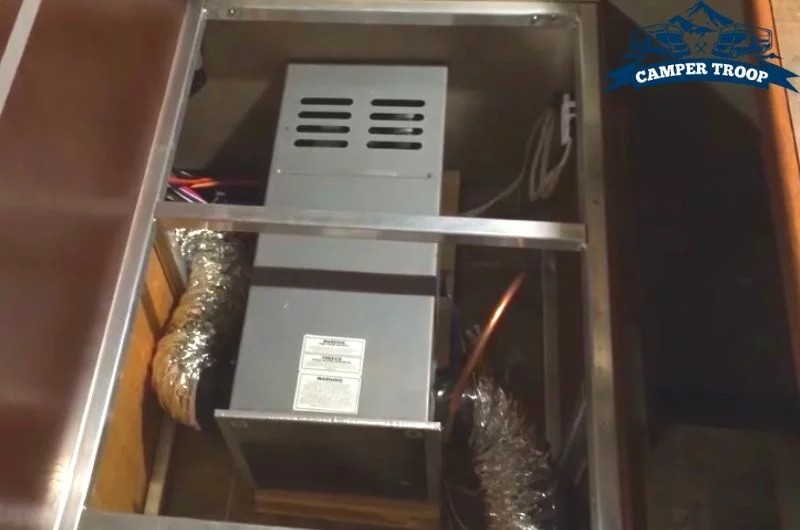
The Forest River furnace has several parts. A problem with any one of them can affect how the whole furnace runs. Often, the furnace will stop working.
Key parts are the thermostat, the control (circuit) board, the blower relay and motor, the sail switch, the limit switch, the gas valve, and the ignitor. If any of these parts fail, the furnace probably won’t heat.
To understand why it might stop, it helps to know the order things happen in. Here is the step-by-step sequence of a Forest River furnace.
- Step One – The thermostat calls for heat.
- Step Two – The circuit board receives the signal.
- Step Three – A relay on the circuit board processes the signal and activates the blower motor.
- Step Four – The fan comes up to full speed.
- Step Five – Two safety switches check conditions. The sail switch confirms there is enough airflow. The limit switch checks that the temperature has not gone too high.
- Step Six – Both switches must be closed before the board moves on. If either one is open, the gas valve stays shut.
- Step Seven – When both switches are closed, the gas valve opens. At this point, the ignitor receives the required signal from the circuit board and makes a spark. The spark ignites the propane, and the heat is then distributed throughout the RV through ducts.
This order matters for troubleshooting. If the fan runs but you never get heat, the problem is usually at Step Five or later: airflow, switches, propane or ignition.
Read Also: Forest River Battery Disconnect Switch Location and Purpose
Which Furnace Brand Is in My Forest River RV?
Forest River does not build its own furnaces. It installs units from RV furnace makers, most often Suburban or Dometic (Dometic bought Atwood, so older units may say Atwood). The brand matters because each one uses different fault codes and reset steps.
To identify yours:
- Look for the data plate or label on the furnace. You can often see it after removing the inside access cover.
- Check the outside vent cover. It often carries the maker’s name.
- Look in the appliance manuals that came with your RV, or ask your Forest River dealer with your VIN.
Write down the brand and model number. You will need them to read fault codes, order parts, or file a warranty claim.
What Should You Do If You Smell Propane?
If you smell propane, do not try to light or troubleshoot the furnace. Do not check the ignitor while you can smell gas. Instead:
- Shut off the furnace at the thermostat.
- Turn off the LP supply at the tank.
- Open windows and roof vents.
- Keep sparks and flames away. Do not flip switches or light anything.
- Call an RV professional to check for leaks.
This advice comes from Camping World’s furnace maintenance guide.
Your RV’s LP and carbon monoxide (CO) detectors are your backup. Test them before each trip and never disable them. If a CO alarm sounds, get everyone outside into fresh air first, then figure out the cause.
When not to DIY: leave gas valve, regulator and gas line repairs to a trained RV technician. Simple checks like power, fuses, propane level, resets and clearing vents are fine for most owners.
Why is the Forest River RV Furnace Not Working?
Now that you know how the furnace works, you can see where something could go wrong. Here are the most common causes.
Problem With the Thermostat
The furnace only makes heat. The thermostat sets the target temperature and turns the furnace on and off. On a combined thermostat, the Heat/Cool or mode setting switches between the furnace and the roof air conditioner. It does not switch the furnace between hot and cold air.
When the thermostat malfunctions, the furnace won’t get the signal to start. If the thermostat has any issues, the furnace will not work.
Some of the most typical symptoms of a faulty thermostat are inaccurate temperature readings, black displays, a lack of response, failure to adjust the temperature, and error codes.
Before blaming the thermostat, make sure it is set to Heat (or Furnace), not Cool, and that the set temperature is above the room temperature. Then test it, find the cause, and fix the issue.
Issue With the Gas Line
The Forest River furnace needs both propane and 12-volt electricity to run. A problem with either one will likely stop it from heating.
Begin by making sure the gas is turned on. Then make sure the furnace is getting gas. Check these points:
- Tank level: Make sure the tank is not empty and the tank valve is fully open.
- Other appliances: Try the stove. If it won’t light or has a weak flame, the problem is the propane supply, not the furnace.
- Regulator: Low or unsteady gas pressure can keep the furnace from staying lit. Regulator testing and replacement is a job for a technician.
- Air in the lines: After a refill or tank swap, air can get into the lines. A common fix is to light a stove burner and let it run until the flame is steady. Then cycle the thermostat so the furnace tries again.
Any lack of gas supply will probably keep the furnace from lighting. So, check that the propane supply is on and working as it should.
Read Also: Forest River Slide Out Seals: Types & Replacement Guideline
Electrical Issue
Any electrical issue can keep the heating system from turning on. Electrical issues include a malfunctioning circuit board, relay, switch, wiring, or a blown fuse.
For instance, the furnace won’t light if the ignitor does not receive the electric signal from the board.
Start with the easy checks. Find the furnace fuse in your RV’s 12-volt fuse panel and look for a broken element. Replace a blown fuse with one of the same amp rating. If the new fuse blows right away, stop and have the wiring checked. Also make sure the furnace’s power switch (if it has one) is on and the battery disconnect is not off.
Lack Of Power in Power Source
The Forest River furnace runs on 12 volts DC. When a furnace doesn’t work, it may be because the battery or converter isn’t providing enough power. In this situation, you should make sure the battery has enough charge.
To test it, set a multimeter to DC volts. Touch the red probe to the battery’s positive post and the black probe to the negative post. A low reading means the battery needs charging before the furnace will run well. Low voltage can let the fan spin slowly, so the sail switch never closes and the burner never lights. Check your furnace manual for its minimum voltage rating.
Either Relay or the Motor is Bad
The relay on the Forest River furnace’s circuit board turns on the blower fan.
When the relay malfunctions, the blower fan won’t run properly. Check the relay, especially when the thermostat is calling for heat but the blower fan is not running.
However, if the relay works, the fan itself has an issue. More specifically, there may be a problem with the blower wheel or blower motor.
If the fan won’t spin, spins slowly, or sounds rough while the relay is working, the blower motor or wheel is the likely problem. Rule out low battery voltage first, since it can make a good motor run slowly.
Read Also: Forest River Water Pump Not Working: Reasons And Solutions
Ignitor Issue
If the fan runs and the furnace gets gas but never lights, the ignitor or flame-sense electrode may have a problem. Modern RV furnaces use direct-spark ignition and sense the flame with an electrode, not a thermocouple. A dirty or worn electrode can stop the burner from lighting or staying lit.
Important: if you smell gas, do not check the ignitor. Shut off the furnace and LP supply, air out the RV, and call a professional, as explained in the safety section above.
Issue With the Control Board
The control board is the brain of the furnace. It sends signals to the other parts and runs the safety checks. When it sees a fault, it may lock out the furnace and flash an LED code. The next section explains how to read those codes.
Blocked Return Air, Ducts or Exhaust Vent
RV forced-air furnaces are designed to run without an air filter. But dust, pet hair and blocked ducts still cut airflow. Low airflow can keep the sail switch from closing or make the limit switch trip from overheating.
Vacuum the return-air grille, open all floor and wall vents, and make sure nothing is stored against the furnace or its ducts. Outside, check the exhaust vent for insects, wasp nests and debris, and never cover it while the furnace is on.
Read Also: Forest River Slide Out Adjustment Guide | Follow These 9 Easy Steps
What Does a Blinking Light on My RV Furnace Mean?
A blinking LED on the furnace control board is a fault code. On Dometic (Atwood) boards, the number of flashes tells you what went wrong, according to Camping World’s furnace troubleshooting guide. You can usually see the LED after removing the inside access cover.
| LED signal | Meaning | Lockout type |
|---|---|---|
| Steady on | Control board has failed | Hard lockout |
| 1 flash | Limit switch or airflow problem | — |
| 2 flashes | Flame-sense fault | Hard lockout |
| 3 flashes | Ignition lockout | Soft lockout (retries after 1 hour) |
| 4 flashes (some boards) | High voltage | — |
| 5 flashes (some boards) | Low voltage | — |
A soft lockout clears once you fix the problem and cycle the thermostat or power switch. A hard lockout needs a manual reset: turn the thermostat or power switch off, then back on.
Suburban furnaces work a little differently. The board tries to light 3 times. If all 3 tries fail, it locks out. It also locks out if the sail switch does not confirm airflow within 30 seconds, or if the limit switch stays open for 5 minutes.
How Do I Reset My Forest River RV Furnace?
Most furnace resets are a simple power cycle. Fix the cause first, or the furnace will lock out again.
- Make sure you do not smell propane. If you do, stop and follow the safety steps above.
- Note the LED blink code, if your board has one.
- Fix the likely cause: charge the battery, refill propane, clear the vents, or replace a blown fuse.
- Turn the thermostat (or the furnace power switch) off.
- Turn it back on and set the temperature above room temperature.
- For a Suburban furnace, turn the furnace’s power off and back on to clear the lockout.
- Listen for the fan, then the burner lighting. If it locks out again, move on to the troubleshooting table below or call a technician.
Why Is My RV Furnace Blowing Cold Air?
If the fan runs but the burner won’t light, the furnace blows cold air. The fan is working, but something is stopping ignition. Common causes:
- Empty propane tank, closed tank valve, or air in the lines
- Low battery voltage, so the fan spins too slowly to close the sail switch
- Blocked return air or ducts, which keeps the sail switch open
- A dirty or faulty ignitor or flame-sense electrode
- The board is in ignition lockout after failed attempts
Check the blink code, then work through propane, voltage and airflow in that order.
Why Does My RV Furnace Keep Shutting Off or Won’t Stay Lit?
A Forest River furnace usually fails to stay lit because of a dirty or faulty flame-sense/ignitor electrode, low or unsteady propane supply or pressure, low 12-volt voltage, a sail switch problem, or restricted airflow that trips the limit switch. A thermostat fault can also cause it.
Short cycling (turning on and off quickly) often points to airflow. When air can’t move through the furnace, heat builds up and the limit switch shuts the burner off. Clear the return-air grille, open the vents, and check the outside exhaust before you suspect a part.
In What Order Should You Troubleshoot an RV Furnace?
Work from the easiest and safest checks to the hardest. Use this table as a guide.
| Symptom | Check first | Then check |
|---|---|---|
| You smell propane | Stop. Shut off furnace and LP, ventilate | Call an RV technician |
| Nothing happens at all | Thermostat set to Heat, battery charge, fuse, power switch | Thermostat wiring, control board |
| Fan doesn’t run | Battery voltage, fuse | Relay, blower motor or wheel |
| Fan runs, no heat (cold air) | Propane level and valve, blink code | Sail switch, ignitor, flame sensor |
| Lights, then shuts off | Return air, vents, outside exhaust | Flame sensor, gas pressure, limit switch |
| LED blinking | Read the code table above | Fix cause, then reset |
How Much Propane Does an RV Furnace Use per Hour?
A 30,000 BTU RV furnace burns about 0.33 gallons (about 1.4 lb) of propane per hour of nonstop burning, according to Camping World. Real use is lower, because the furnace cycles on and off. At a 40–50% duty cycle, that works out to about 0.13–0.16 gallons per hour.
To estimate your own furnace, divide its input BTU rating by about 91,500. That gives gallons per hour of nonstop burning. The actual amount depends on furnace size, outside temperature, insulation and your thermostat setting.
Does an RV Furnace Run on Battery or Shore Power?
Both, through the 12-volt system. The Forest River furnace burns propane for heat, but its fan, board and ignitor run on 12 volts DC. That power comes from the battery or from the converter.
When you are plugged into shore power, the converter supplies 12 volts. When you are dry camping, the battery does. The blower fan is the biggest electrical load, so a weak battery is a common reason the furnace quits overnight off-grid.
Does an RV Furnace Need an Air Filter?
No. RV forced-air furnaces are designed to run without a filter. Adding one can void the warranty and create a hazard, because it can restrict airflow and cause overheating. To keep airflow up, vacuum the return-air grille and keep the ducts and vents clear instead.
What Furnace Maintenance Should You Do Each Year?
A short seasonal checklist prevents most no-heat calls:
- Use a portable air compressor to blow dust, debris, pet hair and insect nests out of the furnace exhaust tube.
- Check the outside vent for wasp nests, spider webs and debris, especially after storage.
- Vacuum around the return-air vent (with the stove off).
- Open and clear all heat vents and ducts.
- Charge the battery and check its voltage with a multimeter.
- Fill the propane tanks and check that the stove lights normally.
- Test the LP and CO detectors.
- Run the furnace through a full heat cycle before your trip.
When Should You Call an RV Technician?
Call a qualified RV technician when:
- You smell propane or an LP or CO detector goes off.
- The board shows a steady LED (failed board) or keeps going into hard lockout.
- A fuse blows again right after you replace it.
- You suspect the regulator, gas valve or gas pressure.
- Battery, propane and airflow are fine, and the furnace still won’t heat.
If your RV or furnace is still under warranty, contact your Forest River dealer before taking the furnace apart or replacing parts yourself. Unapproved changes, such as adding a filter, can void the warranty.
Conclusion
A furnace that won’t work is frustrating, but most causes are simple. Make sure the furnace has good 12-volt power and that you have enough propane. Then read the blink code and reset the furnace.
In addition, keep the airflow to the furnace clear, with no blocked return air or ducts. The vent shouldn’t have a cover when the furnace is on.
If you smell propane, the most important thing is to stop. Shut off the furnace and LP supply, air out the RV, and call a professional to check for leaks. Last but not least, always check the furnace before a long trip.
Read Also: How To Fix Forest River Slide Out Problems
Frequently Asked Questions
What voltage does an RV furnace need to run?
A Forest River furnace runs on 12 volts DC. The battery or converter powers its fan, control board and ignitor. Low voltage can make the fan spin too slowly to close the sail switch, so the burner never lights. Check your furnace manual for its exact minimum voltage rating.
Why does my RV furnace fan run but the burner won’t light?
When the fan runs but the burner won’t light, something after the fan step is blocking ignition. Common causes are an empty tank or air in the propane lines, low battery voltage, or blocked airflow that keeps the sail switch open. A dirty ignitor or flame-sense electrode and an ignition lockout can also cause it. Read the blink code first.
Can a blown fuse stop my RV furnace from working?
Yes. A blown 12-volt fuse cuts power to the furnace, so nothing happens when the thermostat calls for heat. Find the furnace fuse in your RV’s 12-volt fuse panel. Replace it with a fuse of the same amp rating. If the new fuse blows right away, stop and have the wiring checked.
How do I get air out of my RV propane lines?
After a propane refill or tank swap, light a stove burner and let it run until the flame is steady. This clears air from the lines. Then cycle the thermostat so the furnace tries to light again. If the stove won’t light or burns weak, the problem is the propane supply, not the furnace.
Does a Forest River RV furnace use a thermocouple?
No. Modern RV furnaces use direct-spark ignition and sense the flame with an electrode, not a thermocouple. If the electrode is dirty or worn, the burner may not light or may not stay lit. Never check the ignitor while you can smell propane. Shut off the furnace and LP supply first.