Quick answer: Jayco Eagle owners often report four problems: roof leaks, a refrigerator that stops cooling, water leaks under the kitchen sink, and lifting floor or countertop laminate. Regular checks catch most of these early. Before you pay for repairs, check Jayco’s warranty and any open recalls. Never try to fix a gas or ammonia leak yourself.
Every RV requires maintenance & care irrespective of its quality. And the Jayco Eagle is no different. However, nobody can guarantee what issues you will encounter. To be on the safe side, you should familiarize yourself with the most common Jayco Eagle problems. It makes sense, right?
Owner reviews often mention leaky roofs, refrigerators not cooling, water leakage under the sink & lifted laminates. Some owners also complain about customer support and hard-to-follow warranty terms. You can’t fix those last two yourself, but this guide shows you how to use your warranty well.
In this article, we focus on the issues you can check or fix yourself. We also explain when to stop and call a pro. Don’t worry. You will get our step-by-step solution guide to save the day.
Sounds interesting? Then, let’s get right into it.
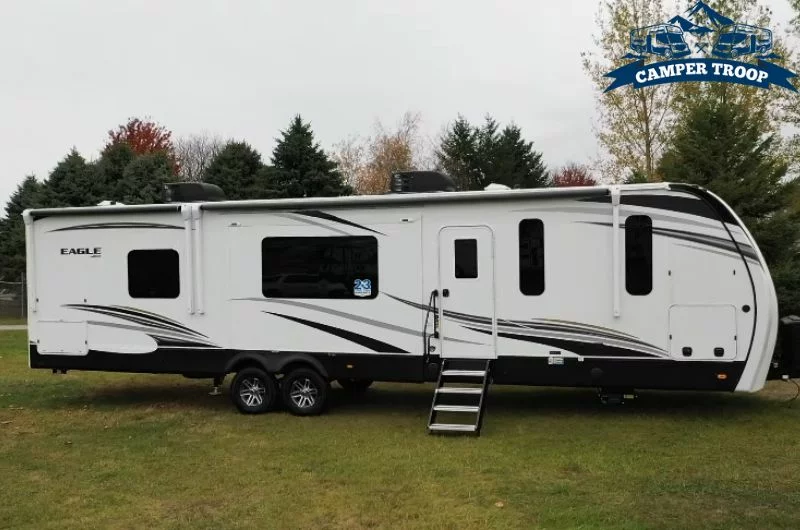
Which Jayco Eagle Models Does This Guide Cover?
This guide covers the Jayco Eagle travel trailers and fifth wheels, plus the lighter Eagle HT line. The problems below show up in owner reports across many model years. They are not tied to one year or one floorplan.
Equipment does change by year, and that changes how you troubleshoot. Two examples:
- Refrigerator: Older Eagles often use an absorption fridge that runs on propane or AC power. The 2026 Jayco Eagle HT travel trailer lists a GE black glass 10 cu. ft. 12V compressor refrigerator as standard.
- Roof: The roof membrane depends on the model year and floorplan. See the roof section below.
Your owner’s manual is the best source for what your exact unit has. Keep your VIN handy. You will need it for warranty claims, recalls and parts.
What Are The Common Problems With The Jayco Eagle?
The Jayco Eagle has established itself as an affordable & spacious RV over the years. But it’s not perfect. After going through a heap of reviews, we have picked the issues that appeared to be more frequent and severe. Have a look.
- Leaking Roofs
- Refrigerator Not Working
- Water Leakage Under the Kitchen
- Laminate Lifting
What Does the Jayco Warranty Cover?
Check your warranty before you start any repair. A DIY fix on a covered part can cost you money you didn’t need to spend.
Jayco towables, including the Eagle, come with a 2-year limited warranty and a 3-year structural warranty. Roof membranes often carry their own separate manufacturer warranty.
That matters for older RVs. As Camping World notes, the main RV warranty may run out while the roof membrane or air conditioner still has a 3- to 12-year manufacturer’s warranty. So check component warranties before you pay for repairs.
Decision rule:
- If the RV is still under Jayco’s warranty, contact your dealer or Jayco first. Take photos and write down when you found the problem.
- If the Jayco warranty has ended, look up the warranty for the part itself (roof membrane, fridge, A/C, water heater).
- Only start a DIY repair once you know no warranty applies, or the fix is small and won’t void coverage.
How Do I Check for Recalls on My Jayco Eagle?
Recall repairs are free, so check before you fix anything. Here is how:
- Find your 17-character VIN. It is on your registration, title and the label on the RV.
- Go to the NHTSA recall lookup at nhtsa.gov/recalls.
- Enter your VIN to see any open safety recalls on your unit.
- If a recall shows up, contact a Jayco dealer to schedule the repair.
Parts made by other companies, like fridges or furnaces, can have their own recalls. Check those makers’ websites too.
How Do You Troubleshoot and Fix Jayco Eagle Problems?
Troubleshooting requires identifying the issue, its cause, and a feasible solution. In this section, we will go through each of the problems and their causes in detail. Finally, we will suggest an easy remedy for you.
Problem 1: Leaking Roofs
Leaking roofs seem to be a problem with any other RV or camper. What appears to be a small crack might let the rain wet your bed and disturb you. Neglecting it will only cause bigger problems in the future.
What Kind of Roof Does a Jayco Eagle Have?
Current Jayco Eagle travel trailers list a 5 in. Magnum Truss roof with plywood decking and an Alpha Ply TPO membrane. Some dealer listings show a Dicor Diflexx III membrane instead.
The membrane depends on the model year and floorplan. Older units may use a different material. To find yours:
- Check the owner’s manual and the roof section of your warranty packet.
- Call Jayco customer service or your dealer with your VIN.
- Ask which lap sealant and primer the roof maker approves.
Do this before you buy sealant. The wrong product may not bond, and it could affect the roof warranty.
What Causes A Leaking Roof On A Jayco Eagle?
It’s not always a manufacturing defect. Sometimes the user doesn’t care for the vehicle enough and ends up damaging it for life. Here’s how a leak might appear:
- Branches falling on the roof.
- Dust, water, and debris get stuck in a small crack.
- Cracked or worn sealant around vents, skylights, the A/C unit and roof edges.
- Walking on or putting weight on the roof in ways the owner’s manual doesn’t allow.
How To Fix A Leaking Roof On A Jayco Eagle?
The easy method is to get a professional to inspect and fix it. If the roof is still under warranty, go that route first. But if you are in a hurry, here is our small guide for you.
Step 1: Inspection
First of all, identify the leakage along with its specific cause. Once you locate it, gently clean the area. Try to remove as much dirt from the cracks as possible.
Step 2: Pick A Sealant
After the initial stage, determine the roof construction material, because the type of sealant depends on the roof type.
For example, many current Eagles use a TPO membrane, while some units use a different membrane such as Dicor Diflexx III. Each roof material may need its own sealant and primer. Check the owner’s manual or ask Jayco before you buy.
Step 3: Apply The Sealant
You have to get the sealant recommended in the manual. Remember to apply the primer around that crack first, if the product calls for it.
Next, put the first coating of the approved sealant on it. If the crack is too big, use a seam tape to join the edges together.
Wait for the first layer to dry out before reapplying.
How Can You Prevent Roof Leaks?
Prevention is cheaper than repair. Follow the roof inspection schedule in your owner’s manual. A simple routine:
- Inspect all sealant every few months and before and after long trips.
- Look closely at seams, roof edges, vents, skylights and the A/C base.
- Touch up cracked or peeling sealant with a product that is compatible with your membrane and the old sealant.
- Watch inside for stains on the ceiling or soft spots near walls. These can be early leak signs.
How Much Does It Cost To Fix A Leaking Roof On Jayco Eagle?
The type of sealant you use will ultimately determine the price. For example, sealants for a fiberglass roof are more expensive than liquid rubber one.
Mechanic Cost: If you follow our method, you won’t have to pay additional labor charges. Just buy a primer and a bucket of sealant for less than $50.
Replacement Cost: To replace an RV roof, you need to pay around $300 per linear foot. Check the roof membrane warranty first. It may still be active after the main Jayco warranty ends.
Read Also: Common Jayco Seneca Problems & Solutions
Problem 2: Refrigerator Not Working
The purpose of getting an RV is to feel at home while traveling. But how are you going to do that if the refrigerator doesn’t work? All your supplies of food will go bad, and you might have to tolerate hunger till you reach the town. That sounds horrible.
What Does It Mean If My RV Fridge Smells Like Ammonia?
Safety first. An ammonia smell or yellow residue on the cooling unit means the cooling system is leaking. Dometic says to turn the fridge off if it is safe to do so, leave the area, and call a qualified service center. Do not keep restarting it.
If you smell LP (propane) gas, open the windows and call a qualified technician or gas supplier. A DIY reset is not a fix for a leak.
Make sure your LP detector works. Test it the way the owner’s manual says, and never ignore it when it alarms.
Which Type of Fridge Does Your Eagle Have?
The fix depends on the fridge type. Look at the label inside the fridge or check the manual.
| Fridge type | Power source | What to check |
|---|---|---|
| Absorption (common in older Eagles) | Propane or AC power | Propane supply, AC power, whether the RV is level |
| 12V compressor (standard on the 2026 Eagle HT travel trailer) | 12V DC power | Battery charge, fuses, breakers, 12V wiring |
A 12V compressor fridge has no propane or leveling step. If yours is a compressor model, skip the propane steps below.
What Causes Refrigerators To Stop Working On Jayco Eagle?
Just because the refrigerator is inside the RV doesn’t mean that it’s the manufacturer’s fault. It’s a common misconception, and many users unknowingly blame the brand. There are other reasons behind such disturbances. For example:
- There might be a lack of AC electricity supply due to a damaged circuit.
- Low battery voltage or a blown fuse (key for 12V compressor fridges).
- A leak in the cooling system. This needs a technician, not a reset (see the safety section above).
- Not having a Propane flow in the tank
How To Fix The RV Refrigerator On A Jayco Eagle?
Here is a quick check method to get the refrigerator back on track again. Remember that it will only work for minor issues. Don’t forget to ask for a mechanic’s help if the problem is more severe than this. Stop right away if you smell ammonia or propane.
Step 1: Check The Power Supply
Sometimes you might forget to plug the refrigerator into the main socket. So, the refrigerator shuts off because there is no electricity. All you have to do is plug it in as usual. Also check the breaker panel, the fridge fuse and your battery charge.
Step 2: Check The Propane Supply (Absorption Fridges Only)
If the first step doesn’t fix the issue, check the propane. Make sure the tank has gas and the tank valve is open. Then check the fridge’s control panel for a fault light or error code.
Step 3: Make Sure The RV Is Level (Absorption Fridges Only)
Absorption fridges need the RV to be level to work as designed. Level the trailer, then give the fridge time to cool.
Step 4: Follow The Reset Steps In Your Fridge Manual
Reset steps differ by brand and model. Use the steps in the fridge maker’s manual rather than a generic button trick. If a reset doesn’t clear the fault, call a technician.
Step 5: Switch On The Power Again
Finally, choose the power mode you want and check the cooling temperature inside the refrigerator after a few hours.
How Much Does It Cost To Fix The Refrigerator On A Jayco Eagle?
The checks we mentioned above need no money at all. But if they fail, you must contact a professional. Here’s how much it may cost.
Mechanic Cost: Repairing an RV camper requires skilled mechanics. The cost starts from $500 to $1,500.
Replacement Cost: It is very unlikely that your RV refrigerator needs a replacement. But, you can buy a replacement for around $1000 to $5000 if the current unit is obsolete. Check the fridge maker’s warranty and recalls before you pay.
Read Also: Common Jayco Seismic Problems & Solutions
Problem 3: Leak Under the Kitchen Sink
Another major issue users face with a Jayco Eagle RV is leakage under the sink. All of a sudden, you notice the pipe is continuously dripping water and wetting the floor.
What Causes Water Leakage On The Jayco Eagle?
Every kitchen has fittings and connections beneath the sink. If one is not tight enough, the water will find a way to keep flowing. As a result, you have to deal with a mini flood. Here are some reasons behind it.
- Cheap quality washers and seals
- Inefficient O-rings
- Debris or dust built up between the inlet and seal.
- Rusty inner parts of the faucet.
- Fittings that loosen over time from road travel.
How To Fix The Kitchen Sink On Jayco Eagle?
Fixing a faucet can be very difficult for a beginner. You can crack the faucet easily by applying too much pressure. That being said, here is a small tutorial to help you.
Step 1: Cut Off The Water Supply
Firstly, you have to turn off the water supply. In an RV, that means switching off the water pump and turning off or disconnecting city water. Then open the faucet to release the pressure.
Step 2: Disassemble The Parts
Now, disassemble all the parts for inspection. Use a flat screwdriver to pull everything out.
Step 3: Inspection
Once the cartridge has come off, look for defects. If it’s rusty or old, you must replace it with a new one.
Also, check whether the O-ring or washer is broken or not. If everything seems fine, clean up the area.
Step 4: Use A Teflon Ribbon/ Putty
Wrap Teflon pipe tape around threaded connections to help seal them. Make it tight. For a drain fitting, plumber’s putty can seal the gap. Carefully fill the gap and wait till it sets. If a pipe or fitting is cracked, replace it. Tape and putty are not a lasting fix for a crack.
As for reassembling, use the same tools to secure everything together. Turn the water back on and watch for drips for a few minutes.
How Much Does It Cost To Fix A Kitchen Sink On A Jayco Eagle?
If you follow the DIY method, you can get away with spending only $10 on the new pipe. However, you will require a toolbox and experience for that.
Mechanic Cost: Expect to spend at least $100 to $150 to get a professional mechanic’s help. You also have to buy a new faucet cartridge for $10 to $80.
Replacement Cost: Replacing the whole kitchen sink would cost you around $300. And, fixing the drainage system would be $150 at least.
Read Also: Common Jayco Pinnacle Problems & Solutions
Problem 4: Laminates Lifting
Many users have complained that the laminates started lifting within a short time. It can be in the form of wrinkles, warps, or straight-out lifting. It shows up in many owner reviews of the Jayco Eagle and can be a real letdown.
Is It Floor Laminate or Countertop/Wall Laminate?
“Laminate” can mean different things in an RV. The fix depends on which one you have:
- Floating laminate floor planks: Rigid boards that click together. Lifting often comes from moisture or no room to expand at the walls. Heat won’t fix these.
- Sheet vinyl flooring: Flexible flooring that can wrinkle or lift at edges.
- Countertop or wall laminate: A thin layer glued to a board. Edges can peel when the glue lets go.
Lifting wall laminate near windows or seams can also be a sign of a water leak. Find and fix the leak first.
What Causes Laminate Lifting On The Jayco Eagle?
So, what went wrong with the Jayco Eagle? You see, there are some pre-conditions to consider before laminating any area. Otherwise, the worst will happen. For example:
- No dehumidifier was present during the laminating process.
- The subfloor had more than 2% moisture during the layout. Once the moisture evaporated, the laminates started bundling up.
- Manufacturers install the laminates tightly against the wall & don’t leave any room for expansion.
How to Fix Laminates On Jayco Eagle?
If you want to give it a try before calling an expert, here is the process. These heat steps are for flexible sheet vinyl and peeling countertop or wall laminate edges. For a floating plank floor that buckles, the usual fix is to remove the trim and make room for the floor to expand at the walls. If you’re unsure, call a pro.
Step 1: Gather The Tools
You can’t bend a hard laminate. For that, you will need a heat gun or blow dryer. Make sure your hands are dry and clean. You can also try gloves for moisture locking.
Step 2: Warm Up The Area
Now, locate the edge that is showing signs of lifting up. Turn on the heat gun on a low setting and warm up that area. Keep it moving so you don’t scorch the surface.
Step 3: Pull The Sheet Open
Once it’s warm enough, pull it open a bit more. If it was 1 and 1.5 inches before, make it 2 inches wider. This will help to reduce the tension causing creases.
Step 4: Blend The Edges
Now, use the same heat gun to gently blend the laminate sheet with the floor or countertop. It will take 10 to 15 minutes to complete. Keep pressing the area to fix it nicely.
How Much Does It Cost To Fix Laminates On A Jayco Eagle?
The overall cost depends on how many areas need fixing. Apart from the labor charge, get ready to pay for a new laminate sheet (if necessary).
Mechanic Cost: It might cost you $8 per sq. ft. We are talking about quick repairs only.
Replacement Cost: If you want to replace it with a new floating floor, the cost per square foot can go up to $14. The average price for laminate sheets can be between $10 and $400, depending on the quality.
Read Also: Common Jayco Outback Problems & Solutions
What Other Jayco Eagle Issues Should You Check?
The four problems above get the most attention. But like most travel trailers and fifth wheels, an Eagle has other systems worth checking on a regular basis:
- Slide-outs: Watch for slides that stick, move unevenly or leak at the seals. Keep the seals clean and follow the manual’s lube schedule.
- Leveling and hydraulic systems: On units with powered leveling, error codes or slow jacks can point to low battery voltage, fluid or a fault. Check the maker’s manual before resetting.
- Electrical and converter: If 12V items act up while plugged in, check the converter, fuses and battery connections.
- Exterior wall delamination: Bubbles or soft spots on outside walls often mean water got in. This is usually tied to a leak, so treat it as urgent.
- Frame and suspension: Look over the frame, springs, hangers and tires before each trip. Uneven tire wear can point to a suspension or alignment issue.
Structural issues, like frame problems, may fall under Jayco’s 3-year structural warranty. Contact your dealer before paying for those repairs.
Should You Use a Dealer, a Mobile RV Tech, or DIY?
Pick the repair route based on the problem and your warranty status:
| Option | Best for | Trade-off |
|---|---|---|
| Jayco dealer | Warranty work, recalls, structural issues | Wait times can be long |
| Mobile RV technician | Out-of-warranty repairs at your site, fridge and appliance diagnosis | May not be able to do warranty or recall work |
| DIY | Sealant touch-ups, faucet parts, small laminate edges, basic power checks | Mistakes can void coverage or make damage worse |
Always call a pro for: propane or ammonia smells, LP detector alarms, frame damage and major roof or wall water damage.
Is the Jayco Eagle a Good Quality RV?
The Jayco Eagle is a popular, spacious RV. It has flaws, but the problems owners report, like roof leaks and fridge issues, are common across many RV brands. There is no reliable public data that ranks the Eagle’s reliability against rival models.
To compare the Eagle with other trailers or fifth wheels, look at:
- Warranty length, including the structural warranty.
- Roof build and membrane warranty.
- Recall history on NHTSA for the model and year you want.
- How close the nearest dealer service center is.
- A full pre-delivery inspection before you sign.
Conclusion
The Jayco Eagle is true to the name of a “recreational vehicle.” The bedroom, kitchen, and activity compartments are finely organized for you. Yes, it has a lot of flaws. But so do most other RVs.
Our suggestion is to reconsider whether you can tackle those troubles or not. Check your warranty and recalls first, inspect the roof often, and never DIY a gas or ammonia leak. Do that, and the Jayco Eagle can serve you well.
With that, we have reached the end of our discussion. Hopefully, now you have an insight into the common Jayco Eagle problems and their solutions. Happy camping!
Read Also: Common Jayco North Point Problems & Solutions
Frequently Asked Questions
Why is my RV refrigerator not cooling on propane?
An absorption fridge often stops cooling on propane because the tank is empty, the tank valve is closed, or the RV isn’t level. Check the control panel for a fault light or error code. Then follow the reset steps in the fridge manual. If you smell ammonia or propane, stop and call a technician.
How much does it cost to replace an RV roof?
Replacing an RV roof costs around $300 per linear foot. Before you pay, check the roof membrane warranty. Roof membranes often carry their own manufacturer warranty, so it may still be active after the main Jayco warranty ends. A small sealant repair usually costs much less, often under $50 for primer and sealant.
Does the Jayco Eagle HT have a propane refrigerator?
The 2026 Jayco Eagle HT travel trailer lists a GE 10 cu. ft. 12V compressor refrigerator as standard, so it does not run on propane. Older Eagles often use an absorption fridge that runs on propane or AC power. Check the label inside the fridge or the owner’s manual to confirm your type.
What do bubbles on the outside walls of a Jayco Eagle mean?
Bubbles or soft spots on the outside walls usually mean water got in, a problem called delamination. It is often tied to a roof, window or seam leak, so treat it as urgent. Find and fix the leak first. Major wall water damage is a job for a dealer or qualified RV technician.