Quick answer: An RV converter fan that turns on and off may simply be reacting to changing 12V DC demand. On WFCO converters, the fan starts at about 3 to 6 amps and stops when current falls below that range. Check 12V loads and test the battery before replacing any parts.
Fan cycling does not prove that the battery or converter is bad. A simple voltage test and a check of your 12V loads can narrow down the cause. In some cases, fixing a load, connection, or charging problem will solve it.
Let’s explore in detail.
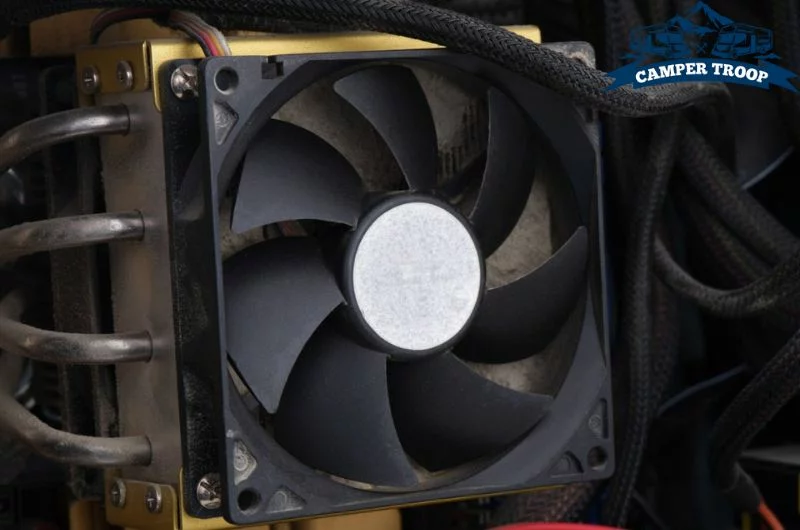
Why Does My RV Converter Fan Turn Off and On Frequently?
The fan usually cycles because the converter’s operating conditions keep changing. On a load-controlled converter, the main trigger is DC current. That current includes your RV’s 12V loads and the power used to charge the battery.
WFCO’s FAQ gives these fan control ranges:
| WFCO fan state | Approximate DC current |
|---|---|
| Starts at low speed | 3.0 to 6.0 amps |
| Reaches maximum speed | 14.0 to 15.0 amps |
| Shuts off | Below 3.0 to 6.0 amps |
If total demand keeps moving in and out of the 3 to 6 amp range, the fan can keep starting and stopping. Possible reasons include:
- 12V loads that cycle on and off
- Battery charging demand that changes
- Hot weather condition, on temperature-controlled models
- Low battery performance
- Appliances issue
Test the battery and check the 12V loads before you blame either the battery or the converter.
Is It Normal for an RV Converter Fan to Cycle?
Yes, cycling can be normal. A WFCO fan is designed to turn on and off as DC load changes. There is no verified time limit that separates normal cycling from a fault, so look for a cause rather than timing the fan.
Investigate further if the fan does not match the load, the battery fails a test, or you notice any of the warning signs listed in the safety section below.
Do All RV Converters Control the Fan the Same Way?
No. Fan control varies by brand and model. WFCO says its fan is controlled by load. Other converters may use temperature sensing or a different design.
Find the model number on the converter label and check its manual. The amp ranges above apply to WFCO and should not be assumed for other brands.
How Do You Inspect an RV Converter Safely?
Remove all power sources before you open the converter area or touch its wiring. An RV can feed the power center from more than one source.
- Unplug the RV from shore power.
- Turn off the generator and any other AC power source.
- Disconnect the battery.
- Follow the converter manual before removing any cover.
- Call a qualified RV technician if you are not comfortable working around 120V AC wiring.
When Should You Shut Down the Converter Immediately?
Shut it down if you notice a burning smell, melted wiring, or repeated breaker trips. Disconnect shore power and generator power, then disconnect the battery if you can do so safely. Do not keep resetting a breaker. Have the system inspected before using it again.
Troubleshooting and Fixing RV Converter fan On/Off Issue:
Start with the cause that matches how your converter controls its fan. On a load-controlled unit such as a WFCO, begin with DC current. On a unit with temperature sensing, also check heat and airflow.
How Do You Check for Changing or Parasitic 12V Loads?
Use a clamp meter that can read DC amps. Then watch how the current changes as you turn loads off.
- With shore power connected, clamp the meter around the converter’s positive DC output wire.
- Note the amp reading and whether the fan is running.
- Turn off the 12V lights, water pump, furnace, and other loads you control.
- Watch the reading. On a WFCO, a reading that keeps moving through the 3 to 6 amp range can explain the cycling.
- To check for a hidden drain, disconnect shore power and generator power. Clamp the meter around the battery cable.
- Remove one 12V fuse at a time. A clear drop in amps points to the circuit to inspect.
Some small loads may stay on by design, such as detectors and control boards. Compare what you find with the appliance manuals before treating it as a fault.
Hot Weather Conditions
Heat matters most if your converter’s manual says the fan uses temperature sensing. In that case, a hot compartment may cause the fan to run more often.
On a WFCO converter, look at load first because WFCO says load controls the fan. On any model, keep the vents clear and don’t overlook the outside temperature when you look for a pattern.
Read Also: Why RV Water Pump Not Working When Winterizing? (Solved)
Low Battery Performance
A discharged battery draws charging current from the converter. On WFCO models, that current counts toward the total load that controls the fan. As charging demand changes, the fan can change too.
Check the battery’s age and water level, if it has removable caps. Also check whether a charge was interrupted. These are reasons to inspect and test the battery. Replace it only if testing shows that it is bad.
Battery prices depend on type, size, and capacity. Confirm that you need a new battery before you start comparing options.
Trickle Charging
Multi-stage converters do not simply wait for the battery to fall below 12 volts. A WFCO unit moves between charging modes, and its float mode serves a role similar to trickle charging.
After about 44 hours with no significant change in current draw, float mode lowers output toward 13.2V. Any load returns the unit to 13.6V absorption mode.
You do not need a different converter just because yours has a float mode. WFCO says its fan is controlled by load, so measure the current before you change any equipment.
Read Also: RV 12-volt System Not Working When Plugged In: How to Fix?
Appliances Issue
RV appliances and controls that use 12V power can change the load on the converter. As they start and stop, the fan may follow.
Some 12V consumers take power through a fuse set instead of the circuit breaker. That can include circuits for the water heater, lights, or refrigerator. Use the amp test above to find which circuit changes the reading.
Turn off the circuit that shows an unusual draw, then repair that appliance or its wiring. Get expert help if you can’t tell why it is using more power than expected.
Read Also: RV Battery Disconnect Switch Problems: How to Fix Them!
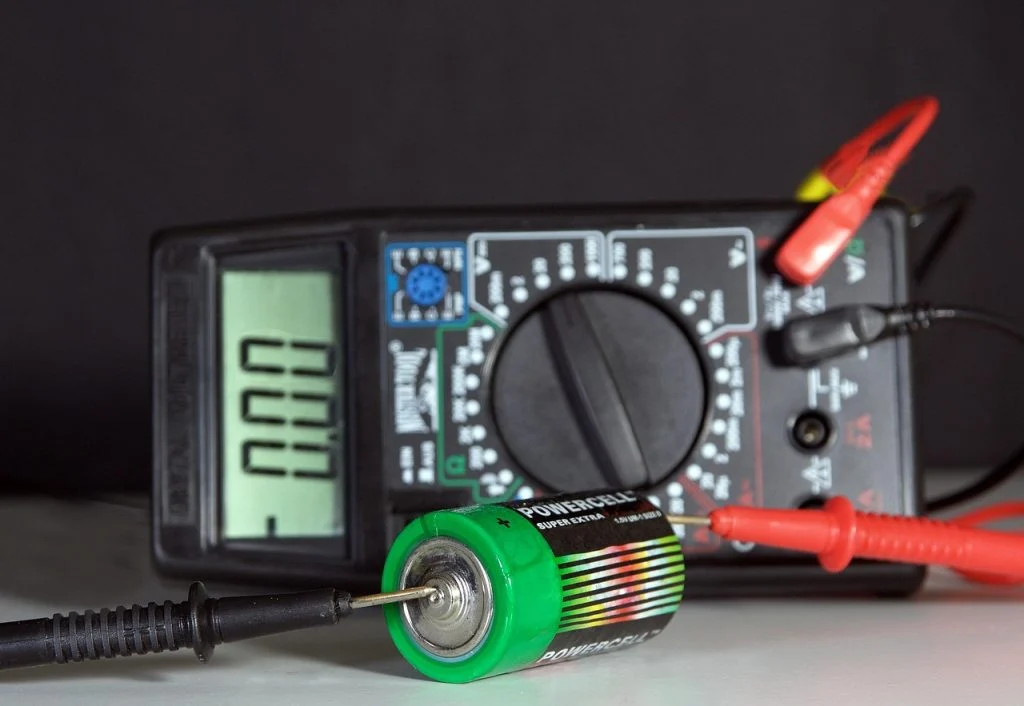
How Do You Test the Battery and Converter?
Compare the battery voltage with AC power off and on. etrailer’s test helps separate a battery problem from a converter problem.
- Turn off shore power and the generator.
- Set a multimeter to DC volts and measure at the battery terminals.
- Record the resting voltage.
- Turn AC power back on and measure again.
- Compare both readings with the table below.
| Lead-acid battery reading | What it suggests | Next step |
|---|---|---|
| About 12.6V to 12.7V at rest | Full resting charge | Check the AC-on reading and 12V loads |
| Slightly below 12.6V at rest | May simply not be fully charged | Charge it and test again |
| Below 12V while disconnected | WFCO treats this as a possible sign of battery trouble | Inspect and test the battery |
| Rises to about 13.6V to 14.4V with AC on | The converter appears to be charging | Check loads and battery condition |
| Does not rise with AC on | Charging path may have a fault | Check the converter breaker, reverse-polarity fuses, and connections |
What Voltage Should an RV Converter Put Out?
A WFCO converter normally puts out 13.2V to 14.4V, depending on its charging mode. WFCO lists three modes:
| WFCO mode | Voltage | When it applies |
|---|---|---|
| Bulk | Nominal 14.4V | Up to four hours |
| Absorption | Default 13.6V | Default mode; any load in float returns the unit here |
| Float | 13.6V down to 13.2V | After about 44 continuous hours with no significant change in current draw |
Exact behavior varies by model, so confirm the numbers in your converter’s manual.
Do These Numbers Apply to AGM and Lithium Batteries?
Don’t assume they do. The resting voltages in this article are for lead-acid batteries. Do not use them to judge a lithium battery.
Flooded, AGM, and lithium batteries can have different charging needs. Check the battery maker’s specifications and the converter manual to confirm that the two are compatible.
Why Does RV Converter Fan Run Continuously?
On a load-controlled converter, a fan that won’t shut off usually means DC demand is staying above the fan’s shutoff point. That demand can come from RV 12V loads, battery charging, or both. It does not always mean something is broken.
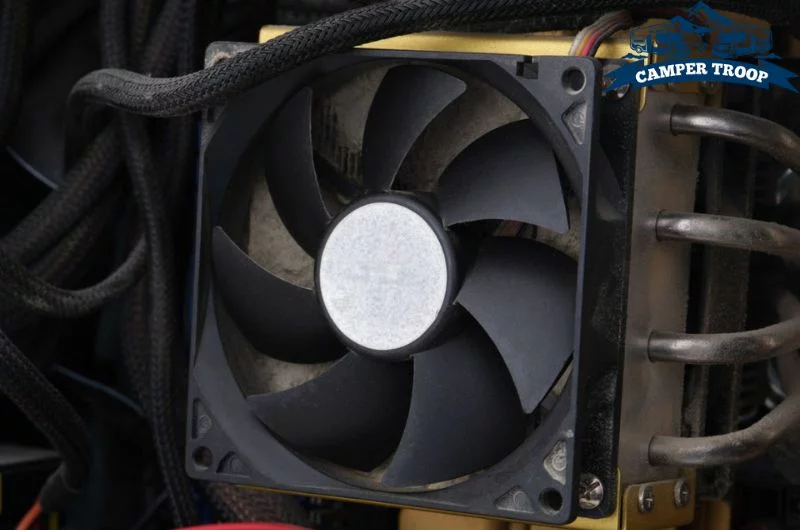
To lower demand, turn off the 12V loads you don’t need. If you see a warning sign such as a burning smell or melted wiring, follow the shutdown steps above instead.
Poor Battery Conditions
Can a bad battery make the fan run constantly? It can if the battery keeps drawing enough charging current to hold the total load above the shutoff point. Sometimes your RV converter battery is the place to start, but it should be tested first.
A new battery will not solve a fan problem caused by a 12V load or a converter fault. Replace the battery only if testing shows that it is bad.
Extra Power Consumption
A 12V appliance or circuit may be using more power than you expect. Use the amp test to find it. Replacing a blown fuse may restore a circuit, but it does not explain why the circuit is using additional power. Get expert support if the cause is not clear.
Damaged Circuit Board or Charging Fault
If the converter isn’t charging, the battery won’t have power to recharge from shore power. Check the battery terminals with a multimeter while AC power is on.
If the voltage does not rise, check the converter breaker, reverse-polarity fuses, and connections. If those are good, have the converter and its circuit board tested.
Loose Wiring Connections
With all power disconnected, inspect the converter and fan connections. Look for loose, broken, or discolored wiring. Tighten loose connections if you have the skills and tools to do it safely. Have damaged wiring repaired or replaced before you use the system.
Poor Ventilation
Poor airflow makes it harder for the fan to remove heat from the converter. It matters most on models that use temperature to control the fan.
With all power disconnected, follow these steps:
- Move stored items away from the converter and its vents.
- Remove dust from the vents and fan with a soft brush or vacuum.
- Check that the fan blades can move freely.
- Look up the required clearance in your converter manual, because it can vary by model.
Read Also: RV AC Freeze Sensor Location [Complete Guide to a Freeze Sensor]
What Is the Difference Between RV Fuses and Circuit Breakers?
A circuit breaker trips and can be reset. A fuse blows and must be replaced. Both protect a circuit from too much current.
Many RV power centers place AC breakers and DC fuses in or near the same panel, but layouts vary. Some converters also have reverse-polarity fuses. Check your RV or converter manual to find each one.
Replace a fuse only with one of the correct rating. If a breaker looks damaged or keeps tripping, consult a licensed technician.
Different Ways to Check the RV Converter Fan
If the fan won’t run at all, use these checks to narrow down the cause:
- Using a multimeter: Check whether the fan is getting power while the converter is under enough load to call for the fan. A power reading alone does not prove that the fan is good.
- Observing the breaker and fuses: Check the converter breaker and reverse-polarity fuses for a trip or blown fuse.
- Inspecting connectors: With all power disconnected, look for dirt or a poor fit at any accessible input jack or fan connector.
- Checking the temperature sensor: If your model has a fan thermostat or sensor, use the manufacturer’s test procedure and replacement part. Do not bypass it.
- Contacting a qualified mechanic: Get help if the checks don’t show a clear cause or if the repair involves 120V AC wiring.
How Do I Know if My RV Converter Is Bad?
The clearest sign is a battery voltage that does not rise with AC power connected, even though the converter breaker, reverse-polarity fuses, and connections are good. A healthy charging system should bring the reading to about 13.6V to 14.4V.
Fan cycling alone is not enough to condemn the converter. Confirm the voltage problem first.
Should You Repair the Fan, Replace the Converter, or Replace the Battery?
Let your test results decide. Replace only the part the tests point to.
| What you find | Best next step |
|---|---|
| Fan changes with DC load and voltage is normal | No repair may be needed; manage or inspect 12V loads |
| Battery stays low after charging or fails a test | Replace the battery |
| Voltage does not rise, but a breaker, fuse, or connection is at fault | Repair that item and test again |
| Voltage does not rise and the breaker, fuses, and connections are good | Have the converter tested and replace it if confirmed bad |
| Converter charges normally, but the fan fails when it should run | Check fan wiring and consider replacing the fan |
| Burning smell, melted wiring, or repeated breaker trips | Shut down and have the system inspected |
How Much Does It Cost to Replace an RV Converter or Fan?
There is no single reliable price. The cost depends on the part, amperage, brand, compatibility, and local labor rates.
A fan-only repair replaces one component, so the part must match your converter. A full converter replacement costs more in parts and may involve more wiring work. It also requires a suitable amp rating and battery compatibility. Ask for a written quote that lists parts and labor separately.
How Does the Converter Fit Into Your RV’s Power System?
The converter supplies 12V DC power from a 120V AC source and charges the battery. These answers cover overheating, running without a converter, and power use.
Can an RV Converter Overheat?
Yes! An RV converter can overheat if the fan fails to operate. For troubleshooting, you can check whether the fan is receiving power or not with a multimeter. If even after getting power, the fan is not running, you may need to replace it to solve the overheating problem.
Can I Use an RV Without a Converter?
Yes, you can, but you shouldn’t. A converter converts 120 volt AC power into 12 volt DC so that the appliances in your RV, like the refrigerator, can use the power. Without a working converter, you can lose converter-supplied 12V DC power and battery charging from shore power, so your battery may drain. The converter does not supply the RV’s AC loads.
Whether a converter can power 12V loads with no battery connected depends on the model. Check the manual before you try it.
How Much Electricity Does an RV Converter Use?
It depends on the capacity of the converter and the load on it. For example, a 45A converter running at WFCO’s 13.6V default delivers about 612 watts (45 x 13.6 = 612). That works out to about 5.1A at 120V AC before conversion losses, so the real draw is higher. Check the unit’s label for its rated AC input.
Final Words
A converter fan that turns on and off is not automatically a problem. Find out how your model controls the fan, then check the 12V loads and test the battery with AC power off and on.
Repair or replace only what the results point to. If you find damaged wiring, a burning smell, or repeated breaker trips, stop and get expert help.
Read Also: 6 Reasons Why Does RV AC Compressor Start and Then Stop
RV Converter Fan FAQs
Can a bad battery make an RV converter fan run constantly?
Yes, a bad battery can make the fan run constantly if it keeps drawing enough charging current to hold total DC load above the fan’s shutoff point. Test the battery before replacing it, because a new battery will not fix a fan problem caused by a 12V load or a converter fault.
Does an RV converter work without a battery?
It depends on the converter model. Whether a converter can power 12V loads with no battery connected varies, so check the manual before you try it. A converter’s job is to supply 12V DC power from a 120V AC source and charge the battery. It does not supply the RV’s AC loads.
At what amperage does a WFCO converter fan turn on?
A WFCO converter fan starts at low speed at about 3 to 6 amps of DC current. It reaches maximum speed at about 14 to 15 amps and shuts off when current falls below 3 to 6 amps. These ranges apply only to WFCO, so check the manual for other brands.
Why won’t my RV converter fan run at all?
A fan that won’t run may simply have too little load, or it may have a power or part problem. On a WFCO, the fan stays off below about 3 to 6 amps. Otherwise, check the converter breaker, reverse-polarity fuses, connectors, and fan wiring. Consider replacing the fan if it fails when it should run.
Should I replace my RV battery if the converter fan keeps cycling?
No, fan cycling alone does not prove the battery is bad. Measure the resting voltage, charge the battery if it reads slightly below 12.6V, and test again. Replace it only if it stays low after charging or fails a test. These voltage readings apply to lead-acid batteries, not lithium batteries.
What does float mode do on a WFCO converter?
Float mode lowers the converter’s output after the battery system has been steady for a long time. After about 44 continuous hours with no significant change in current draw, output drops from 13.6V toward 13.2V. Any load returns the unit to 13.6V absorption mode. Exact behavior varies by model, so check your manual.