Most RV tankless water heater problems come from a few simple things: no propane, no 12V power, too little water flow, or a valve left in the wrong position. Check those first and you can often fix the heater yourself in minutes. If the unit shows an error code, start there, because it points straight to the fault.
How to Troubleshoot & Fix RV Tankless Water Heater Problems?
Work through these checks in order. They start with the most common and easiest causes. Move to the next step if one doesn’t solve the problem.
Step 01: Read the User Manual and Any Error Code
Start with the manual for your exact make and model. If you don’t have one, you will find it online. For example, Girard’s GSWH-2 owner’s manual is posted on Forest River’s site.
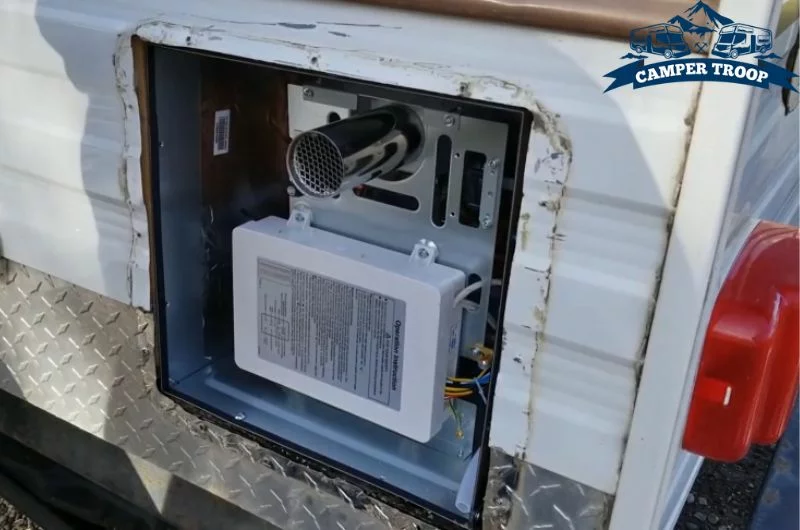
Not all tankless water heaters are built the same, so one fix may not work for another unit. The manual shows where each part is located and lists what each error code means.
Many units shut down when they detect a problem and display a code. A Girard GSWH-2, for example, shuts down when it detects an unsafe condition and shows an error code for the cause. Look up that code before you start taking things apart.
Step 02: Check the Level of Propane
A gas tankless heater can’t light without enough propane. If the tank is low, filling it is the fix. Also make sure the tank valve is fully open.
Don’t have a gauge to check the propane level? Here is an easy method.
- Turn the stovetop burner on. Wait for 10 – 15 seconds. If the height of the flame is normal and stays lit throughout time, the propane level is good enough. Then, turn the burner off.
Safety warning: If you smell propane, don’t try to light anything. Shut off the gas at the tank, get everyone out of the RV, and call a certified RV technician or your propane supplier.
Step 03: Check 12V Power and the Fuse
Gas tankless heaters still need 12V DC power for the control board and igniter. If the display is dark or the unit does nothing, check that the heater’s switch is on, the RV battery is charged, and the heater’s fuse in the 12V panel isn’t blown.
Step 04: Check Water Flow and Pressure
A tankless heater only fires when water flows fast enough. Gas units like the Girard GSWH-2 use a flow sensor to start the burner. Girard lists a minimum flow of about 0.70 GPM (+/- 10%). The heater keeps running only while flow stays above that level. An older owner’s manual dated November 2020 lists 0.60 GPM per hot-water faucet, so check the manual for your own unit.
If flow is too low, the heater won’t light. It may also go hot, then cold, if flow drops below the minimum while you use it. To fix low flow:
- Open the hot faucet further. A trickle may not trigger the sensor.
- Make sure the water pump is on and running when you use the fresh tank.
- On city water, check that the spigot is fully open and the hose isn’t kinked.
- Clean any clogged faucet aerators, shower heads, or inlet screens and filters.
A short burst of cold water between hot uses is called a “cold water sandwich.” It happens when cold water sits in the line between the heater and the faucet. Keeping a steady flow rather than turning the tap on and off reduces it.
Step 05: Inspect the Bypass Valves
Many owners use the bypass valves when they sanitize the water lines or winterize the RV. If the valves are still set to bypass, water never reaches the heater. Set them back to normal operation.
Step 06: Check the Outdoor Shower
Does your outdoor shower have a wand or handle with a shutoff valve? The wand valve can be left open without you noticing.
When that valve is open, cold water can cross over into the hot side. The result is lukewarm or cold water inside the RV. A crossover can also create back pressure, so a tankless heater may need more flow than normal before it turns on. This can make it seem like the heater isn’t working.
So, if you are not getting hot water inside your RV, close both the hot and cold knobs on the outdoor shower and test again.
Step 07: Descale the Heat Exchanger
Mineral buildup slowly cuts heating performance. Truma notes that RV water is usually hard, so debris builds up inside the AquaGo over time. Truma recommends regular decalcifying with its own kit or tablets. For other brands, follow the descaling steps in your manual.
Step 08: Check the Exhaust Vent
Bugs, nests, and debris can block the exhaust or air intake on the outside of the RV. A blocked vent can stop the burner from lighting or cause it to shut off. With the heater off and cool, look through the vent and clear anything inside.
Read Also: 8 Common Causes of a DSI Fault Light on RV Water Heater
Step 09: Malfunctioned Check Valve
Low water pressure can also cause RV tankless water heater problems. The check valve is a likely culprit if the hot water flows in a small stream.
A check valve prevents water backflow. If it fails, water pressure on the hot side can drop to low or zero while you run hot water.
In this case, replacing the check valve is necessary. Ask for professional help to complete the job efficiently.
Read Also: Where is the RV Water Heater Reset Button and How To Use It?
Do RV Tankless Water Heaters Have an Anode Rod, Heating Element, or Thermostat?
No. RV tankless heaters such as the Girard GSWH-2 and Truma AquaGo have no storage tank and no anode rod. Gas tankless units use a flow sensor to start the burner and a control board to manage the flame and show error codes. Their routine maintenance is descaling and winterizing.
Anode rod, heating element, and thermostat checks apply mainly to tank-style electric or combo heaters:
- Anode rod: Suburban tank heaters use steel, glass-lined tanks with a replaceable anode rod. The rod reduces corrosion and should be checked at least once a year. Running a Suburban without it voids the warranty. Atwood/Dometic tank heaters use aluminum tanks and no anode rod. Dometic warns that adding an aftermarket anode rod can damage the tank.
- Heating element: Elements can go bad over time. The element can melt if you turn on the water heater with no water in it. A bad element needs to be replaced.
- Thermostat: A failed thermostat looks normal from the outside. Test it with a multimeter and replace it if it’s bad.
If you have a tank heater, the thermostat swap is simple with basic RV knowledge:
- Turn off the electric power of your RV.
- Dismantle the wiring clips.
- Then the old thermostat switch needs to be pulled out.
- Replace the damaged one with the new one.
- Finally, reinstall all the wire connections and turn the power on.
When Should You Call a Certified RV Technician?
Call a certified RV technician if:
- You smell propane or your carbon monoxide alarm goes off.
- An error code keeps coming back after you fix the obvious cause.
- The burner won’t light even with good propane, 12V power, and water flow. This points to the igniter, flame sensor, or control board.
- You see leaks or cracks, which can mean freeze damage from a unit that wasn’t winterized.
- You need to work on gas lines or the regulator.
FAQs.
What are the most common problems with an RV tankless water heater?
The most common problems with RV tankless water heaters include,
- Flame failure
- Sandwich of cold water
- Buildup of mineral
- Ignition failure
- Exhaust blockage
How do you troubleshoot a tankless water heater?
Read the below table discussing the troubleshooting process based on the problem.
| Problem | Troubleshooting Process |
| Low water pressure | Check the pump, city water hose, aerators, and check valve |
| Too hot water | The temperature might be set too high |
| No Hot Water | Check propane, 12V power, water flow, bypass valves, and any error code |
What to do if my RV tankless water heater is not working?
If your RV tankless water heater is not working, follow the below points.
- Check whether the breaker of the electric unit hasn’t tripped
- For gas-powered units, check the gas valve to see if it is fully opened.
If these checks don’t fix it, work through the steps above or call a certified RV technician.
Summing Up
Most no-hot-water problems trace back to propane, 12V power, low water flow, or a valve in the wrong position. Regular descaling and proper winterizing prevent many of the rest. When in doubt, especially with gas, call an expert.
Read Also: Why Does My Rv Water Heater Sound Like A Jet Engine?