Quick answer: A fullway termination valve is the sliding knife-gate valve that opens to empty an RV’s black tank into the sewer hose. It sits at the sewer outlet, often on the roadside, though some RVs place it in a heated underbelly or compartment or use remote handles or electric controls.
If you own an RV, you need to know the parts of its waste system. The termination valve is one of the most important because it controls when the black tank empties.
This article explains what the valve does, how to find it on your RV, and how to dump and flush safely. It also covers what to do if the valve sticks, leaks, or breaks.
What Is Fullway Termination Valve?
A fullway termination valve is the valve that holds waste in the black tank until you open it to dump. It is a sliding knife-gate valve at the sewer connection.
Different manufacturers use different names for this part. Keystone calls it the termination valve, while Airstream’s owner guide says black water valve. Owners may also say black tank valve, gate valve, or dump valve.
We could not confirm where the word “fullway” comes from or how widely it is used. If your manual does not use it, look for “termination valve” or “black water valve” instead.
Termination valves are not limited to the black tank. Gray tanks have them too. RV.com says they are typically 3 inches for black tanks and 1.5 inches for gray tanks.
Read Also: How Much Can A Chevy Suburban 2500 Tow? (Capacity Chart)
How The Fullway Termination Valve Works
The valve uses a flat gate that slides to open or close the path out of the tank. When it is open, black water flows through the sewer outlet and into the hose. When it is closed, waste stays in the tank.
Black water that overflows or leaks is extremely unsanitary and can cause severe illnesses. That is why you should know where the valve is and whether it is open before you run water into the tank.
Are All Termination Valves Operated the Same Way?
No. Termination valves do the same job in every RV, but the controls vary.
| Control type | What to know |
|---|---|
| Handle | You work the valve with a handle connected to it. |
| Remote cable | The handle can sit away from the valve, so the handle may not show you where the valve is. |
| Electric | You use an electric control. Check your manual for its location and operating steps. |
Read Also: Why 15 Amp Fuse Keeps Blowing In Rv: How to Fix it?
Where Is The Fullway Termination Valve Located?
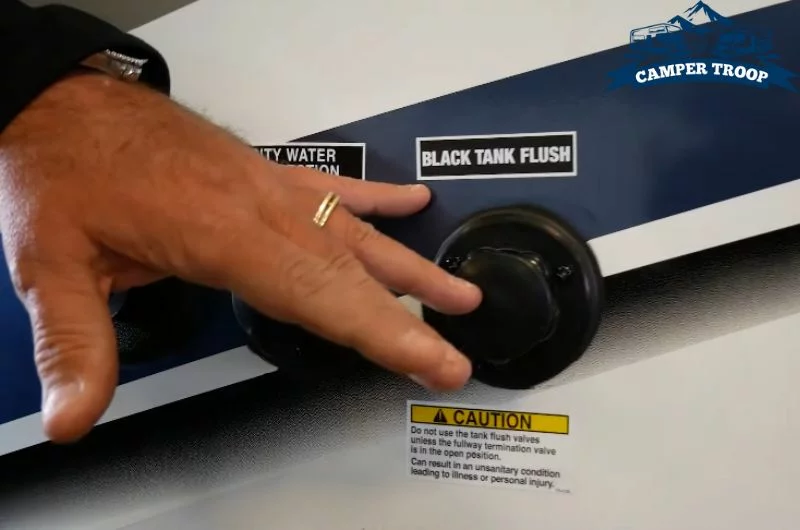
The valve is at the sewer outlet, so start there. On some RVs, it sits inside a heated underbelly or compartment, or you work it with remote handles. The exact spot depends on the make, model, and year.
Here is what the brand sources confirm, and what to check when they do not give a single location.
Camper Trailer
Camper layouts vary, so there is no single location that fits them all. Start at the sewer outlet and look for the point where black water leaves the tank to go to the sewer line.
If you cannot see a valve there, check for a compartment, a remote handle, or an electric control.
Winnebago
We could not verify one valve location or handle color that applies to all Winnebago models. Use the owner’s manual for your exact model and year to find the valve and its controls.
Keystone
Keystone uses the name termination valve and places these valves on the roadside.
Each Keystone holding tank has its own termination valve, and some models have more than one gray valve. Make sure you have identified the black tank valve before you open anything.
Airstream
Airstream’s guide uses the name black water valve. It points owners to a large black tube on the roadside labeled “Sewage Holding Tank” or something similar.
The external black tank flush hookup is usually near the fresh water hookup. Do not confuse either connection with the valve.
How Can You Confirm the Location on Your RV?
- Find the owner’s manual for your exact model and year.
- Search it for “termination valve,” “black water valve,” and “black tank valve.”
- Go to the sewer outlet and match what you see to the manual.
- Check labels to separate the black valve from any gray valves.
- If you only find a handle or electric control, use the manual to confirm which tank it operates.
Read Also: Complete Guide on How to Jack Up a Travel Trailer in 4 Steps
Is the Termination Valve the Same as the Flush Inlet or Sewer Cap?
No. These three parts are close together on many RVs, but each one has a different job.
| Part | What it does | What connects to it |
|---|---|---|
| Termination valve | Holds waste in the tank or lets it out | The tank’s drain line and sewer outlet |
| Black tank flush inlet | Sends rinse water into the black tank | A dedicated garden hose, through an inline vacuum breaker |
| Sewer outlet cap | Covers the outlet when no hose is attached | The end of the sewer outlet |
Should the Black Tank Valve Be Open or Closed When Flushing?
It depends on your RV. Airstream says you can flush with the black valve open or closed. Follow your owner’s manual or flush kit instructions.
If you flush with the valve closed, stay with the RV and limit how long the water runs. Never start the water and walk away.
What Happens If You Flush the Black Tank With the Valve Closed?
The tank fills with water instead of draining. It will not always overflow, but it can overfill if the water runs too long.
Overfilling a black tank can push effluent back into the RV. RV.com warns that this often causes serious damage or a total loss.
How Do You Dump and Flush an RV Black Tank?
Dumping and flushing are different tasks. Dumping empties the tank through the open valve. Flushing runs clean water into the tank to rinse it.
Use these general steps, and let your owner’s manual override them where it differs.
- Put on disposable gloves.
- Confirm that all termination valves are closed, then remove the sewer outlet cap.
- Connect the sewer hose securely to the RV outlet and the dump station inlet.
- Open the black tank valve and let the tank empty.
- Connect a dedicated flush hose to the flush inlet through an inline vacuum breaker.
- Set the black valve open or closed as your manual or flush kit directs, then turn on the water. If the valve is closed, stay with it and limit the run time.
- Flush until the water running through the sewer hose is clear. A clear 45-degree sewer fitting makes this easy to see.
- Turn off the water, disconnect the flush hose, and make sure the black tank has drained.
- Empty any gray tanks through their own valves, using the tank order your manual gives.
- Close every termination valve.
- Disconnect the sewer hose and replace the cap.
- Remove your gloves and wash your hands well.
How Often Should You Flush an RV Black Tank?
Follow your owner’s manual or flush system instructions. We could not verify a fixed schedule, such as once a month, that applies to every RV.
Should You Leave the Black Tank Valve Open at a Full-Hookup Site?
No. Keep the black termination valve closed between dumps, even when you have a sewer connection at your site.
Leaving it open lets solids collect at the bottom of the tank. Over time, they can block the flow.
How Do You Protect Fresh Water When Flushing?
Use an inline vacuum breaker and a hose reserved for flushing. RV.com says black tank flush systems connect to a garden hose through an inline vacuum breaker, and that hose should not be used for drinking water.
Mark the flush hose and store it away from your drinking water hose. Because the flush hookup is often near the fresh water hookup, check the label before you connect anything.
How Do You Fix a Stuck, Leaking, or Broken Termination Valve?
Clean and lubricate the valve first, then replace it if the problem continues. Termination valves are held on by four bolts, so they can be removed, cleaned, lubricated with waterproof valve lubricant, or replaced.
Warning: Removing the valve opens the path out of the tank. If a valve is stuck closed on a tank that still holds waste, do not unbolt it without a safe plan to contain the contents. Consider calling an RV service technician.
| Problem | What to do |
|---|---|
| Stuck or hard to move | Do not force it. If the tank can be emptied safely, remove, clean, and lubricate the valve. Replace it if it still sticks. |
| Leaking | Empty the tank, then clean and lubricate the valve. Replace it if the leak continues. |
| Broken valve | Empty the tank if possible and replace the valve. |
| Remote cable or electric control fails | Check your manual or contact an RV service technician, since the repair depends on the system. |
What Should You Check Before Buying a Replacement?
Measure or confirm the size first. Black tank valves are typically 3 inches, and gray tank valves are typically 1.5 inches.
Also match how the valve is operated, whether by handle, remote cable, or electric control. Your manual or RV manufacturer can help confirm the right part.
How Should You Care for the Valve in Cold Weather?
Follow the winterizing steps in your owner’s manual. Do not assume your valves are protected from freezing. Some RVs have heated underbellies or compartments, but not all do.
FAQs.
In this section, we will cover some of the most frequently asked questions about the fullway termination valve.
When Do I Need to Use the Fullway Termination Valve?
Open it when your sewer hose is connected and you are ready to empty the tank. Keep it closed between dumps, even at full-hookup sites. Whether it should be open during a flush depends on your RV, so follow your owner’s manual or flush kit instructions.
How Long Should I Flush My Black Tank?
Flush the black tank until the water running through the sewer hose is clear. Go by the water instead of a set time. A clear 45-degree sewer fitting makes it easy to check.
How Often Should I Flush Black Tanks?
Follow your owner’s manual or flush system instructions. We could not verify a fixed schedule, such as once a month, that applies to every RV.
What Happens If The Fullway Termination Valve Is Closed During Flushing?
The tank fills with water instead of draining. It will not always overflow, but it can overfill if the water runs too long, so stay with it and limit the run time. Overfilling a black tank can push effluent back into the RV and often causes serious damage or a total loss.
Read Also: When To Use The Check Valve, Before Or After Pump? Find Out!
Conclusion
The fullway termination valve can be hard to find because the name varies. Different manufacturers use different names for this valve, and its controls and location vary too.
Start at the sewer outlet, then confirm the details in the manual for your model and year. Make sure you can tell the black valve from any gray valves and from the flush inlet.
Follow your manual on whether the valve should be open during a flush, stay with the water while it runs, and keep the valve closed between dumps. These habits help you drain and flush the tank without a mess or damage to your RV.
Read Also: Why Your RV Oven Pilot Won’t Light and What to Do About It?