Quick answer: Common Bighorn RV problems include electrical faults, ice maker leaks, tire and wheel wear, water leaks and propane leaks. Slide-outs, roof seals and leveling systems also need watching. Many electrical, water and tire issues are simple DIY checks. Leave propane and 120V electrical repairs to a qualified RV technician.
The Bighorn is Heartland RV’s luxury fifth wheel. Like any large towable, it can have problems on the road and at the campsite. Most of them show clear warning signs, and many can be fixed or prevented with regular checks.
This guide covers the five most common Bighorn RV problems, plus slide-outs, roof leaks, leveling and frame issues. It also explains recalls, warranty claims and when to call a professional.
Who Makes the Bighorn Fifth Wheel?
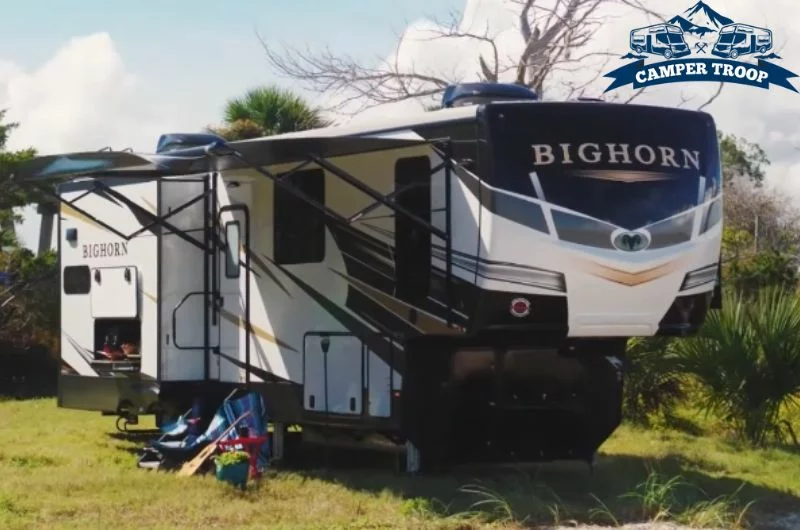
Heartland RV makes the Bighorn. Heartland is part of Thor Industries. The Bighorn is a towable fifth wheel, not a motorhome. It has no engine, ignition or transmission. You tow it with a pickup that has a fifth wheel hitch in the bed.
It sits at the premium end of the market. Heartland lists the 2026 Bighorn with these specs:
- Starting MSRP: $107,475 (before destination, taxes, fees and options)
- Length: 36′ 0″
- Dry weight: 13,060 lb
- Sleeps: up to 8
Dealer prices and specs vary by floorplan. Older model years differ, so check your owner’s manual for your exact unit.
Is the Heartland Bighorn a Good Fifth Wheel?
It can be, but quality depends on the individual unit and how well it has been maintained. The Bighorn is Heartland’s luxury line, with features that suit long stays. More features also mean more systems that can fail: slides, leveling, residential-style appliances and a large electrical system.
The problems below can happen on any fifth wheel. They are not limited to one Bighorn model year or floorplan. To see whether a specific issue affects your unit, check for recalls by VIN (covered below) and read your owner’s manual.
What Are The Common Problems With Bighorn RV?
Even a well-built fifth wheel has parts that wear, loosen or leak over time. These are the five problems this guide covers in detail:
- Electrical issues
- Leaking ice makers
- Wheel and tire issues
- Water leakages
- Propane leakage
Owners should also watch for slide-out, roof seal, leveling, landing gear and frame problems. These are covered in their own section further down.
How Do You Troubleshoot and Fix Bighorn RV Problems?
The first step to troubleshooting your RV problem is identifying and detecting the issue. Look for symptoms. Ask what is affecting your RV directly and what could be affecting it indirectly. Then work from the simplest cause, like a tripped breaker or low battery, to the most complex.
Problem 1: Electrical Issues
A Bighorn RV relies heavily on electricity. It has two main systems:
- 12V DC system: lights, slide-outs, leveling, the water pump, furnace controls and the trailer brakes (powered through the 7-way connector from your truck).
- 120V AC system: outlets, air conditioners and the converter that charges the batteries.
Electrical issues can be serious, especially if they affect the trailer brakes, slides or leveling. Lights going out, sudden power loss and components that won’t run are the usual signs of an electrical problem.
What Causes Electrical Issues On Bighorn RV?
Most often, electrical issues are caused by wiring issues or voltage problems. Sometimes battery problems can disrupt electricity. Here are the prime causes of electrical issues in your RV:
- Issues in fuses and breakers
- Problems occurring in the 12-volt system
- Issues in power sources, such as shore power, a generator or the batteries
- Abnormal current draws in appliances
- Physical damage to components
- A failing converter or inverter
- Loose or corroded battery terminals
How To Fix Electrical Issues On Bighorn RV?
There are a couple of ways to diagnose and fix electrical issues in your RV. Apply these strategies to see if they solve your problems:
Strategy One: Identify the Blown Fuse
Find the 12V fuse panel. Use a multimeter or a test light to check each fuse on the circuit that stopped working. A blown fuse will show no continuity. Replace it with a fuse of the same amp rating. If the new fuse blows right away, there is a short or overload, and the circuit needs a closer look.
Strategy Two: Check The Fuse and Breaker
Check the fuses and breakers. Make sure every breaker is switched on. Look for any faults or physical damage in your electrical components.
Strategy Three: Check Power Sources
- Batteries: Check voltage with a multimeter. Clean and tighten the terminals. Low battery voltage can stop slides, leveling and the furnace.
- Converter: If the batteries don’t charge while plugged in, the converter or its breaker may be at fault.
- Inverter: If your unit has one, make sure it is switched on and not in a fault mode.
- Shore power: Check the campground pedestal breaker and your power cord. Use a surge protector to guard against bad pedestal wiring and voltage spikes.
- Truck connection: If trailer lights or brakes fail while towing, inspect the 7-way plug for dirt, corrosion or bent pins.
Safety rule: Swapping 12V fuses and cleaning battery terminals is DIY work. Leave 120V wiring, panel and converter repairs to a qualified RV technician or electrician.
How Much Does It Cost To Fix Electrical Issues On Bighorn RV?
You can find a variety of fuses and breakers on the market. Most fuses range from $2 to $65. Breakers usually range from $10 to $50. Converter, inverter or wiring repairs cost more and depend on the part and labor rates in your area.
Read Also: Common FR3 RV Problems & Solutions
Problem 2: Ice Makers Leak
Ice makers are a lifesaver in an RV. In hot weather, an ice maker can make a big difference in the comfort of your trip. The usual symptoms of a faulty ice maker are leaking water, not freezing correctly, or taking a long time to make ice.
What Causes Ice Maker Leaks On Bighorn RV?
Electrical surges and physical damage often cause issues in ice makers. Here are a couple of common issues that cause problems in ice makers.
- Electrical fault
- Insufficient water supply
- Freezing component failure
- A loose or cracked water supply line behind the refrigerator
How To Fix Ice Maker Leaks On Bighorn RV?
Fixing any ice maker leaking issue usually requires checking the water valve and supply line. Turn off the water pump or city water and unplug the refrigerator first. Then follow these steps to find the issue.
Stage One:
Access the bottom vent to check for faults in your ice maker. After that, detach the main panel. Look for problems with the water valve and its line fittings.
Stage Two:
You should spot a bluish water valve in the chamber. Check the water supply. Replace the water valve if it does not supply water. Use a multimeter to identify any type of electrical fault.
Tip: In freezing weather, drain the ice maker line when you winterize. Ice can crack the line and cause a leak the next time you use it.
How Much Does It Cost To Fix Ice Maker Issues On Bighorn RV?
If your ice maker is completely busted, you need to buy a new one and install it. A brand new ice maker can cost up to $550. But you can get a decent ice maker within the range of $150 to $250.
Read Also: Common Keystone Bullet Problems and Solutions
Problem 3: Water Leaks
Plumbing leaks are common on any fifth wheel. Drain lines and fittings under sinks, showers and the toilet are frequent leak points. Water can run into the basement storage, onto the carpet and under the flooring.
A leak can also show up as water around the toilet. Any water leak will harm the RV’s floor and carpeting. Over time, water can cause mold and rot in the floor.
What Causes Water Leaks On Bighorn RV?
Damaged pipes or high water pressure mainly cause water leaks in a Bighorn RV. Sometimes loose hoses or taps can result in leaks. Here are the prime reasons behind water leaks in your RV:
- Drainage pipe leaks
- Excessive water pressure
- Loose pipes
- Faulty toilet system
- Loose taps
How To Fix Water Leaks On Bighorn RV?
Check the pipes and water lines for leaks. Tighten any loose pipe or fitting right away. Look for leaky taps that may need repairing.
If you notice any holes in the water lines, fix them as soon as possible. Check for internal damage and corrosion. If you find it, replace the water pipes. Leaving a leak unchecked will lead to a bad smell and mold growth.
Use a water pressure regulator at the campground spigot. It protects your plumbing from high city water pressure, one of the causes listed above.
If you find water on the floor but no plumbing leak, the source may be the roof or a slide-out seal. See the roof and slide-out sections below.
How Much Does It Cost To Fix Water Leaks On Bighorn RV?
If the toilet system is faulty, it will need to be replaced. Depending on the quality, the price may range from $150 to $1000. Fixing pipes and taps may cost around $100. Repairing water-damaged flooring costs far more, which is why catching leaks early matters.
Read Also: Common Oliver Trailer Problems And Solutions
Problem 4: Tire and Wheel Problems
Like every other part, Bighorn RV tires lose strength and performance over time. Tire and wheel issues concern many RV owners. Wheel bearings can also fail.
Tire and wheel problems can be hazardous and annoying. They can ruin your trip and raise the risk of an accident. A heavy fifth wheel puts a lot of load on each tire, so address issues as soon as possible.
What Causes Tire and Wheel Issues On Bighorn RV?
There could be multiple reasons behind a tire or wheel failure. A few of them could be:
- Extreme heat can damage the tires and bearings
- Excessive air pressure or low air pressure
- Driving faster than the tire’s speed rating
- Overloading the tires beyond their load rating
- Old tires, even if the tread looks fine
- Worn, dry or poorly adjusted wheel bearings and brakes
How To Fix Tires and Wheel Issues On Bighorn RV?
Always check the tire pressure before heading out, with the tires cold. The right pressure will help prevent sudden tire failures. Use the pressure listed on the trailer’s tire placard or the tire sidewall.
If your tires and wheels are too hot, let them cool down before driving again. A hub that is much hotter than the others can mean a bearing or brake problem. Check the RV tire’s speed limit and rating. Do not overspeed your RV.
Have the brakes inspected and adjusted if they grab, pull or feel weak. Torque the lug nuts to the spec in your owner’s manual, and recheck them after new tires or wheels are mounted.
How Fast Can You Drive on ST Trailer Tires?
ST (Special Trailer) tires are rated for 65 mph unless a higher speed rating is molded on the sidewall, according to industry standards. Read your sidewall. If it shows no higher rating, stay at or below 65 mph.
How Do You Check Tire Load Rating and Age?
- Load rating: Find the maximum load on the sidewall. Multiply it by the number of tires. The total should be more than the trailer’s actual loaded weight on the axles. A truck scale gives you the real number.
- Tire age: Find the DOT code on the sidewall. The last four digits are the week and year it was made. For example, “2423” means the 24th week of 2023.
- Replace by age, not just tread: Trailer tires often age out before they wear out. Follow the tire maker’s age guidance and replace tires with cracks, bulges or uneven wear.
How Much Does It Cost To Fix Tires and Wheel Issues On Bighorn RV?
You may need to replace the wheel bearings if they are badly damaged. Wheel bearing work can get expensive. It may cost up to $350 per wheel. Tire prices vary by size and load range.
Read Also: Common Roadtrek SS Agile Problems & Solutions
Problem 5: Propane Leak Problems
A propane leak is one of the most dangerous problems an RV can have. On a Bighorn, propane lines feed the LP appliances, such as the furnace, water heater, cooktop and, on some models, the refrigerator. Cracks or loose fittings in these lines are a main cause of leaks.
A propane leak can lead to an explosion or fire that can seriously injure or kill. Propane is very flammable and can ignite within seconds.
Propane is also a simple asphyxiant. In an enclosed space, it can push out oxygen. This can cause dizziness, headache, nausea and drowsiness. In severe cases, it can cause a rapid loss of consciousness. Liquid propane can cause cold burns (frostbite) on contact. An LP leak detector can warn you of a leak.
What Causes Propane Leaking On Bighorn RV?
Cracks or openings in the propane lines may be the primary cause of a leak. However, some other reasons could be as follows:
- Crack in the propane line
- Fracture in propane tank
- Faulty sealings
What Should You Do If You Smell Propane in Your RV?
Propane has an odorant added, so it smells foul, often compared to rotten eggs. If you smell it, act right away:
- Put out all flames and smoking materials.
- Do not use electrical switches, appliances or phones near the leak.
- Get everyone, including pets, out of the RV.
- Shut off the propane supply valve only if it is safe to do so.
- Call your propane supplier or 911 from a safe distance.
- Do not try to find the leak or replace gas lines yourself. A qualified technician should repair and leak-test the system before you use it again.
How To Fix Propane Leaking On Bighorn RV?
Prevention is the best fix. Always be alert to odd smells in your RV, since a foul odor is a sign of a propane leak. Keep your propane cylinders inspected and in date.
The lines that carry propane to your appliances can get damaged by road vibration or debris. Have them checked for leaks. As a routine check after swapping a cylinder, you can brush soapy water on the connection. Growing bubbles mean a leak. If you ever smell gas, skip this and follow the emergency steps above.
An annual RV propane leak test by a professional is advised. Also test your LP detector and CO detector with their test buttons before each trip. Replace either detector if it fails the test or is past its expiration date.
How Often Do RV Propane Tanks Need to Be Recertified?
No federal rule says you must replace an RV propane tank after seven years. A portable DOT cylinder, the type used on fifth wheels like the Bighorn, must be requalified 12 years after the manufacture date stamped on its collar. After that, the interval depends on the test method under 49 CFR 180.209:
- Visual inspection: commonly cited as good for 5 years
- Volumetric expansion test: good for 12 years
- Proof pressure test: good for 10 years after the first 12-year period
Some sources still give a 10-year figure, and Canada uses 10 years. Many propane dealers can requalify a cylinder or tell you if it is out of date.
How Much Does It Cost To Fix Propane Leaks On Bighorn RV?
Costs depend on what failed. A cylinder that is out of date can often be requalified instead of replaced. If you need a new cylinder, the price depends on its size. Leaking lines, regulators or fittings should be repaired by a professional. It costs more than DIY, but it is much safer.
What Other Problems Do Bighorn Fifth Wheels Have?
Large fifth wheels have heavy moving parts and a big roof. These areas need regular checks too.
Why Are My RV Slide-Outs Not Working?
Slide-outs most often stop because of low battery voltage, a blown fuse or tripped breaker, or something blocking the slide. Work through these checks:
- Check battery voltage. Slides draw a lot of power and may not move on a weak battery.
- Check the slide fuse or breaker.
- Clear anything inside or outside that blocks the slide path.
- Look for a slide that moves unevenly or sits crooked. This can point to a mechanism or alignment problem.
- Inspect the rubber seals for tears or gaps that let water in.
- If the slide still won’t move, check your owner’s manual for a manual override, then call a technician.
Never force a slide that is stuck or crooked. You can damage the mechanism or the walls.
How Do You Prevent Roof and Seal Leaks?
Inspect the roof sealant around vents, A/C units, skylights and edges on a regular schedule, such as each spring and fall. Follow the intervals in your owner’s manual. Look for cracks, gaps or sealant pulling away. Reseal small gaps with a sealant made for your roof material. Also check window, door and sidewall seals.
Signs of a roof leak include stains on the ceiling, soft spots in the roof or walls and a musty smell.
What Causes Leveling and Landing Gear Failures?
Leveling systems and landing gear usually fail because of low battery voltage, blown fuses, low hydraulic fluid (on hydraulic systems), damaged wiring or a worn motor. Start with the battery and fuses. Check the fluid level if your system is hydraulic. Keep the legs clean and follow the manual for lubrication. If your model has auto-leveling and it shows an error, look up the code in the manual before calling for service.
What Frame, Pin Box and Suspension Issues Should You Watch For?
A heavy fifth wheel puts a lot of stress on its frame, pin box and suspension. Check these areas before trips and at least once a season:
- Pin box: Look for cracked welds, loose bolts and unusual movement. Torque bolts to the spec in your manual.
- Frame: Look for cracks, bends or rust near the front of the frame and around the axles.
- Suspension: Check shackles, bushings and equalizers for wear. Uneven tire wear can be an early sign.
- Weight: Stay within the trailer’s and truck’s weight ratings. Overloading speeds up wear on all of these parts.
Frame and pin box damage is a structural safety issue. Have a qualified RV shop inspect and repair it. Do not weld or modify it yourself.
Bighorn RV Problems at a Glance
| Problem | Common symptoms | First fix to try | Typical cost |
|---|---|---|---|
| Electrical issues | Lights out, power loss, slides or pump not working | Check batteries, fuses, breakers and shore power | Fuses $2–$65; breakers $10–$50 |
| Ice maker leaks | Water under fridge, slow or no ice | Check water valve and supply line | New ice maker about $150–$550 |
| Water leaks | Wet floor, musty smell, soft spots | Tighten fittings, use a pressure regulator | Pipes and taps about $100; toilet $150–$1,000 |
| Tire and wheel | Hot hubs, uneven wear, blowouts | Check pressure, load rating, age and speed | Bearings up to $350 per wheel |
| Propane leaks | Rotten-egg smell, LP alarm | Evacuate and call for help; pro repair only | Varies by part |
| Slide-outs | Slide won’t move or moves crooked | Check battery, fuse and obstructions | Varies by part |
| Roof and seals | Ceiling stains, leaks after rain | Inspect and reseal | Varies |
| Leveling and landing gear | Legs won’t extend, error codes | Check battery, fuses and fluid | Varies |
When Should You Call a Professional Instead of DIY?
Use this simple rule: if a mistake could cause a fire, explosion, shock or crash, call a pro.
- Usually DIY: swapping 12V fuses, resetting breakers, cleaning battery terminals, checking tire pressure, tightening water fittings, resealing small roof gaps, testing detectors.
- Call a professional: any propane leak or gas line repair, 120V wiring and panel work, converter or inverter replacement, brake and bearing service (unless you are trained), frame or pin box damage, and slides that are stuck or crooked.
Are There Recalls on Heartland Bighorn Fifth Wheels?
Recalls vary by model year and production run, so the only reliable way to check is by VIN. Here’s how:
- Find your 17-character VIN on the trailer’s ID label or your registration.
- Enter it at NHTSA’s recall lookup.
- Check again every few months. New recalls can be issued at any time.
- Contact a Heartland dealer to schedule any open recall repair.
Appliances and components such as the fridge, furnace or axles can have their own recalls from their makers. Check those model and serial numbers too.
What Does the Heartland RV Warranty Cover and How Do You File a Claim?
Heartland’s warranty terms depend on the model year. Read the warranty booklet that came with your Bighorn, or check Heartland’s website for your year. Appliances like the refrigerator, A/C and water heater usually carry separate warranties from their own makers.
To file a claim:
- Contact your selling dealer or an authorized Heartland dealer first.
- Have your VIN, purchase date and proof of ownership ready.
- Describe the problem clearly and send photos or video.
- Keep copies of all emails, work orders and maintenance records.
- If the dealer can’t resolve it, contact Heartland’s customer service directly.
Report problems as soon as you find them. Delays can lead to more damage, especially with water leaks.
What Should You Check Before Buying a Used Bighorn?
A used Bighorn can be a good value if you inspect it well. Consider hiring an independent RV inspector. At minimum, check:
- Recalls: Run the VIN at NHTSA and ask for proof open recalls were fixed.
- Water damage: Press on floors, walls and ceilings for soft spots. Look for stains and smell for mustiness.
- Roof: Check sealant condition around every opening.
- Slides and leveling: Run every slide and leveling leg fully in and out.
- Tires: Read the DOT date codes and check for cracks.
- Frame and pin box: Look for cracked welds and rust.
- Appliances: Test the fridge, ice maker, furnace, water heater and A/C on both propane and electric where they apply.
- Propane: Check cylinder date stamps and ask for a recent leak test.
- Records: Ask for maintenance and repair records.
Conclusion
The Bighorn is Heartland’s premium fifth wheel, with a 2026 starting MSRP of $107,475 before extras. Its condition and how often problems show up depend heavily on upkeep and maintenance.
Even if you maintain your RV often, it is normal for issues to come up. Many common problems, like blown fuses, loose fittings and low tire pressure, are simple DIY fixes. Leave propane, 120V electrical, brake and frame repairs to a qualified technician. Check for recalls by VIN, and keep good records in case you need a warranty claim.
Read Also: Common Roadtrek 190 Problems & Solutions
Frequently Asked Questions
Is the Heartland Bighorn a motorhome or a fifth wheel?
The Heartland Bighorn is a towable fifth wheel, not a motorhome. It has no engine, ignition or transmission. You tow it with a pickup truck that has a fifth wheel hitch in the bed. Its trailer brakes and lights get power from the truck through the 7-way connector.
Why is there water on my RV floor if the plumbing isn’t leaking?
If the plumbing is dry, the water most likely comes from the roof or a slide-out seal. Check the roof sealant around vents, A/C units, skylights and edges. Then check the slide-out rubber seals for tears or gaps. Ceiling stains, soft spots and a musty smell point to a roof leak.
Do RV appliances have their own warranty and recalls?
Yes. Appliances like the refrigerator, A/C and water heater usually have warranties from their own makers, separate from Heartland’s warranty. Parts such as the fridge, furnace or axles can also be recalled by their makers. Check those model and serial numbers, not just your trailer’s VIN.
How often should you test RV propane and CO detectors?
Test your LP and CO detectors with their test buttons before each trip. Replace a detector if it fails the test or is past its expiration date. Also have a professional do a propane leak test on the RV once a year. An LP detector can warn you of a leak early.
Should you use a surge protector and water pressure regulator on an RV?
Yes, both protect your Bighorn at the campground. A surge protector guards against bad pedestal wiring and voltage spikes that can damage the electrical system. A water pressure regulator at the spigot protects your plumbing from high city water pressure, which is a common cause of water leaks.