Quick answer: A correctly rated 15 amp RV fuse that keeps blowing usually means the circuit has a fault, such as a short, damaged or wet wiring, a failing device, or too much load. Replace it once with the same rating. Never go larger. If it blows again, have an electrician or certified RV technician find the fault.
When your RV’s 15 amp fuse keeps blowing, it can be frustrating. Don’t worry. Read the rest of this article to learn why it happens, what you can safely check, and when to hand the job to a professional.
What Does a 15 Amp Fuse Do in an RV?
A 15 amp fuse is a safety device that cuts power when current on its circuit gets too high. It sits in the circuit and is designed to fail when current exceeds a safe limit.
A fuse does not supply power, hold a device to 15 amps, or maintain or balance voltage. It simply opens the circuit when something goes wrong.
A 12-volt RV system also does not call for a 12 amp fuse. Volts and amps are separate ratings, and each circuit needs the fuse rating specified for it.
How Does Fuse Rating Relate to Wire Size?
The fuse rating is matched to the circuit, including the wire gauge. Wire can only carry so much current before it overheats. The fuse needs to open before the wire reaches that point.
This is why a bigger fuse is not a fix. It lets more current through the same wire.
Which RV Devices Can Share a 15 Amp Circuit?
Twelve-volt devices such as water pumps, slide motors, fans, and lighting may be on a 15 amp circuit or share one. The layout varies by RV, so check the fuse panel label or owner’s manual to see what each fuse protects.
What Types of Fuses Do RVs Use?
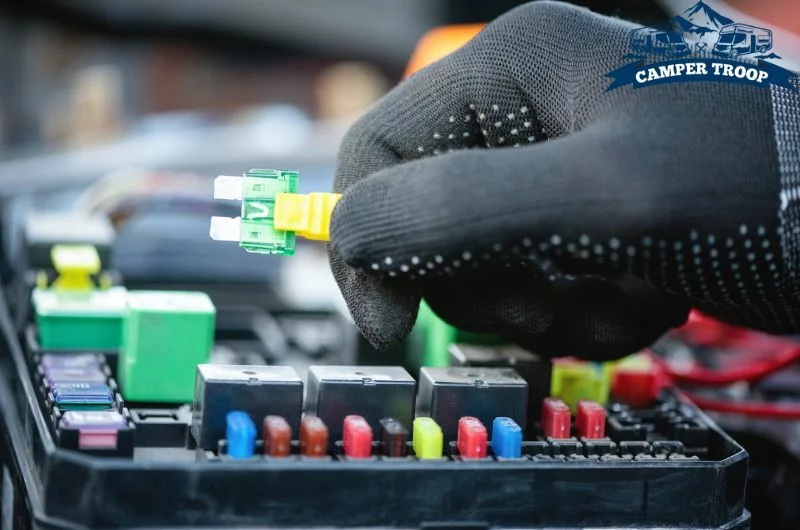
Many RV 12V circuits use automotive-style blade fuses. Replace a blown fuse with the same type and amperage.
| Blade fuse type | How to identify it |
|---|---|
| ATC | Standard-size blade fuse with a closed plastic body |
| ATO | Standard-size blade fuse with an open bottom |
| Mini | A smaller blade fuse |
| Maxi | A larger blade fuse used for higher-current circuits |
What Is the Difference Between the 12V Fuse Panel and the 120V Breaker Panel?
RVs have two separate protection systems. Fuses protect 12V DC circuits, while breakers protect 120V AC circuits. Some 120V outlets also have GFCI protection.
| Feature | 12V DC fuse panel | 120V AC breaker panel |
|---|---|---|
| Protection | Fuses | Circuit breakers, plus GFCI protection on some outlets |
| Example loads | Lighting, fans, water pump | Air conditioner, dryer, 120V outlets |
| After a fault | The fuse must be replaced | The breaker trips and can be reset |
| Rating source | Fuse panel label or owner’s manual | Breaker panel label or owner’s manual |
An RV’s fuse box is located in its electrical panel, and the panel’s location varies by model. The converter may also have its own fuses.
Why Does a 15 Amp Fuse Keep Blowing in an RV?
A properly rated fuse that keeps blowing points to a problem in the circuit. The new fuse will not solve that problem. These are the main causes to look for:
- Damaged Wiring: Worn or pinched insulation can create a short.
- Defective Electronics: A failing motor or device can draw too much current.
- Wrong Fuse Type: A fuse rated below what the circuit specifies can fail during normal use.
- Moisture On The Wiring: Water can reach wires or connections and cause a fault.
- Circuit Overload: Too many devices may be running on the same circuit.
- ARC Issues: Electricity jumping across a gap is a serious fault that needs professional repair.
- Reversed Battery Polarity: Connecting a battery backward can blow converter fuses.
What Is the Difference Between an Overload and a Short Circuit?
An overload happens when devices on a working circuit ask for more current than the fuse allows. The fuse may hold briefly, then blow once the load stays too high.
A short circuit happens when current finds an unintended path, such as a bare wire touching metal. Current can spike fast, so the fuse often blows right away.
Read Also: 6 Most Common Problems with Predator 3500 Generator
How Do You Safely Turn Off RV Power Before Checking a Fuse?
Remove every power source before you touch wiring or connections. An RV can stay live from more than one source.
- Turn off the appliances and devices on the circuit.
- Unplug the RV from shore power.
- Shut off the generator and make sure it cannot auto-start.
- Turn off the inverter.
- Disconnect the battery. A battery disconnect switch may leave some circuits live, so check your manual.
- If your RV has solar, follow the system’s instructions to isolate it too.
How Do You Check a Blade Fuse?
Pull the fuse and look through the plastic body. A broken metal strip means the fuse has blown. If the fuse looks fine, test it.
- Remove the fuse from the panel.
- Set a multimeter to continuity or low ohms.
- Touch one probe to each metal blade.
- A beep or a reading near zero means the fuse has continuity. No beep or an open-circuit reading means it has blown.
How To Fix 15 Amp Fuse Blowing Issue in RV?
Replace the blown fuse once with the same type and rating. Airstream’s 2007 Safari manual says to use the same size, never a larger one, and to have an electrician or certified RV technician locate the trouble if the fuse opens again.
Do not keep feeding new fuses into a circuit that keeps blowing them. The checks below can help you narrow down the cause and give a technician useful details.
Use The Right Fuse For Right Device
Confirm that the fuse matches the rating listed for that position. A 15 amp fuse in a 20 or 30 amp position blows only when current exceeds its limit, so it may not blow right away. It is still the wrong fuse and can cause repeated failures.
A fuse rated too high creates the opposite problem. It is less likely to blow and can allow a dangerous overload.
Most RVs have circuit names on the fuse panel, but some older RVs do not. If yours is unmarked and you do not have the manual, look up the manual for your exact RV model or ask the manufacturer.
How Do You Find Which Device Is Blowing the Fuse?
Isolate the circuit by bringing its devices back one at a time. This lets you do the test with a single replacement fuse.
- With the power off, use the panel label or manual to identify everything on that fuse.
- Switch off, unplug, or disconnect each device you can safely reach.
- Install one new fuse of the correct type and rating, then restore power.
- Turn on or reconnect one device at a time, with power off whenever you reconnect wiring.
- If the fuse blows, stop and note what you had just turned on. Do not install another fuse.
If the fuse blows with every device off or disconnected, the fault may be in the wiring. Leave the fuse out and call a technician.
How Do You Measure Current Draw on a 12V Circuit?
A DC-capable clamp meter is the simplest tool for this job. Many clamp meters read AC only, so check yours before you start. Only test a circuit that shows no signs of damage or overheating.
- Set the meter to DC amps and zero it if your model requires that.
- Clamp it around one wire only. Clamping both the positive and negative wires will give a false reading.
- Turn on the circuit’s devices one at a time and watch the reading.
- Compare the reading with the fuse rating and the device’s listed current draw.
A reading near the fuse rating suggests an overload or a device working too hard. A multimeter can also measure current, but it must be wired in series and the circuit’s current must stay within the meter’s amp limit. If you are unsure how to do that, leave this test to a technician.
Check The Wiring
Wires connect each device to the fuse panel. When there is a problem with the wiring, the 15 amp fuse can blow even after you replace it, because the fuse is not the real problem.
First, determine which 15 amp fuse is blowing and which devices are connected to it. With all power off, check the wiring you can reach for damage, tears, pinched spots, corrosion, or moisture.
If you find damaged or wet wiring, do not restore power to that circuit. Have an electrician or certified RV technician repair it and find the source of any water.
Read Also: What Causes Tecma Rv Toilet Red Light? (Explained)
Investigate If Any Connected Electronics Are Damaged
A faulty device on the circuit can keep blowing its fuse. Fuses are not only for older devices, and a new device can fail too.
If your isolation test points to one device, leave it disconnected and have it inspected or replaced. Keep the correct fuse rating in place when the circuit goes back into service.
Check The Circuit Breaker
Circuit breakers protect 120V AC circuits, while 12V DC circuits have their own fuses. A blown fuse does not make a breaker trip repeatedly, and removing a breaker will not fix a fuse that keeps blowing.
If you also have a breaker that keeps tripping, treat it as a separate problem. According to Camping World’s breaker troubleshooting guidance, the breaker may be defective or an appliance may be drawing too much power.
Finding Out The ARC Issue Origin And Resolving it
Arcing happens when electricity jumps across a gap. It can damage electronics and create a fire risk, so it is not a do-it-yourself repair.
If you see sparks or hear buzzing or crackling from a panel, connection, or device, shut off all power and leave it off. Have an electrician or certified RV technician locate and repair the fault.
Read Also: How Much Can A Chevy Suburban 2500 Tow? (Capacity Chart)
Can I Replace a 15 Amp RV Fuse With a 20 Amp Fuse?
No. If the panel label or manual calls for a 15 amp fuse, use a 15 amp fuse. A 20 amp fuse may stop the blowing, but it hides the fault and lets more current flow through wiring meant for a 15 amp limit. That can lead to overheating and fire.
Why Does My RV Water Pump Keep Blowing Fuses?
A water pump that keeps blowing fuses may have a failing motor, a wiring short, or moisture at its connections. Pumps often sit in areas where leaks can reach the wiring, so check for water around the pump and its connectors.
Disconnect the pump and repeat the isolation test. If the fuse holds with the pump disconnected, have the pump and its wiring checked before you reconnect it.
Why Does My RV Furnace Keep Blowing a Fuse?
Repeated furnace fuse failures point to a fault in the furnace or its circuit, or to the wrong fuse rating. Confirm the rating first. If the correct fuse blows again, have a qualified technician inspect the furnace and wiring.
What Size Fuse Does an RV Furnace Use?
There is no single furnace fuse size. It depends on the model, so use the rating shown on the furnace or fuse panel label.
Where Is the RV Furnace Fuse Located?
Start at the 12V fuse block in your RV’s electrical panel and look for a furnace label. The location varies by model, so check the owner’s manual or furnace manual if the panel is not marked.
Why Do Reverse Polarity Fuses Keep Blowing in My RV Converter?
A battery connected backward is a known cause. Airstream’s 2007 Safari manual warns that connecting a battery with reversed polarity will blow the power converter main fuses. Confirm that positive goes to positive and negative goes to negative before you replace anything.
Camping World advises inspecting reverse-polarity fuses for visible breaks and using a continuity tester if you do not see any. Replace a blown fuse with the same type and amperage rating.
If the battery connections are correct and the new fuse blows, the converter, inverter, or connected wiring may have a fault. Have a qualified technician test the system.
When Should You Call an RV Technician or Electrician?
Call a qualified professional when a correctly rated replacement fuse blows, or when you cannot safely find the cause. Stop using the circuit and keep power off if you notice any of these fire risk signs:
- A melted or discolored fuse holder
- Scorched wires or connectors
- A burning smell
- Sparks, smoke, buzzing, or crackling
- Wet wiring or water inside the electrical panel
Also call for help if the problem involves the converter, inverter, or 120V wiring and you are not qualified to work on it. If there is active smoke or fire, get everyone out and call 911.
FAQs.
As 15 Amp fuse blowing on RV is a common issue around, people who use it ask several questions, and here are some of those:
How Can I Tell If My 15 Amp Fuse Is Blown?
One or more devices on that circuit may stop working. Remove the fuse and look for a broken metal strip inside. If the fuse looks fine, test it with a multimeter or continuity tester.
Do All RV Electronics Use 15 Amp Fuses?
No. RVs use different fuse ratings, and the right one depends on the circuit. Air conditioners and 120V outlets are generally protected by AC breakers, not 12V fuses. Check the panel label or owner’s manual.
Where Is The Fuse Box Located On An RV?
Fuse box of an RV is located in the electrical panel that can be in many places, depending on your RV model. See their manual or search online.
Is It Possible That RV Furnace Is The Reason For 15 Amp Fuse Blowing Repeatedly?
Yes, if the furnace is on that circuit and has a fault. Check the panel label to see what the fuse protects and use the listed rating. If the correct fuse blows again, have an electrician or certified RV technician find the fault.
Read Also: Complete Guide on How to Jack Up a Travel Trailer in 4 Steps
Conclusion
Before making any attempt, you must shut down power. It can be very irritating when you replace a fuse and it keeps blowing, but the repeat failure is telling you the circuit needs attention.
Match the fuse to the rating on the panel label, replace it once, and never install a larger fuse. Use the checks above to narrow down the cause. If the correct fuse blows again, have an electrician or certified RV technician find the fault.
It also helps to keep spare fuses in the types and ratings your RV uses. That’s it; best of luck, and feel free to ask further questions.
Read Also: What Is Fullway Termination Valve: And Where Is It Located?