Most Forest River RV water heaters that stop working have a simple cause: no propane, no 12V power, a tripped high-limit (ECO) switch, a bypass valve left in the winter position, or a gas lockout after failed ignition tries. Check those in order. First, find the brand label on the heater, because the fix and the reset location depend on the brand.
Which Water Heater Does Your Forest River RV Have?
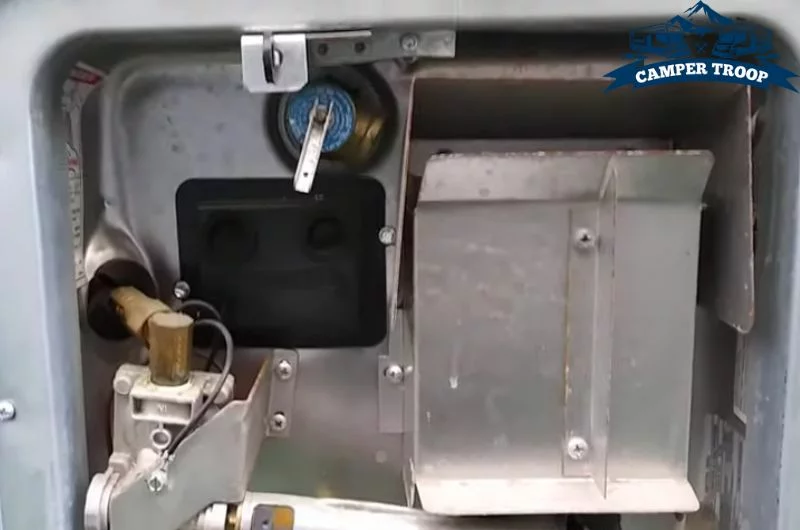
Forest River does not make its own water heaters. It installs units from other brands, most often Suburban or Atwood (now Dometic). Some models have tankless units from Girard or Truma (AquaGo). Open the exterior access door and read the label for the brand and model number. Then use that brand’s manual, since switch locations, reset buttons and parts differ.
This guide covers tank-style Suburban and Atwood/Dometic heaters. Tankless units use error codes instead. See the tankless guide linked below.
Safety Checks Before You Start
- Never run the heater with an empty tank. On electric mode, a dry element burns out fast. On gas, an empty tank can overheat. Open a hot faucet first and make sure water flows steadily with no sputtering air.
- Smell for propane. Propane smells like rotten eggs. If you smell it, turn off the tank valve, put out all flames, open the doors, and do not use switches until the leak is found and fixed.
- Watch for carbon monoxide. A gas water heater must vent outside. Make sure your CO detector works, and never block the exterior vent.
Forest River RV Hot Water Heater Not Working: Reasons and Solutions
Work through these checks in order. The first ones are the quickest and the most likely.
1. Check Both Switches
Many Forest River RVs have separate switches for gas mode and electric mode. Often one is inside, on the wall or control panel, and one is on the heater behind the exterior access door. If only one is on, you only get that mode. If both are off, you get no hot water at all.
Read Also: How to Know Your RV Water Heater Switch On or Off?
2. Check Your Propane
Next, confirm that the water heater is getting propane. Check that the tank valve is open and that the tank has propane in it.
A quick test is to light a stove burner. If the stove lights and the flame is a steady blue, propane is reaching your appliances. If the stove won’t light either, the problem is the tank, valve or regulator, not the water heater.
After you refill or reconnect a tank, the heater may lock out before gas reaches the burner. If that happens, turn the switch off and on again to clear the lockout (see the reset steps below).
3. Check 12V Power
Gas mode still needs 12V DC power. The control board and the ignitor run on the house battery. If the battery is dead or the water heater’s 12V fuse has blown, the burner will not light, even with a full propane tank.
Check the house battery voltage, and look in the 12V fuse panel for a blown water heater fuse. Replace a blown fuse with one of the same rating. If the new fuse blows right away, there is a short, and a technician should find it.
4. Check the Bypass Valve
The bypass valve is used for winterizing. If it is still in the winterize (bypass) position, water skips the water heater tank. You will not get hot water at your kitchen or bathroom faucets.
The valves are inside the camper, on the back side of the water heater. Where you reach them depends on the floor plan. Look for an access panel near the heater. There are usually valves on the hot and cold lines and a bypass valve between them. Set them to the normal flow position so water can fill the tank. Then run a hot faucet until the air is out before you turn the heater on.
Read Also: How to Troubleshoot & Fix RV Tankless Water Heater Problems?
5. Why Does My RV Water Heater Click but Not Light?
When you turn on gas mode, the ignitor clicks to spark the propane. If it clicks for a few seconds and then stops without lighting, the water won’t heat. On direct spark ignition (DSI) units, this usually means the heater has gone into lockout after several failed tries.
Dometic/Atwood gas heaters make three ignition attempts after the switch is turned on. If none of them lights, the unit locks out and the red lockout lamp on the wall switch stays lit.
Common causes include:
- No propane, or air in the line after a tank change.
- Low 12V voltage, which gives a weak spark.
- Spider webs, insect nests or debris in the burner tube or orifice. These are common after storage. Look into the burner tube with a flashlight.
- Wind blowing out the flame. The vent needs open airflow, so never cover it. Try again when the wind dies down, or park so the vent faces away from the wind.
- A dirty, cracked or out-of-place ignitor electrode or flame sensor.
Read Also: Where is the RV Water Heater Reset Button and How To Use It?
6. Check Flame Sensing, the Thermostat and the ECO Switch

Most current water heaters in Forest River RVs, such as Suburban DSI and Dometic/Atwood models, use direct spark ignition. The control board senses the flame. If it can’t sense a flame, it shuts off the gas and locks out after three failed tries. Thermocouples are found mainly on older pilot-light models.
The heater also has a thermostat that controls water temperature and an ECO (high-limit) switch. The ECO is a safety cutoff that shuts the heater off if the water gets too hot. On Dometic/Atwood units, an ECO trip locks out the heater until it is reset. If the ECO trips again and again, the thermostat may be bad, or the ECO itself may be failing.
If the burner lights and then goes out after a few seconds, inspect the flame sensor or electrode for dirt, corrosion or damage. Look up your model’s manual before you clean or adjust it.
Read Also: Why Does My RV Water Heater Sound Like A Jet Engine?
7. Why Does My RV Water Heater Work on Gas but Not Electric?
Electric mode needs 120V AC from shore power or a generator, and it has its own switch. If gas works but electric doesn’t, the cause is usually one of these: the electric switch is off, the 120V breaker is tripped, or the heating element has burned out. A burned-out element is common if the heater was ever turned on with an empty tank.
Check that you have shore power or the generator is running. Then check the water heater breaker in the 120V panel and reset it if it tripped. If it trips again, stop and find the cause before you reset it a second time.
Read Also: All About RV Water Heater (9 Things You Should Know)
8. Test the Heating Element and ECO With a Multimeter
- Turn off the 120V breaker and the 12V power to the water heater.
- Open the exterior access panel and remove the cover from the electrical box.
- Take a photo of the wiring, then disconnect the wires from the part you are testing.
- Set the multimeter to resistance (ohms) and touch the probes to the two element terminals. An open reading (no continuity) means the element is bad. Compare any reading to the value in your model’s manual.
- Test the ECO switch across its terminals when the water is cool. It should show continuity. An open ECO on cool water means it is tripped or has failed.
- Reconnect the wires as shown in your photo, then replace the cover.
To replace the element, you have to drain the tank first. If you are not comfortable working on 120V wiring, have a technician do this test.
How to Reset a Forest River RV Water Heater

There are two kinds of reset. One clears a gas ignition lockout. The other resets a tripped ECO switch. Neither one means holding a button for several seconds.
Step 01: Fix the cause first
Make sure the tank is full of water, the propane is on, and the 12V power is good. A reset won’t help if the cause is still there.
Step 02: Clear a gas lockout
Turn the water heater switch OFF. Wait about five seconds, then turn it back ON. On Dometic/Atwood units, the red lockout lamp should go out, and the heater will try to light three more times.
Step 03: Find the ECO reset if it still won’t heat
Turn off the switches and the breaker. Open the exterior access panel. The ECO (high-limit) reset is near the thermostat. You will not find a residential-style upper thermostat with a cover here. Not every model has a separate ECO reset button, so check your manual.
Step 04: Press the ECO reset once
On models that have an ECO reset button, press it once. Then close the access panel.
Step 05: Turn the power back on
Switch the breaker and the water heater switches back on.
Step 06: Test the water heater
On gas, listen for the burner to light. Give the tank time to heat, then check a hot faucet. If the heater locks out or trips again, the problem needs repair, not another reset.
Read Also: How To Tell If Your RV Tank Heaters Are Working?
Is It Normal for the Pressure Relief Valve to Drip?
An occasional drip from the pressure/temperature (P/T) relief valve while the water heats is normal, because heated water expands. A valve that keeps discharging is not normal. On Dometic/Atwood heaters, it often means the tank’s air gap is gone.
- Turn off the water heater and the water supply.
- Let the water cool completely. Dometic warns that you can be scalded if the water is still hot.
- Open the nearest hot faucet.
- Pull the P/T valve handle and hold it open until the water stops flowing.
- Release the handle, close the faucet, and turn the water back on.
If the discharge keeps coming back, Dometic recommends a permanent fix. You can add a pressure relief valve on the cold inlet line set to relieve at 100-125 PSI. Or you can add a diaphragm-type expansion tank on the cold inlet. If the valve leaks constantly even with a good air gap, it may be faulty and need replacing.
How Do You Make a Forest River RV Water Heater Last Longer?
How long a water heater lasts depends on its model, how much you use it, how well you maintain it, and how well it was installed. Regular maintenance makes the biggest difference.
- Flush the tank from time to time to remove sediment. Always let the water cool and turn off the water pressure before you drain it.
- Check and replace the anode rod on steel-tank units such as Suburban. Aluminum-tank Atwood/Dometic units do not use an anode rod, and Dometic advises against adding aftermarket anode rods.
- Inspect the pressure relief valve.
- Look for leaks, damage and insect nests in the burner area, especially after storage.
For a correct, manufacturer-approved installation, use a qualified RV technician. If your water heater is old and needs major repairs, replacing it may make more sense than fixing it.
Read Also: 5 Common Reasons Why Your RV Water Heater Won’t Shut Off
When Should You Call an RV Technician?
Call a certified RV technician if you smell propane or find a gas leak. You should also call one for work on the gas valve, control board or burner, if the ECO keeps tripping, or if fuses or breakers keep blowing. Gas and 120V repairs carry real fire and shock risks.
FAQs
Is there a reset button on the Forest River RV water heater, and how do I use it?
It depends on the brand and model. To clear a gas ignition lockout, turn the water heater switch OFF, wait about five seconds, and turn it back ON. If the ECO (high-limit) switch has tripped, find its reset near the thermostat behind the exterior access panel and press it once, on models that have one.
Is it better to repair or replace my Forest River RV water heater if it’s not working?
It depends on how bad the problem is, how old the heater is, and how the repair cost compares to a new unit. If the repair is expensive or the heater is old, replacing it may cost less in the long run.
What are the common reasons for a malfunctioning Forest River RV water heater?
Common reasons for a malfunctioning Forest River RV water heater include:
- A blown fuse.
- Tripped circuit breaker.
- Faulty heating element.
- Depleted or faulty anode rod (steel-tank models).
- Gas supply issues.
- Thermostat or ECO switch problems.
- Sediment buildup.
- Ignition lockout (or a faulty pilot light on older models).
Final Words
Most hot water problems in a Forest River RV come down to switches, propane, 12V power, the bypass valve or a lockout. Start with your heater’s brand and manual, work through the easy checks first, and leave gas and control board repairs to a technician.