Quick answer: The most common Arctic Fox truck camper problems are exterior wall delamination, roof and sealant leaks, electrical faults, toilet and plumbing issues, and strain on the truck’s tires, suspension and brakes from too much weight. Most of these start with water getting into the walls or with a camper that is too heavy for the truck. Regular sealant checks and a payload check prevent many of them.
Is your Arctic Fox truck camper giving you trouble? Are the same problems coming back again and again? If so, no worries. This guide walks you through each common problem, what causes it, and how to fix it.
Some fixes are easy DIY (do-it-yourself) jobs. Others need a trip to an RV shop. Don’t fret. We will tell you which is which and guide you through the steps.
Who Makes Arctic Fox Truck Campers?
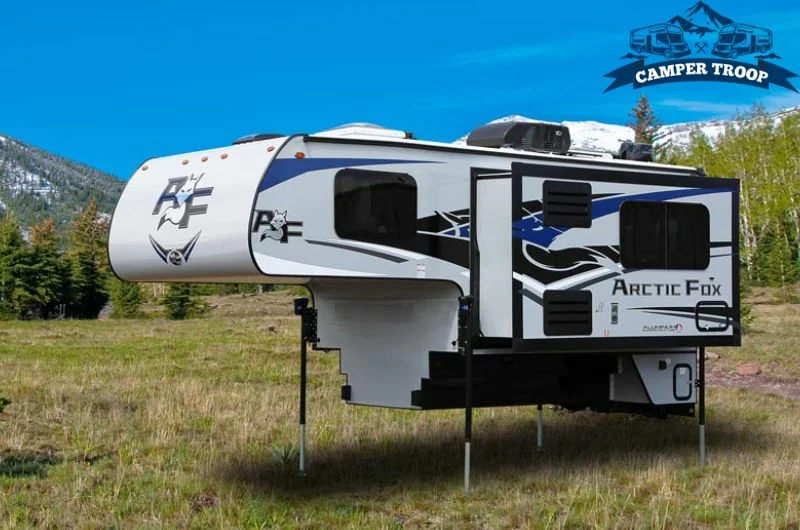
Arctic Fox truck campers are built by Northwood Manufacturing in La Grande, Oregon. The wall panels are laminated with polyurethane adhesive and then CNC-routed for windows, doors and slide-outs, according to a Truck Camper Magazine factory tour.
Arctic Fox campers are slide-in campers. They ride in the bed of a pickup truck. Current floor plans include the 865, 1140 and 1150. Older models, such as the 992, are common on the used market.
How Much Does an Arctic Fox Truck Camper Weigh?
Arctic Fox truck campers have listed dry weights of about 2,600 to 3,500 pounds, depending on the floor plan. Dry weight means no water, propane, food, gear or people. Your real weight on the road will be higher.
| Model | Listed dry weight |
|---|---|
| 2025 Arctic Fox 865 | 2,641 lbs |
| 2022 Arctic Fox 992 | 3,235 lbs |
| 2025 Arctic Fox 1150 | 3,358 lbs |
| 2024 Arctic Fox 1140 (used listing) | 3,465 lbs |
Sources: RVGuide 2025 865 specs and RVGuide 2025 1150 specs. Always check the weight sticker on your own camper, since options change the number.
What Are The Common Problems With Arctic Fox Truck Campers?
It’s unusual for a big rig to run smoothly without any hiccups. Arctic Fox truck campers are no different. These are the four problems owners run into most often:
- Issues Regarding the Camper’s Exterior Walls
- Electrical Faults
- Truck Tire, Suspension and Brake Strain from Camper Weight
- Toilet-related Problems
Further down, we also cover roof leaks, jacks and tie-downs, slide-outs, and propane appliances.
4 Common Problems with Arctic Fox Truck Campers & Their Solutions:
Common problems usually have common fixes. Below, each problem has its symptoms, causes, steps to fix it, and what to expect on cost. Let’s dive straight in.
Problem 1: Issues Regarding the Exterior Wall
Wall problems, mainly delamination, come up more than anything else on owner forums. The good news is that delamination is easy to see and feel. The common symptoms include:
- Small bumps felt on the walls
- Elevated surfaces
- Wavy or rippled fiberglass, often near windows, doors or roof edges
- Soft or spongy spots when you press on the wall
What Is the Cause Behind This Problem?
Arctic Fox walls are laminated panels. From outside to inside, each panel has a one-piece fiberglass exterior skin, a luan (thin plywood) backing, foam block insulation, and an interior panel. The layers are bonded with polyurethane adhesive over a welded aluminum frame. There is no fiberglass skin on the inside.
Delamination happens when the fiberglass skin lets go of the luan behind it. These could be some of the causes:
- Excessive exposure to sunlight
- Water leakage, often from failed sealant around windows, vents, lights or roof seams
- The constant strain of the fiberglass
How Do You Spot Delamination Early?
- Look down the length of each wall in low, angled light. Ripples stand out this way.
- Press gently with your palm around every window, door and light. Feel for give or a hollow spot.
- Check inside for water stains, soft paneling or a musty smell near the same spots.
- Inspect the sealant above each problem area. Delamination almost always sits below a leak.
How to Troubleshoot this Problem?
This issue is best handled by a professional. However, if you want to try a small repair yourself, here is the basic injection method:
- Find and fix the leak first. Reseal the window, vent or seam above the damage. Let the wall dry out fully before you glue anything.
- Buy a delamination repair kit from a reputable brand. Follow its instructions where they differ from these steps.
- Drill small holes through the fiberglass skin into the gap behind it. Go only deep enough to reach the separated layer. Do not drill through the foam into the interior.
- Fill the holes with the adhesive from the delamination kit.
- Press the skin flat with padded boards or clamps while the adhesive cures.
- Fill and seal the holes once the glue has hardened.
- Clean off any excess glue.
When to go pro: If the luan behind the skin is rotted, or the damage covers a large area, injection will not hold. That job usually means replacing the wall panel or skin. Take it to an RV body shop.
What Is the Price Range for the Fix?
A DIY kit is the cheapest route for a small, dry spot. Professional repair costs depend on how big the damaged area is and whether the wood behind it has rotted. Full panel replacement is a major job. Get written quotes from more than one RV body shop before you commit.
Read Also: 5 Common Issues with Sandstorm Toy Hauler: How to Fix Them?
Problem 2: Electrical Faults
Electrical faults are common for Arctic Fox owners. The fault can be small, like a blown fuse, or bigger, like a fridge that won’t run. Let’s start with the symptoms.
- Issues with the microwave
- Issues with the fridge
- Issues with the air conditioning
- Lights, fans or the water pump not working
What Is the Cause Behind This Problem?
The main cause is power supply. Most electrical faults happen because an appliance is not getting enough power. Your camper has two systems: 120-volt AC (shore power, generator or inverter) and 12-volt DC (the battery). The main culprits are:
- Faulty wirings
- Faulty battery system
- Tripped breakers or blown fuses
- Loose connections from road vibration
How to Troubleshoot This Problem?
Before anything else, make sure you are comfortable working with electricity. If you are unsure, don’t rush it. Call an RV technician instead.
Safety first: Before you open any panel or touch wiring, unplug shore power, turn off the generator and inverter, and disconnect the battery. Both 120-volt and 12-volt systems can hurt you or start a fire.
The solution to the issue includes the following:
- Check which appliances work and which don’t. If everything on 120 volts is dead, the problem is your power source or main breaker. If only 12-volt items (lights, fans, pump) are dead, check the battery and fuse panel.
- If your air conditioner or fridge is not working, try looking into the 120-volt power supply. Check the shore power cord, the pedestal breaker and the camper’s breaker panel.
- If your microwave or another single 120-volt appliance is not working, check its breaker at the power converter panel.
- Check the battery voltage and clean any corroded terminals. A weak battery can cause odd faults across the camper.
How Do Fridge Modes Affect Troubleshooting?
Many truck camper fridges are three-way absorption units. They can run on propane, 12-volt DC or 120-volt AC. Others are 12-volt compressor fridges. Check your fridge’s label or manual to know which you have. For a three-way fridge, test each mode on its own:
- Works on propane, not on 120V: Check the outlet behind the fridge, the breaker, and the 120V heating element.
- Works on 120V, not on propane: Check that the propane tank is open and full, and that other propane appliances light. Then suspect the igniter or burner.
- Fails only on 12V: Check the fridge fuse and the truck-to-camper charge connection. The 12V mode is usually meant for driving.
- Fails on every mode: The control board or cooling unit may be the issue. This is a job for a technician.
Also note that absorption fridges cool best when the camper is close to level.
What Is the Price Range for the Fix?
The price depends on the problem. A fuse or breaker costs very little. Calling a repair tech for the one appliance that failed is usually cheaper than paying for a full system check.
Here’s a small list of rough replacement estimates. Prices vary by model and shop, so get a quote:
- A/C – about $600
- Power inverter – $2000
- Fridge – $1000
Read Also: Common Rockwood RV Problems & Solutions
Problem 3: Truck Tire, Suspension and Brake Strain
An Arctic Fox truck camper has no tires, axles or brakes of its own. It rides in the pickup’s bed. That means your truck’s tires, suspension and brakes carry and stop the camper’s full weight. This affects safety, so watch for these signs:
- Sudden jerks
- Brakes taking too long to work
- Uneven or fast tire wear
- Rear end sagging, body sway or wandering on the highway
What Is the Cause Behind This Problem?
Weight! Arctic Fox campers have dry weights of about 2,600 to 3,500 pounds. Add water, propane, gear and passengers, and the load on the truck goes up a lot. If that total is more than the truck’s payload rating, the tires, springs and brakes work beyond their limits. Summarizing everything:
- Overloading past the truck’s payload rating
- Tires run below the pressure listed for the load
- Off-road tracks
How Do You Troubleshoot This Problem?
Start with tires, since that is the easiest check. Caution is still needed. If you notice a worn-out or low tire, follow these steps:
- Check the pressure on every tire when the tires are cold. Compare it to the pressure on your truck’s door-jamb sticker and your tire’s sidewall limit.
- If a tire is flat or damaged, park on firm, level ground. With a camper loaded, the truck is very heavy. Use a jack rated for the load and never get under the truck on a jack alone.
- Loosen the lug nuts with a wrench, lift the truck, and remove the wheel.
- Mount the spare and tighten the lug nuts in a star pattern to the truck maker’s torque spec.
If your brakes are not working properly, go to a nearby shop and get them fixed. Brakes are a safety-critical part of the truck and should be handled by a pro. Also weigh your loaded rig at a truck scale to see if overloading is the root cause.
What Is the Price Range for the Fix?
Tire and brake costs depend on your truck, not the camper. Buy tires with a load rating that fits your loaded weight, since they will last longer. For brakes, get a quote from your truck dealer or a brake shop. The cheapest fix is often prevention: carry less weight and keep tires at the right pressure.
Read Also: Common Northern Lite Truck Camper Problems & Solutions
Problem 4: Toilet and Sink Problems
Toilet and sink problems are smaller than the others, but they still make the list. They are usually simple and cheap to fix. Look into them if you notice:
- Bubbling of the water
- Urine smell
- Black water coming out
- Slow sink drains or water under the sink
What Is the cause Behind This Problem?
Toilet issues come from a group of common causes. These include:
- Clogging in the pathway
- Blocked vent
- Blocked or partially blocked black water tank
- A worn toilet seal that no longer holds water in the bowl
When waste can’t pass freely, or air can’t vent out the roof, you get bubbling, smells and backups. Here is how to fix each one.
How Do You Troubleshoot This Problem?
Why is my RV toilet bubbling? Bubbling usually means air can’t escape through the vent, or the tank or pipe is clogged. Try these three things:
- Check your roof vent for any blockage. Also, look underneath the vent cap just to be sure. If there is any debris, clean it out.
- Add plenty of water and an RV-safe tank treatment to the toilet. Let it sit, then drive or wait before dumping. This helps break down clogs.
- Empty and flush the black water tank completely (steps below).
Why does my RV toilet smell? Smells usually mean the seal is leaking or the tank needs cleaning:
- It might be a sign to clean out your toilet and tank
- Change the seal if water drains out of the bowl between flushes
- Keep some water in the bowl. It blocks tank odors from coming up.
How Do You Flush the Black Tank?
- Put on gloves and connect your sewer hose to the camper and the dump station.
- Open the black tank valve first. Let it drain fully.
- Close the black valve. Add fresh water through the toilet or the tank flush inlet, if your camper has one.
- Open the valve again and drain. Repeat until the water runs mostly clear.
- Drain the gray tank last. Its soapy water helps rinse the hose.
- Close all valves and add a few gallons of water plus tank treatment to the black tank.
Why Do My Holding Tank Sensors Read Wrong?
Tank sensors often read “full” when the tank is empty. Waste or paper sticks to the sensor probes inside the tank. Flush the tank well, use plenty of water with each flush, and use a tank treatment. If the reading is still wrong after a good cleaning, a sensor or wire may have failed.
How Do You Fix Sink and Plumbing Leaks?
- Turn off the water pump and city water before you start.
- Dry the area under the sink, then run water and watch for the drip.
- Hand-tighten loose drain fittings (P-trap nuts). Road vibration often loosens them.
- Replace cracked fittings or worn washers. Check PEX connections for drips at the crimp rings.
- For slow drains, clear the P-trap. Don’t use harsh drain cleaners unless they are labeled safe for RV plumbing and tanks.
- After winter, check for freeze damage before you fill the system.
What Is the Price Range for the Fix?
Honestly, this is the cheapest fix and would mostly require manpower over money. Still, we suggest a little over $100, just in case you need to buy any spare parts.
Read Also: Common Tiffin Allegro Breeze Problems & Solutions
What Other Arctic Fox Problems Should You Watch For?
Beyond the big four, owners also deal with roof leaks, jacks and tie-downs, slide-outs, and propane appliances. Catching these early keeps them from turning into bigger problems.
Roof Leaks and Sealant Wear
Roof leaks are the main cause of wall delamination. Water gets in through cracked sealant around vents, the A/C, skylights, antennas and roof edges. It then runs down inside the walls.
How often should you reseal a truck camper roof? Inspect the roof sealant at least every spring and fall, and after any hard off-road trip. Reseal any spot that is cracked, peeling or pulling away. Follow your owner’s manual and the sealant maker’s guidance for full resealing.
- Clean the area and let it dry.
- Remove loose or cracked old sealant.
- Use a sealant that is made for your roof material and compatible with the old sealant.
- Apply a full bead with no gaps, and let it cure before rain or travel.
Camper Jacks, Tie-Downs and Turnbuckles
The corner jacks lift the camper on and off the truck. Tie-downs and turnbuckles hold it to the truck frame. Problems here can be dangerous.
- Jacks stick or won’t move: Clean and lubricate them as the jack maker says. For electric jacks, check the battery, fuses and remote first.
- Uneven lifting: Raise the jacks a little at a time and keep the camper level. Uneven loading stresses the camper body.
- Turnbuckles work loose: Check them before every trip and at stops along the way. Snug them, but don’t over-tighten. Too much force can strain the camper’s mounts.
- Cracked or bent tie-down mounts: Stop using the rig and have the mounts repaired. Never drive with a loose camper.
Never stand or crawl under a camper resting on its jacks.
Slide-Out Problems
Slide-out models add space, but they add moving parts and seals that can fail.
- Slide won’t move or moves slowly: Check battery voltage and the slide fuse or breaker. Low voltage is a common cause.
- Leaks around the slide: Inspect the rubber seals for tears or flat spots. Clean them and treat them with a seal conditioner.
- Grinding or jamming: Clear debris off the slide roof before bringing it in. Lubricate the mechanism only as the manual says.
- Before driving: Make sure the slide is fully in and locked.
Propane, Furnace and Water Heater Problems
If you smell propane: Turn off the tank valve, don’t use flames or switches, open doors and windows, and leave the camper. Have the system checked by a qualified technician before you use it again. Test your propane detector regularly.
- Furnace won’t light: Check that propane is on and the tank isn’t empty. Check battery voltage, since the furnace fan and controls run on 12 volts. Make sure the outside vents aren’t blocked by bugs or debris.
- Water heater won’t heat: Make sure the tank is full of water before you turn it on. Check that bypass valves are set for normal use, not winterizing. Check the propane supply or 120V breaker, depending on the mode.
- Burners light then go out: Low propane pressure or a dirty burner is a likely cause. Leave regulator and gas-line work to a pro.
How Do You Match an Arctic Fox to Your Truck’s Payload?
Your truck’s payload rating must be higher than the camper’s loaded weight plus everything else in the truck. Dry weight alone is not enough. Use these steps:
- Find your truck’s payload on the Tire and Loading Information sticker on the driver’s door jamb.
- Find your camper’s dry weight on its weight sticker or spec sheet.
- Add water, propane, batteries, food, gear, options and every passenger.
- Add the weight of any tie-downs, hitch or accessories on the truck.
- Make sure the total stays under the payload, and that each axle stays under its rating.
- Weigh the loaded rig at a truck scale to confirm.
What Truck Do You Need for an Arctic Fox 1150?
The 2025 Arctic Fox 1150 has a listed dry weight of 3,358 pounds. Loaded for camping, it will weigh much more. You need a heavy-duty pickup whose door-jamb payload covers that full loaded weight, plus people and gear in the cab. Don’t pick a truck by its class name alone. Two trucks in the same class can have very different payloads.
What Happens If You Overload Your Truck?
- Tires run hot and can fail, especially if under-inflated.
- Springs sag, and handling gets loose and tippy.
- Brakes take longer to stop the truck and wear out faster.
- Frame, wheels and tie-down mounts take extra stress.
Are Arctic Fox Truck Campers Good Quality?
Arctic Fox campers are built for four-season use. Dealer listings describe a fully welded, thick-wall aluminum frame, a one-piece fiberglass skin and four-season foam block insulation. That is solid construction. Still, no camper is free of problems. Most owner complaints trace back to water leaks and to trucks that are carrying too much weight.
Is Arctic Fox Better Than Lance or Northern Lite?
There is no single “best” brand. We could not find a verified reliability ranking that compares Arctic Fox, Lance and Northern Lite. Each brand builds its campers differently, and each has fans. Instead of picking by name, compare these points for the exact models you are looking at:
- Weight: Does the loaded weight fit your truck’s payload?
- Construction: Frame material, wall build and how the roof is sealed.
- Climate: Insulation and tank heating if you camp in the cold.
- Floor plan: Slide-outs add space but also add weight and parts to maintain.
- Support: Warranty terms and how close a dealer or service shop is.
Our Northern Lite truck camper problems guide covers that brand’s common issues if you are comparing.
Are There Recalls or Warranty Coverage for Arctic Fox Campers?
We could not verify a list of specific Arctic Fox model years with known defects. To check your own camper, search its VIN on the NHTSA recall lookup at nhtsa.gov/recalls. Recall repairs are done free by an authorized dealer.
For warranty terms, check your owner’s paperwork or contact Northwood Manufacturing or your dealer. Ask what is covered, for how long, and whether coverage transfers to a second owner. Keep receipts for sealant checks and maintenance, since warranty claims for leaks may depend on them.
How Do You Inspect a Used Arctic Fox Before Buying?
- Walls: Sight down each wall for ripples and press for soft spots, especially below windows and roof edges.
- Roof: Get up top, if it is safe, and check every sealant line for cracks or gaps.
- Interior: Look for water stains, soft floors, and musty smells in cabinets and the cab-over area.
- Jacks and mounts: Run all jacks up and down. Inspect tie-down points for cracks.
- Slide-out: Run it in and out a few times. Check the seals and listen for grinding.
- Appliances: Test the fridge on each mode, the furnace, water heater, A/C, lights and pump.
- Plumbing: Fill the fresh tank, run every faucet, flush the toilet and look for leaks underneath.
- Paperwork: Check the VIN for open recalls and confirm the camper’s weight sticker.
- Pro help: If you aren’t sure, pay an RV inspector before you buy. Moisture meter readings can find hidden leaks.
Conclusion
Owning an Arctic Fox truck camper takes regular care. It is a heavy load for your truck and a lot of seals for water to find. We advise you to take your truck and camper for a maintenance check at least every 6 months.
Every maintenance check would cost a couple of hundred bucks. It should cover basics like tire pressure, brakes, sealant and tie-downs. This helps you avoid the problems we have covered above.
We hope this article helps you solve your problems. Take good care of your camper and truck, and contact a professional if you notice anything you can’t fix safely. Have a good day!
Read Also: Common Roadtrek Zion Problems & Solutions
Frequently Asked Questions
Why is my RV toilet bubbling or smelling?
RV toilet bubbling usually means air can’t escape through the roof vent, or the tank or pipe is clogged. Clear debris from the vent and under its cap, add water and an RV-safe tank treatment, then fully flush the black tank. A smell often points to a worn toilet seal or a tank that needs cleaning.
How often should you reseal a truck camper roof?
Inspect truck camper roof sealant at least every spring and fall, and after any hard off-road trip. Reseal any spot that is cracked, peeling or pulling away. For a full reseal, follow your owner’s manual and the sealant maker’s guidance. Use a sealant made for your roof material that works with the old sealant.
Can you fix truck camper delamination yourself?
You can fix small, dry delamination spots yourself with a delamination repair kit. First fix the leak and let the wall dry. Then drill small holes into the gap, inject adhesive and clamp the skin flat while it cures. If the wood behind the skin is rotted or the area is large, see an RV body shop.
Does an Arctic Fox truck camper have its own brakes or tires?
No. An Arctic Fox truck camper is a slide-in camper with no tires, axles or brakes of its own. It rides in the pickup’s bed, so the truck’s tires, suspension and brakes carry and stop its full weight. Keeping the loaded weight under the truck’s payload rating protects those parts.
Why won’t my truck camper slide-out move?
A slide-out that won’t move or moves slowly most often has a power problem. Check battery voltage first, then the slide fuse or breaker, since low voltage is a common cause. If it grinds or jams, clear debris off the slide roof. Lubricate the mechanism only as your owner’s manual says.
What should you do if you smell propane in your camper?
If you smell propane, turn off the tank valve right away. Don’t use flames or switches. Open the doors and windows and leave the camper. Have a qualified technician check the system before you use it again. Test your propane detector regularly so it can warn you early.