Quick answer: The most common Keystone Hideout problems are roof leaks, floor damage from water, clogged toilets and black tanks, kitchen faucets with low flow, and trouble changing a flat tire safely. Owners also run into AC dust, electric brake issues and faulty tank sensors. Regular roof checks, at least every 90 days, prevent the most costly damage.
Like any other vehicle, the Keystone Hideout runs into issues. Some issues are common. Average people with basic mechanical knowledge and the right preparation and research can handle these common issues.
On the other hand, some issues require skill sets and professional help. The most common RV issues with the Keystone Hideout include, but are not limited to, too much dust coming out of the AC, faulty brakes, plumbing leaks, water tank issues, floor issues, and a leaky roof.
In the rest of the article, we will discuss these issues, including the causes, symptoms, and simple fixes. We also cover recalls, warranty claims, and when to call a dealer instead of doing it yourself.
What Are the Common Problems With Keystone Hideout?
An RV is big. Just like your actual home, it runs into many kinds of issues. Our purpose here is to cover the most common ones first, then the others owners should watch for.
Here is a list of five common issues that owners often encounter. Later in this article, we’ll discuss the simple solutions to these problems. Keep reading.
- Issue with Changing a Flat Tire
- Clogged Toilet
- Kitchen Faucet Stopped Working
- Leaky Roof
- Floor Issue
This table gives you a quick view of each problem and who should usually fix it.
| Problem | Common cause | DIY or dealer? |
|---|---|---|
| Flat tire | Wrong pressure, overloading, old tires, road debris | DIY with the right tools and safety steps |
| Clogged toilet / black tank | Toilet paper build-up, too little water | DIY in most cases |
| Faucet low flow | Clogged aerator, cartridge, filter or empty tank | DIY in most cases |
| Leaky roof | Cracked or worn sealant at seams and fixtures | DIY for small reseals; dealer if water damage is found |
| Soft or loose floor | Water damage, failed glue | Dealer or RV repair shop |
| AC dust, weak airflow | Dirty filters, dust in ducts | DIY for filters; tech for the AC unit |
| Electric brakes | Controller settings, wiring, worn parts | Check settings yourself; shop for brake repairs |
| Tank sensor errors | Waste or residue on sensors | DIY flush first |
Is the Keystone Hideout Still Being Made?
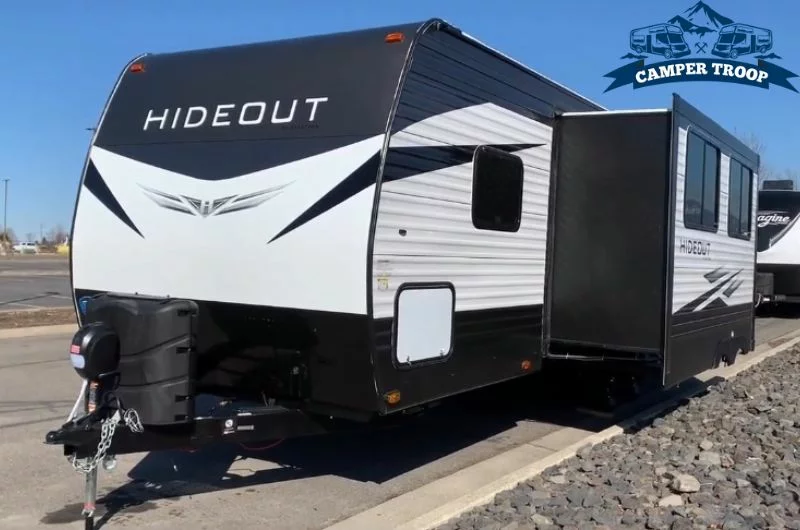
Keystone has sold Hideout travel trailers over many model years. They range from small single-axle models, such as the 2017 Hideout 177LHS (example listing), to larger tandem-axle floorplans.
Floorplans and features change from year to year. To see what is built today, check Keystone’s website or ask a Keystone dealer. The problems in this guide apply to most travel trailers of this type, whatever the model year.
5 Common Problems with Keystone Hideout & How to Solve Them:
Troubleshooting means finding the cause and then solving the issue. When a Keystone Hideout issue appears, the best strategy is to find the root cause first, then try the simple fixes.
If the problem is severe, find a mechanic for professional help. And of course, never forget to check the owner’s manual for your model year. You will get a detailed discussion of the issues here.
Problem 1: Keystone Hideout Issue with Changing a Flat Tire
Flat tires, as we all know, are a very common occurrence for any vehicle owner. Road debris, concrete, or other bad elements are responsible for this issue. The main concern for the owner is actually how to replace the old one.
While changing the tire, you may want to know whether you need to put the bottle jack under the axle or the frame. Similar to this question, you may have other questions too. We will address this question in the strategy section below.
What causes the Keystone Hideout Flat Tire Issue?
Wear and tear or the tire being too old are the common reasons for a flat tire. Many other reasons include the following.
- Tire pressure is not accurate
- Towing or loading more than its limitation
- Tire Leaks
- Rubbed or leaked Tires
How to Fix Keystone Hideout Issue With the Changing Flat Tire?
As stated, many Keystone owners find it hard to replace a tire. In this section, we answer the question about how to lift the trailer.
To change the tire, you have to lift that wheel off the ground. On a tandem-axle trailer, many owners use a ramp-style tire changer, such as the Trailer Aid. You pull the good tire on the same side up onto the ramp. That lifts the flat tire so you can change it.
Some owners also use a bottle jack. However, we could not confirm from Keystone that the axle is an approved jack point. Check your owner’s manual or ask your dealer before you place a jack under the axle or the frame.
Where Do You Put the Jack to Change a Tire on a Travel Trailer?
Use only the lift points shown in your Hideout’s owner’s manual. Lift points can differ by axle and suspension type. Never use the stabilizer jacks to lift the trailer. They are made to steady a parked trailer, not to hold its weight.
Follow these safety steps every time:
- Park on flat, firm ground, well away from traffic. Turn on your hazard lights.
- Keep the trailer hitched to your tow vehicle and set the parking brake.
- Chock the wheels on the side you are not working on.
- Loosen the lug nuts slightly while the tire is still on the ground.
- Lift the flat tire with a ramp or at an approved jack point.
- Never put any part of your body under a trailer that is held up only by a jack.
- Mount the spare and tighten the lug nuts in a star pattern.
- Torque the lug nuts to the spec in your manual. Re-check the torque after the first miles of driving, as the manual directs.
How Do You Choose the Right Replacement Tire?
Match the size and load range of your current tires. You can find both on the tire sidewall. Your trailer also has a tire and loading information label, usually near the front on the road side.
- Use ST tires. “ST” means Special Trailer. These tires are built for trailer loads.
- Never go below the original load range. A lower load range may not carry your trailer’s weight.
- Check tire age. The last four digits of the DOT code show the week and year the tire was made. Old tires can fail even when the tread looks good. Ask the tire maker how old is too old for your tires.
How Much Does it Cost to Fix the Flat Tire Issue?
The cost depends on tire size, load range, brand and whether you pay for mounting and balancing. A simple puncture repair costs much less than a new tire. Get quotes from a local tire shop before you buy.
Read Also: Common Tiffin Allegro Breeze Problems & Solutions
Problem 2: Keystone Hideout Clogged Toilet
You flush the toilet, but nothing goes down. Or you open the black tank valve, but nothing comes out, even though the tank is full. This is a common toilet issue people with a Keystone Hideout often encounter.
What causes the Keystone Hideout RV Clogged Toilet Issue?
The build-up of toilet paper or any other material is the most common reason the Keystone RV toilet is clogged. The other reasons include the following:
- Solid waste piled up in the black tank (often called a “poop pyramid”)
- Waste is not flowing into the sewer
- Too little water used with each flush
- Leaving the black valve open at a campsite, so liquids drain and solids stay behind
How to Fix Keystone RV’s Clogged Toilet Issue?
Here is a step-by-step guide to follow. Hopefully, you will be able to resolve the issue.
- Close the black tank valve.
- Add a few gallons of water through the toilet.
- Add an RV-safe tank cleaner or enzyme treatment.
- Let it sit for about 15 hours so the cleaner breaks down the clog.
- Connect your sewer hose and open the black tank valve to drain it.
- Rinse the empty tank with the black tank flush (if your trailer has one) or a tank wand. Then close the valve.
Warning: Do not use household chemical drain cleaners in an RV toilet or tank. Harsh chemicals can damage plastic parts, seals and valves. Use products labeled safe for RV holding tanks.
If the clog will not move after a second try, call a mobile RV tech or a dealer. A blocked valve or pipe may need to be taken apart.
How Do You Prevent Black Tank Clogs?
- Use toilet paper labeled RV-safe or septic-safe. It breaks down faster.
- Use plenty of water with every flush.
- Keep the black valve closed until the tank is mostly full, then dump it all at once.
- Flush the tank with clean water after each dump.
- Never flush wipes, paper towels or feminine products, even if the label says “flushable.”
How Much Does it Cost to Fix the Keystone Clogged Toilet?
Usually, the toilet issue is solved by the cleaner. So in most cases, you only pay for the tank cleaner. If you need a tech to clear a blocked valve or pipe, you also pay for labor. Ask for a quote first.
Read Also: Common Roadtrek Zion Problems & Solutions
Problem 3: Keystone Hideout Kitchen Faucet Stopped Working
Usually, the kitchen tap and sprayer stop working and give just a trickle. Everything else works fine, including the bathroom faucet, toilet, and shower. You may try different fixes, including changing the entire head, but the issue may remain.
What Caused The Keystone Hideout RV Faucet To Stop Working?
A clogged aerator or faulty water filter is one of the most common reasons the faucet is not working. The other reasons include the following:
- Faulty Water filter
- Simply the water tank is empty
- A faulty valve
- Freeze damage to the faucet or lines after a cold night
How To Fix Keystone Hideout RV Faucet Stop Working Issue?
Since there is more than one cause for the problem, various solutions may be used. The best quick fixes are listed below for you to try.
Simple Fix 1: Cleaning
There is a cartridge inside the faucet. Debris in it can cause low pressure, so take it out, check it for debris and clean it. You might be able to fix the problem. Check the backflow preventer as well, because debris may also collect there.
Simple Fix 2: Switching Spray Mode
The supply line to the sink may be clogged and responsible for the issue. Using the button on the head, you can try switching from spray to stream and back again.
To check the flow without the spray head attached, disconnect the spray head. If water flows well without it, the head is the problem. If the flow is still weak, the problem is further back in the supply line, cartridge or filter.
Simple Fix 3: Check the Water Source
If you are on tank water, make sure the fresh tank has water and the pump is on. If you are on city water, check that the inlet filter or screen is not clogged.
How Much Does it Cost to Fix a Faucet that Stops Working?
If cleaning or Simple Fix 2 solves the problem, you do not have to pay anything.
If you have to change the cartridge, the head or the whole faucet, you pay for those parts. Prices vary by brand and style. Check an RV parts store or your dealer for current prices, and bring the old part so you get a match.
Read Also: Common Keystone Cougar Problems & Solutions
Problem 4: Keystone Hideout Leaky Roof
Maybe you left your RV unattended for a few days. When you came back, you found wet bed sheets, damp furniture and a wet floor. A tiny crack in the sealant around a seam or vent may be responsible for all this.
RV owners often experience this kind of situation. It can happen on any Hideout floorplan, from small single-axle models like the 177LHS to larger trailers. Small leaks can often be fixed on your own, but delaying action can lead to serious damage.
What Causes the Keystone Hideout Leaky Roof?
The most common reason for a leaky roof is cracked, shrunken or missing sealant. Check the seams, joints and anything attached to the roof, such as vents, the AC unit, antennas and the ladder.
Road vibration, heat and sun break down sealant over time. Tree branches and walking on the roof can also cause damage.
How Often Should You Reseal a Keystone RV Roof?
Inspect the roof at least every 90 days. Keystone’s roof maintenance guidance says to focus on seams, joints and attachments, then clean and reseal as needed. Also check the maintenance chart in the owner’s manual for your model year.
This is your job as the owner. Keystone says that once an RV leaves its factory, the owner is responsible for maintaining the exterior sealants.
What Sealant Should You Use on a Keystone RV Roof?
Use the same sealant that was originally installed on your roof. Keystone’s guidance sets these rules:
- Reseal with the same sealant as originally installed.
- If your RV has the Alpha roof system, reseal it with Alpha sealants.
- Do not use any silicone products on the roof material.
A self-leveling lap sealant, such as Dicor, is common on RV roofs. But it is not automatically right for every Hideout. Find out your roof type first. Check the owner’s manual, the roof paperwork or ask your dealer. Keystone’s roof guidance covers TPO roof membranes and notes that a TPO roof will not rust or corrode.
How to Fix the Keystone Hideout Leaky Roof Issue?
The best way to avoid a leaky roof is with proper maintenance. To fix a small leak, follow these steps:
- Check your manual to confirm the roof can be walked on, and where to step.
- Climb up with a ladder and look closely at seams, edges, vents and the AC unit.
- Mark any cracked, lifted or missing sealant.
- Clean the area as directed by the sealant maker.
- Apply the same sealant that was originally installed.
- Inside, check ceilings and walls under the leak for soft spots or stains.
If you find soft wood, mold or a sagging ceiling, the water has already spread. At that point, call a dealer or RV repair shop.
How Much Does It Cost to Fix the Keystone Hideout Leaky Roof?
For a small leak, you only need the right sealant for your roof. The cost of sealant changes from brand to brand and with tube size. We suggest you check an RV parts store for the latest price. Hidden water damage costs far more to repair, which is why regular checks matter.
Read Also: Common FR3 RV Problems & Solutions
Problem 5: Keystone Hideout Floor Issue
You might notice a sticky or crackling sound when you step on the floor. Some spots may feel soft or spongy. If you delay solving the problem, more areas will probably be damaged. A sticky floor often means the vinyl is no longer attached to the subfloor.
What Caused the Floor Issue In the Keystone Hideout?
Water damage is the main culprit behind floor issues in a Keystone RV. Any structural flaw or normal wear of the floor can also play a role. The other causes include
- Moisture Damage
- The Glue has failed
- Slow leaks from plumbing, the roof or windows
How To Fix The Floor Issue in the Keystone Hideout?
First, find and stop the water source. A new floor will fail again if the leak is still there. If the issue is severe, call a dealer; they will handle the issue. Repairs may include removing cabinets and disconnecting electrical connections.
After removing and inspecting everything, the damaged floor is cut out and replaced. All the disconnected components are then reconnected. Replacing the floor is a huge task; you need the help of a professional for the job to be done well.
How Much Does it Cost to Fix The Issue?
If you have to replace the floor and the warranty has expired, you pay for both parts and labor. The cost depends on how large the damaged area is and how much has to be removed to reach it. A small patch costs far less than a full floor. Get written quotes from more than one shop.
What Other Keystone Hideout Problems Should You Watch For?
Beyond the five problems above, owners also deal with AC, brake, tank and electrical issues. Here is what to check first for each one.
Why Is Dust Coming Out of the AC?
Dust and weak airflow usually come from dirty AC filters or debris in the ducts. Clean or replace the return air filters, then vacuum the vents. If airflow is still weak, look for a crushed or loose duct. If the AC runs but does not cool, call an RV tech to check the unit.
What Causes Electric Brake Problems on a Hideout?
Weak or uneven trailer brakes often trace back to a few causes:
- Brake controller settings: The gain may be set too low or too high for your load.
- The 7-way plug: Dirty or corroded pins can cut power to the brakes.
- Wiring: Damaged wires under the trailer can break the circuit.
- Worn parts: Brake shoes and magnets wear out over time.
You can adjust the controller and clean the plug yourself. Leave brake part repairs to a trailer or RV shop. Do not tow with brakes you do not trust.
Why Are the Tank Sensors Wrong, and What About Tank Leaks?
Tank sensors often read “full” when the tank is empty. Waste, toilet paper or grease sticking to the sensors inside the tank is the usual cause. Flush the black and gray tanks well and use a tank treatment. If the readings are still wrong, the sensor or its wiring may need service.
For leaks, look under the trailer for drips near the fresh, gray and black tanks. Check valve seals, drain fittings and hose connections. A cracked tank needs a professional repair or replacement.
What About Slide-Out, Awning and Electrical Problems?
- Slide-outs: If a slide moves slowly or stops, check battery voltage first. Low power is a common cause. Keep the slide seals clean and check them for tears that let water in.
- Awnings: Close the awning in wind and rain. If a power awning will not move, check the fuse and battery before calling a tech.
- Converter and battery: If 12-volt lights and the water pump stop working while plugged in, check the converter’s fuses and breaker. A battery that keeps dying may be worn out or drained by small loads while stored.
How Do You Winterize a Hideout to Prevent Plumbing Damage?
Water left in the lines can freeze and crack pipes, valves and faucets. If you store your trailer where it freezes, winterize it before the first hard frost. Follow the steps in your owner’s manual. The basic process looks like this:
- Drain and flush the black and gray tanks.
- Drain the fresh water tank and the water heater. Turn off the water heater first and let it cool.
- Open the low-point drains to empty the water lines.
- Bypass the water heater so antifreeze does not fill it.
- Blow out the lines with air, pump RV antifreeze through them, or both.
- Open each faucet, hot and cold, until antifreeze comes out. Flush the toilet too.
- Pour a little RV antifreeze into each drain to protect the P-traps.
Use only non-toxic RV antifreeze in the water system. Never use automotive antifreeze.
Are There Recalls on the Keystone Hideout?
Check for open recalls using your trailer’s 17-character VIN. Enter it on the NHTSA recall lookup. The VIN is on your registration and on a label on the trailer, usually near the front on the road side.
Recall repairs are done free by an authorized dealer. Check again before each camping season, because new recalls can be added at any time. If you bought the trailer used, make sure Keystone has your contact details so you get recall notices.
Does Keystone’s Warranty Cover Roof or Floor Water Damage?
It depends on your warranty terms and on the cause of the damage. Read the warranty booklet that came with your trailer, or ask a Keystone dealer for a copy for your model year.
Keep in mind that Keystone says owners are responsible for maintaining exterior sealants after the RV leaves the factory. Keep dated photos and notes of every roof inspection and reseal. These records can help if you ever file a claim.
How Do You File a Keystone Warranty Claim?
- Stop using the affected area if it could cause more damage.
- Take clear photos and write down when you first saw the problem.
- Find your VIN, proof of purchase and maintenance records.
- Contact an authorized Keystone dealer. Warranty work usually goes through the dealer.
- Get the repair order and claim details in writing.
Do not start major DIY repairs on a covered part before you talk to the dealer. It could affect your claim.
Is the Keystone Hideout a Good Quality Travel Trailer?
The Hideout is a popular travel trailer, but quality can vary from unit to unit. There is no single trusted reliability score for it. The best approach is to research the exact model year and inspect the trailer you plan to buy.
Use these sources to check owner complaints:
- NHTSA: Search recalls and owner safety complaints by model year or VIN.
- Better Business Bureau: Read complaints about Keystone and about the dealer you plan to use.
- Owner forums and groups: Look for repeat issues reported on your model year and floorplan.
Before buying, especially used, check the roof sealant, push on the floor near doors and slides for soft spots, and look for water stains in cabinets. A paid inspection by an RV inspector can catch problems you might miss.
When Should You Use a Dealer Instead of DIY?
Use these simple rules to decide:
- Do it yourself if the fix is cleaning, flushing, tightening, adjusting or replacing a simple part, and you have the right tools.
- Go to a dealer if the trailer is under warranty or has an open recall.
- Go to a pro for brakes, axles, propane, 120-volt wiring or the AC unit itself.
- Go to a pro if you find soft floors, soft walls, mold or a sagging ceiling. Water damage spreads out of sight.
- Stop and call for help if a repair needs you to get under the trailer while it is lifted, or if you are not sure it is safe.
Conclusion
You are not Walter White. In Breaking Bad Season 2, Episode 9, “4 Days Out” (aired May 3, 2009), the RV’s battery dies in the desert because Jesse left the keys in the ignition. Walter builds a homemade battery from materials on hand to jump-start the RV. There is a purpose for talking about this scene.
Most of us cannot improvise like that. If you have an RV but lack basic repair knowledge, you may get stuck. Some issues are complex and require expert skills. However, minor issues can be solved easily.
This guide covered the common Keystone Hideout problems and how to fix them. The most important habits are simple: inspect the roof at least every 90 days, reseal with the right product, check recalls by VIN, and call a pro when water damage or safety is involved.
Read Also: Common Keystone Bullet Problems and Solutions
Frequently Asked Questions About Keystone Hideout Problems
Can you use silicone sealant on a Keystone RV roof?
No. Keystone’s roof guidance says not to use any silicone products on the roof material. Reseal with the same sealant that was originally installed. If your trailer has the Alpha roof system, use Alpha sealants. Check your owner’s manual or ask your dealer to confirm your roof type before you buy sealant.
Can you use household drain cleaner in an RV toilet?
No. Household chemical drain cleaners can damage the plastic parts, seals and valves in an RV toilet and holding tank. Use only products labeled safe for RV holding tanks, such as an RV-safe tank cleaner or enzyme treatment. If a clog does not clear after a second try, call a mobile RV tech or a dealer.
Can you use stabilizer jacks to lift a travel trailer?
No. Stabilizer jacks are made to steady a parked trailer. They are not built to hold its weight. To change a tire, lift the flat with a ramp-style tire changer or at a jack point shown in your owner’s manual. Never put any part of your body under a trailer held up only by a jack.
Why does my RV floor feel soft or spongy?
A soft or spongy floor usually means water has damaged the subfloor. Slow leaks from the roof, windows or plumbing are common sources. Failed glue can also cause a sticky or crackling floor. Find and stop the leak first. Then have a dealer or RV repair shop inspect the floor and replace the damaged sections.
Who is responsible for maintaining the roof sealant on a Keystone RV?
The owner is. Keystone says that once an RV leaves its factory, the owner is responsible for maintaining the exterior sealants. Inspect the roof at least every 90 days and reseal as needed. Keep dated photos and notes of each inspection, because these records can help if you ever file a warranty claim.
Why is only my RV kitchen faucet getting a trickle?
When only the kitchen faucet is weak, the likely cause is a clogged aerator, cartridge or backflow preventer. Remove and clean the cartridge. Then disconnect the spray head and test the flow. If the flow is still weak, check the water filter, the fresh tank level, the pump and the city water inlet screen.